'We Lived in the Gaps between the Stories' [SOLO PIANO] (2016, AMH) GRAPHIC SCORE
Composer: Alannah Marie Halay (2016)
Instrumentation: piano (with and/or without amplification as desired). A grand piano with the lid removed is preferred;
however, this piece can also be performed on an upright piano (but this might be limiting for the performer).
Performance Notes:
Notation
The blank spaces are just as important as the notes.
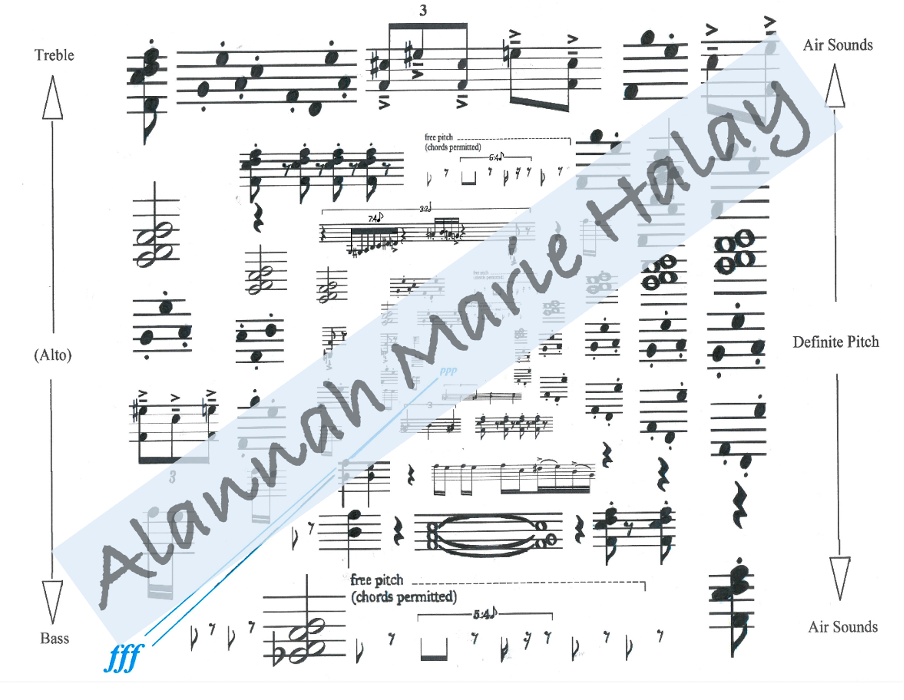
The score represents a time-independent ‘space’ where the performer’s usual required perception of real time, within a typical score, is eliminated. It consists of a three-dimensional vector space which is segmented into three axes: pitch, timbre, and dynamics.
‘We lived in the gaps between the stories’ is a quote from Margaret Atwood’s The Handmaid’s Tale and acts as a source of inspiration for this composition. The quote in context is: ‘[w]e were the people who were not in the papers. We lived in the blank white spaces at the edges of print. It gave us more freedom. We lived in the gaps between the stories.’ As such, ‘We Lived in the Gaps between the Stories.’ (2016) for amplified accordion focuses on the ‘gaps between’ traditional accordion sounds (in other words, the sounds in-between performance techniques and pitches such as noise sounds, breath sounds, glissandi, and so on. It also values the ‘gaps between’ the notation (the blank spaces) as much as the notation itself. In other words, the blank spaces are just as significant as the notes and rests: the unpredictable instability of sounds during these moments should be relished. Moreover, there is no axis denoting ‘time’. As such, temporally, the score can be interpreted in any way the performer chooses. Temporal ‘durations’ are treated as relative positions in ‘space’ (as such they should be interpreted in relation to one another in this senza misura score). In short, this piece is a musical enactment of what it is like to focus on the ‘gaps between the stories’ (or, rather, the ‘gaps’ that arise in relation to certain forms of ‘boundaries’ such as interpreting notation, instrumental logistics, and an unavoidable temporal domain). The ‘stories’ are represented by the visible symbols of the notation and normative instrumental techniques, both of which are required to highlight an ‘in-between’ in the first place.