

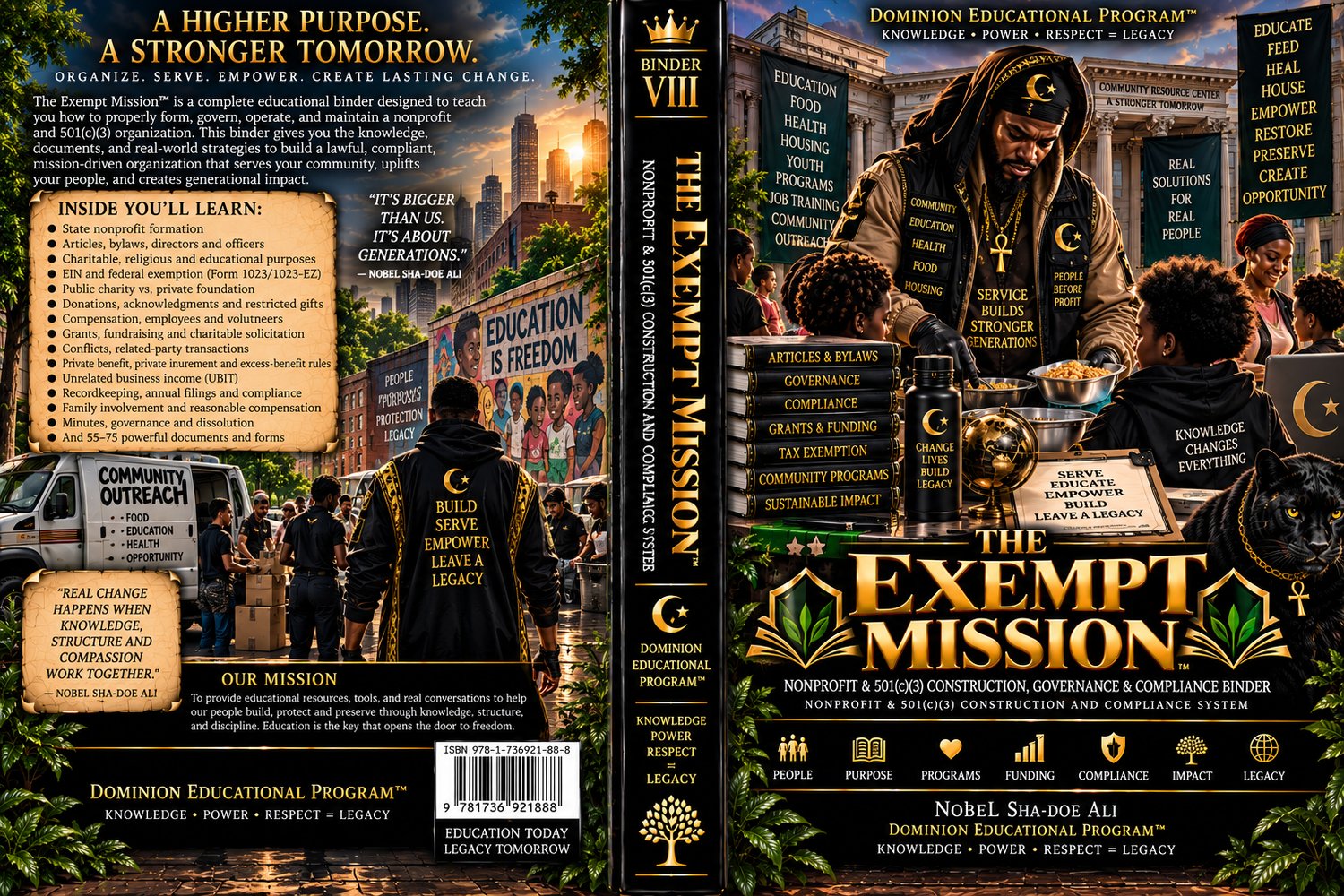
THE EXEMPT MISSION™
THE EXEMPT MISSION™
Nonprofit & 501(c)(3) Construction, Governance & Compliance Binder
Nonprofit & 501(c)(3) Construction and Compliance System
Binder VIII — Dominion Estate Architecture Series™
By NobEL Sha-doe Ali
“A higher purpose. A stronger tomorrow.”
The Exempt Mission™ is a comprehensive educational system for people who want to learn how a nonprofit organization is formed, governed, funded, operated, documented, and preserved.
This book makes one boundary clear from the beginning:
A NONPROFIT IS NOT THE FAMILY'S PRIVATE WEALTH MACHINE.
A nonprofit exists to carry out its charitable, educational, religious, or other qualifying exempt mission. Its money, property, programs, employees, donations, and resources must be administered for that mission—not treated as the founder's or family's personal property.
At the same time, this book rejects the opposite misconception that everyone connected to a nonprofit must work for free.
Students learn how founders, relatives, directors, officers, employees, contractors, and volunteers can legitimately participate while maintaining the legal boundaries that protect both the organization and the people serving it.
FROM AN IDEA TO AN INSTITUTION
A mission statement alone does not create a functioning nonprofit.
Students are taken through the complete organizational process:
PURPOSE → FORMATION → GOVERNANCE → EXEMPTION → PROGRAMS → FUNDING → PEOPLE → CONTROLS → REPORTING → REVIEW → SUCCESSION
The system covers:
State Nonprofit Formation • Articles of Incorporation • Bylaws • Incorporator Actions • Directors • Officers • Members/Nonmember Structures • Board Meetings • Minutes • Resolutions • Committees • EIN • Banking • Budgets • Financial Controls • Federal Exemption • Programs • Donations • Grants • Employees • Volunteers • Compliance • Annual Filings • Succession • Dissolution
STATE NONPROFIT ≠ FEDERAL 501(c)(3)
One of the most important lessons in The Exempt Mission™ is learning to separate state entity formation from federal tax-exempt recognition.
Creating a nonprofit corporation under state law does not, by itself, mean the organization has received federal recognition under IRC § 501(c)(3).
Students learn the difference between:
State Nonprofit Corporation
and
Federal 501(c)(3) Recognition
They then study the organizational and operational requirements that connect those systems.
The book teaches students why exempt-purpose and dissolution provisions are substantive parts of organizational design—not decorative language added merely because an organization wants to call itself a charity.
BUILDING THE GOVERNANCE SYSTEM
A nonprofit has no ordinary equity owners simply entitled to take its assets for themselves.
But that does not mean nobody controls anything.
Students learn how authority is divided among:
BOARD OF DIRECTORS → OFFICERS → COMMITTEES → EMPLOYEES → CONTRACTORS → VOLUNTEERS
The binder examines:
Board Authority • Director Duties • Officer Authority • Meetings • Notice • Quorum • Voting • Written Consents • Committees • Policies • Minutes • Conflicts • Financial Oversight • Annual Governance
The goal is to create an organization where somebody reviewing the records can determine:
Who made the decision?
What authority did they have?
Why was the decision made?
Who benefited?
Was there a conflict?
How was money handled?
Where is the evidence?
FORM 1023 & FORM 1023-EZ
Students are introduced to the federal exemption process, including:
Organizational Test • Operational Test • Form 1023 • Form 1023-EZ Eligibility • Exemption Application Records • Determination Letters • Effective-Date Considerations
The system emphasizes that Form 1023-EZ is not simply the easier application everyone should automatically choose.
Eligibility must first be determined.
PUBLIC CHARITY VS. PRIVATE FOUNDATION
The book explains another distinction that is frequently overlooked:
501(c)(3) DOES NOT AUTOMATICALLY MEAN PUBLIC CHARITY.
Students are introduced to:
Public Charity Classification • Private Foundations • Public Support • IRC § 509 • 509(a)(1) Concepts • 509(a)(2) Concepts • Classification Monitoring
This helps students comprehend that obtaining exemption and determining the organization's foundation classification are related but separate issues.
DONATIONS, FUNDRAISING & RESTRICTED GIFTS
The nonprofit must know what money it receives and what obligations travel with it.
Students study:
Donation Intake • Contribution Acknowledgments • Noncash Gifts • Restricted Gifts • Restricted Funds • Gift Acceptance • Fundraising Campaigns • Events • Online Fundraising • Charitable Solicitation • Grants
The book emphasizes that a restricted gift is not simply ordinary money sitting in the organization's account.
Restrictions must be identified, documented, tracked, and respected.
FAMILY INVOLVEMENT WITHOUT FAMILY OWNERSHIP
This is one of the most important sections of The Exempt Mission™.
The objective is not to remove family from the organization.
It is to establish the difference between legitimate family participation and treating charitable resources as family property.
Students examine situations where relatives:
Work for the organization • Serve as directors • Volunteer • Receive reimbursement • Provide professional services • Lease property • Operate businesses contracting with the nonprofit • Participate in charitable programs
Each situation is analyzed through questions involving:
REAL SERVICES → AUTHORITY → CONFLICTS → REASONABLENESS → FAIR VALUE → TAX TREATMENT → DOCUMENTATION → MISSION PURPOSE
A RELATIVE CAN WORK FOR A NONPROFIT.
The important questions include whether the position and services are real, whether compensation is reasonable, whether conflicts were properly handled, whether the transaction serves the organization, and whether the decision is documented.
Likewise, legitimate organizational expenses paid personally by a family member can potentially be properly reimbursed when substantiated and administered correctly.
But charitable assets do not become family property simply because family members founded or operate the organization.
PRIVATE BENEFIT, PRIVATE INUREMENT & EXCESS BENEFIT
Students receive dedicated instruction on three concepts that should not be casually treated as interchangeable:
Private Benefit
Private Inurement
Excess-Benefit Transactions
The book examines:
Insider Compensation • Property Use • Related-Party Contracts • Family Businesses • Leases • Loans • Reimbursements • Purchases • Sales • Economic Benefits
Students are trained to ask:
WHO RECEIVED VALUE, WHY DID THEY RECEIVE IT, WHAT DID THE ORGANIZATION RECEIVE IN RETURN, AND WHO APPROVED IT?
EMPLOYEES, CONTRACTORS & VOLUNTEERS
Tax exemption does not eliminate ordinary operational responsibilities.
Students examine:
Employees • Payroll • Employment Taxes • Worker Classification • Independent Contractors • Volunteers • Expense Reimbursement • Supervision • Safety • Documentation
A nonprofit is still an operating organization.
UNRELATED BUSINESS INCOME
Another misconception addressed directly is:
“NONPROFIT” DOES NOT MEAN EVERY DOLLAR OF REVENUE IS AUTOMATICALLY TAX-FREE.
Students are introduced to:
Unrelated Business Income • Mission-Related Revenue • Regularly Carried-On Business Activity • Statutory Exceptions and Modifications • Form 990-T • Revenue Classification
The purpose is to teach students to classify revenue before assuming its tax treatment.
RECORDKEEPING & ANNUAL COMPLIANCE
Obtaining recognition is not the end of nonprofit compliance.
It is the beginning of ongoing administration.
Students work through:
Form 990 Series • State Annual Reports • Charitable Registration Renewals • Public Disclosure • Corporate Records • Board Minutes • Financial Reports • Document Retention • Compliance Calendars • Governance Audits
The binder also addresses the federal automatic-revocation risk associated with failing to file required annual returns or notices for three consecutive years.
PROGRAMS THAT ACTUALLY SERVE PEOPLE
The system goes beyond corporate paperwork by teaching students how to construct mission programs.
Examples include:
Education • Food Assistance • Housing Assistance • Health Initiatives • Youth Programs • Rehabilitation • Job Training • Community Development • Relief Programs
Students learn to define:
PURPOSE → CHARITABLE CLASS → ELIGIBILITY → PROGRAM → BUDGET → SELECTION → DELIVERY → DOCUMENTATION → OUTCOME
The mission must exist in actual operations—not merely in the Articles of Incorporation.
81-DOCUMENT NONPROFIT VAULT
The Exempt Mission™ contains an extensive 81-document educational construction and compliance vault, covering:
Articles • Bylaws • Incorporator Actions • Board Organization • Director/Officer Appointments • Governance • EIN • Banking • Budgets • Financial Controls • Form 1023 Preparation • Form 1023-EZ Eligibility • Public Charity Classification • Programs • Charitable Classes • Donations • Acknowledgments • Restricted Gifts • Fundraising • Grants • Compensation • Employees • Contractors • Volunteers • Family Involvement • Conflicts • Related Parties • Private Benefit • Inurement • Excess-Benefit Review • UBIT • Form 990 • Public Disclosure • Compliance • Succession • Dissolution
Students aren't merely given forms.
They are taught to comprehend why the document exists, who should authorize it, when it should be used, what records support it, and what happens after it is completed.
THE EXEMPT-MISSION TRANSACTION GATE™
Before money or property moves, students are trained to ask:
WHAT IS THE TRANSACTION?
WHO RECEIVES VALUE?
WHAT EXEMPT PURPOSE DOES IT SERVE?
WHO AUTHORIZED IT?
IS AN INSIDER OR RELATIVE INVOLVED?
IS THERE A CONFLICT?
IS THE VALUE REASONABLE?
ARE RESTRICTED FUNDS INVOLVED?
WHAT TAX TREATMENT APPLIES?
WHAT MUST BE REPORTED?
WHAT DOCUMENTATION PROVES IT?
That discipline protects the organization's mission, exemption, reputation, resources, directors, founders, employees, and future.
THE DOMINION EXEMPT-MISSION METHOD™
PURPOSE → FORMATION → GOVERNANCE → EXEMPTION → PROGRAMS → FUNDING → PEOPLE → CONTROLS → REPORTING → REVIEW → SUCCESSION
The Exempt Mission™ is ultimately about building something bigger than the founder.
A properly constructed nonprofit should be capable of continuing its work through changing directors, officers, employees, donors, programs, and generations.
SERVE THE PEOPLE.
PROTECT THE MISSION.
DOCUMENT THE WORK.
BUILD SOMETHING THAT OUTLIVES YOU.
DOMINION EDUCATIONAL PROGRAM™
Knowledge • Power • Respect = Legacy