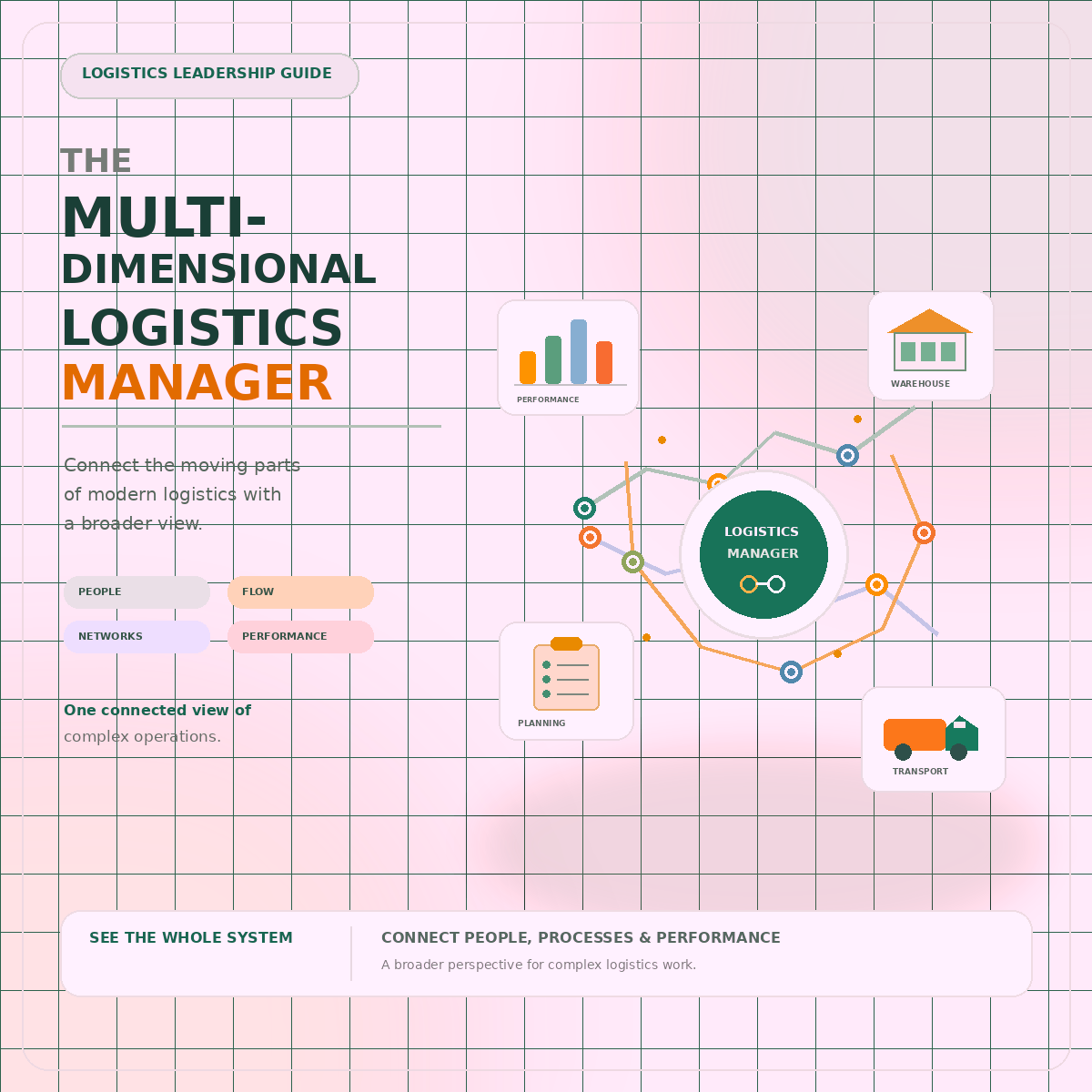
The Multi-Dimensional Logistics Manager
THE MULTI-DIMENSIONAL LOGISTICS MANAGER
One Framework. Seven Priorities. A Smarter Way to Manage Logistics.
The Practical 50-Page Management Guide for Cost Control, Freight, Warehousing, Inventory, Service, Risk, Technology, and Sustainability.
Logistics management is a constant balancing act.
Finance wants lower costs. Customers expect faster deliveries. Operations needs reliable capacity. Sales wants flexibility. Leadership demands measurable performance, fewer disruptions, and greater sustainability.
Optimizing one area in isolation can create problems somewhere else. Lower inventory can increase stockout risk. Faster transportation can erode margins. Higher warehouse utilization can reduce operational flexibility.
The solution is not to optimize every metric independently. It is to manage the entire logistics operation as one connected system.
The Multi-Dimensional Logistics Manager gives you a structured framework for making better decisions across the logistics function, supported by practical calculations, management scorecards, ready-to-use templates, and a 90-day implementation roadmap.
Instead of reacting to individual problems, learn how to connect decisions, costs, service outcomes, operational risks, and measurable business results.
50 Pages. 11 Chapters. 40+ Practical Templates. One 90-Day Roadmap.
GET YOUR COPY TODAY — $12.99
Digital download · Print-ready A4 edition · Offline HTML edition
STOP MANAGING LOGISTICS ONE FIRE AT A TIME
An emergency shipment to rescue a late order. Overtime to compensate for poor warehouse planning. Excess inventory because nobody trusts the forecast. Carrier invoices that are paid without proper verification. Technology investments that promise efficiency but lack a clear financial justification.
These problems may appear unrelated, but they often share a common cause: logistics decisions are being made without a consistent framework for evaluating their wider consequences.
This guide helps you move from reactive problem-solving toward disciplined logistics management.
One Connected Framework for Seven Priorities
Cost
Understand freight expenditure, landed cost, cost-to-serve, customer contribution, and operational variances.
Speed
Choose transportation modes, routing strategies, and operating processes that meet delivery commitments without paying unnecessarily for urgency.
Service
Define service expectations, establish exception-management procedures, and measure performance consistently.
Assets
Improve warehouse utilization, inventory decisions, fleet and capacity planning, and the productive use of operational resources.
Risk
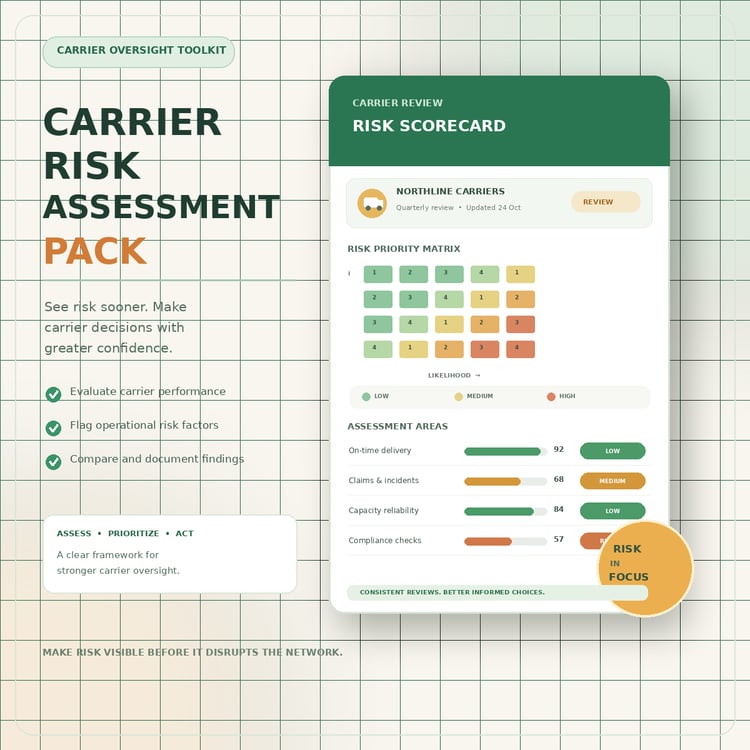
Structure carrier controls, business continuity planning, customs considerations, cargo security, and operational risk reviews.
Carbon
Identify opportunities to reduce emissions through better transport choices, load utilization, routing, and operational efficiency.
People and Performance
Establish clear accountability, useful performance measures, balanced incentives, and repeatable management routines.
The central principle is simple: every major logistics decision should be evaluated against its impact on the wider operation.
EXPLORE THE 11 CHAPTERS
CHAPTER 1 — THE LOGISTICS MANAGEMENT SYSTEM
Build the foundation for a more disciplined logistics operation.
Explore the nine management domains, a consolidated performance scoreboard, operating review routines, responsibility assignment through RACI, approval limits, an order-to-delivery process map, and five essential master data files.
Learn how to establish a common management structure that connects day-to-day execution with business performance.
CHAPTER 2 — NETWORK AND FLOW DESIGN
Understand how facility locations, transportation modes, routing decisions, and inventory positioning influence service and cost.
Explore network redesign, mode and service selection, lane guides, push-versus-pull strategies, postponement, and insourcing-versus-3PL decisions.
Review contract considerations that can help align network design with operating requirements.
CHAPTER 3 — TRANSPORTATION AND FREIGHT MANAGEMENT
Develop a more structured approach to freight procurement and carrier performance.
Explore freight expenditure, procurement cycles, request-for-proposal preparation, rate structures, invoice auditing, carrier scorecards, and ten ranked cost-reduction levers.
Learn how to evaluate freight decisions using consistent commercial criteria rather than relying on quoted rates alone.
CHAPTER 4 — WAREHOUSING AND FULFILMENT
Improve the way warehouse layout, labor, picking, receiving, and inventory movement are managed.
Explore flow-first layout design, slotting methods, storage media, labor standards, picking strategies, cycle counting, returns, automation decisions, and third-party warehouse operations.
Understand how process design and operational discipline can improve productivity without automatically resorting to expensive equipment investments.
CHAPTER 5 — INVENTORY AND DEMAND
Connect forecasting, inventory policy, and replenishment decisions.
Explore forecasting methods by demand behavior, forecast accuracy using MAPE and bias, safety stock, reorder points, economic order quantity, ABC-XYZ classification, sales and operations planning, shrinkage, and excess-and-obsolete inventory rules.
Follow a worked EOQ example to understand the calculations behind inventory decisions.
CHAPTER 6 — COST AND MARGIN
Move beyond total logistics expenditure to understand the economics of individual orders and customers.
Explore landed cost calculations, cost-to-serve, customer contribution, flexed budgets, variance analysis, pricing decisions, chargebacks, and negotiation levers.
Learn how to identify situations in which revenue growth may not translate into profitable operations.
CHAPTER 7 — SERVICE AND CUSTOMER MANAGEMENT
Create a more consistent framework for customer commitments and service recovery.
Explore written OTIF definitions, tiered exception management, operational playbooks, claims and OS&D documentation, root-cause analysis, customer communication routines, and quarterly business reviews.
Build a service-management process that makes expectations clearer and performance easier to evaluate.
CHAPTER 8 — RISK, TRADE AND SUSTAINABILITY
Address the operational and external risks that can disrupt logistics performance.
Explore customs fundamentals, penalties, security controls, dangerous goods, risk registers, continuity planning, carbon calculations, and eight practical emissions-reduction levers.
Understand how risk management and sustainability can be incorporated into everyday logistics decisions.
CHAPTER 9 — TECHNOLOGY AND DATA
Make better-informed technology and data-management decisions.
Explore a five-layer technology stack, integration principles, single-source-of-truth rules, dashboard design, metric definitions, automation and AI evaluation, and vendor scorecards.
Learn to evaluate technology based on operational suitability, total cost of ownership, and measurable business value.
CHAPTER 10 — PEOPLE AND PERFORMANCE
Build the organizational capabilities required to sustain improvements.
Explore role design, skills matrices, certification calendars, incentive structures, metric gaming, and change management.
Understand why clear ownership and balanced performance measures matter just as much as the systems and processes themselves.
CHAPTER 11 — DASHBOARD AND 90-DAY ROADMAP
Translate the framework into an actionable implementation plan.
Explore a one-page KPI dashboard, a 90-day roadmap with milestones and proof points, an 18-point final checklist, and a glossary of key concepts.
Use the roadmap to organize improvement priorities and review progress at days 30, 60, and 90.
40+ PRACTICAL TEMPLATES TO PUT THE FRAMEWORK TO WORK
Understanding the principles is important. Applying them consistently is what creates operational value.
The guide includes more than 40 reusable templates and structured tools to help you translate concepts into practical management activities.
Examples include:
- RACI and responsibility matrices.
- Management scorecards and KPI definitions.
- Freight routing guides.
- Carrier evaluation scorecards.
- Freight procurement and RFP structures.
- Invoice-audit rules.
- Inventory planning formulas and policy matrices.
- Cost-to-serve and customer contribution frameworks.
- Risk registers and continuity planning tools.
- Technology vendor evaluation scorecards.
- Operational checklists and improvement planning structures.
These templates are designed to be copied and adapted to your existing spreadsheets, business systems, and internal procedures.
You do not need to purchase a new software platform simply to begin applying the framework.
PUT THE NUMBERS BEHIND YOUR DECISIONS
Strong logistics management requires more than general principles. It requires calculations that make trade-offs visible.
This guide incorporates worked numerical examples and structured decision tools to support more consistent analysis.
Understand Inventory Economics
Explore safety stock, reorder point, and EOQ calculations to support inventory decisions using demand, replenishment, and cost assumptions.
Calculate the True Cost of an Order
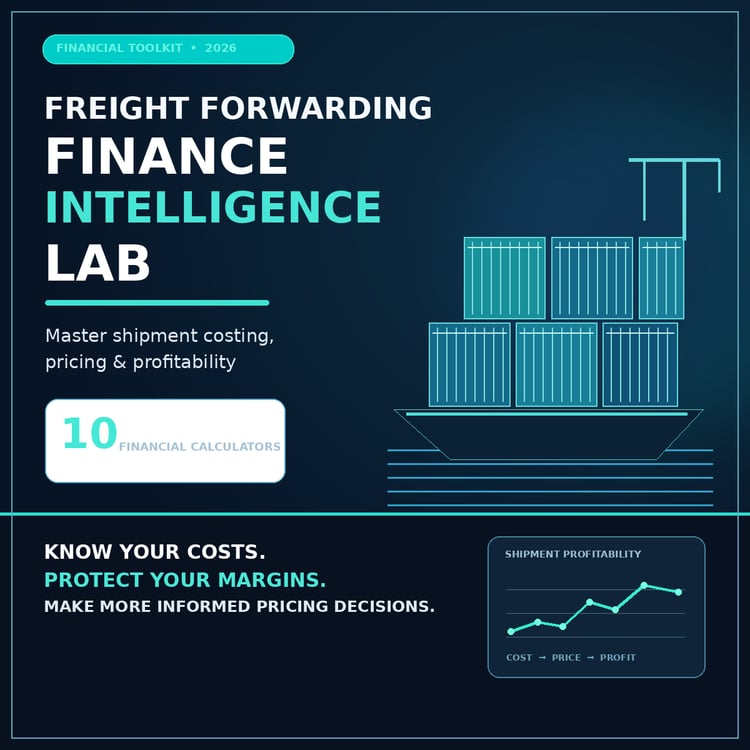
Build up landed cost and examine the contribution generated by individual customers and services.
Evaluate Freight Procurement
Structure carrier comparisons, tender scoring, and invoice reviews to make purchasing decisions more transparent.
Define Service Performance
Establish written OTIF definitions, meaningful measures, and exception procedures that support consistent reporting.
Evaluate Technology Investments
Use a structured vendor scorecard and total-cost-of-ownership approach to compare potential solutions.
Measure Progress Over 90 Days
Organize improvement initiatives around owners, milestones, and evidence of progress rather than relying solely on activity reports.
The examples are educational decision-support tools. Actual outcomes depend on your business data, operating conditions, assumptions, and implementation.
YOUR 90-DAY LOGISTICS IMPROVEMENT ROADMAP
A framework is most useful when it leads to action.
The guide includes a phased 90-day roadmap that helps organize improvements into manageable stages.
DAYS 1–30: ESTABLISH THE BASELINE
Review existing processes, clarify responsibilities, define key metrics, and identify the most important gaps in cost, service, inventory, and operational control.
DAYS 31–60: IMPLEMENT PRIORITY IMPROVEMENTS
Assign owners, introduce selected controls, improve data consistency, and begin testing changes against defined performance measures.
DAYS 61–90: VALIDATE AND STANDARDIZE
Review the evidence, compare results against the baseline, document lessons learned, and establish the routines needed to sustain improvements.
The roadmap includes proof points so that progress can be evaluated through evidence rather than assumptions.
Use it as a starting structure and adjust the priorities, timing, and targets to fit your operation.
WHO SHOULD READ THIS GUIDE?
Logistics and Supply Chain Managers
Build a connected management framework across freight, inventory, warehousing, cost, service, and operational risk.
Operations Directors
Establish clearer accountability, more consistent performance reviews, and a structured approach to improvement.
Warehouse and Distribution Centre Managers
Connect warehouse layout, labor, inventory movement, and service outcomes to wider business objectives.
Freight Buyers and Procurement Professionals
Improve tender preparation, carrier evaluation, freight-cost analysis, and invoice control.
Inventory and Demand Planners
Strengthen forecasting reviews, inventory policies, replenishment decisions, and demand-management routines.
Exporters and Growing Distributors
Develop a more structured approach to logistics management, including customs exposure, service commitments, and cost control.
Consultants and Trainers
Use the chapter structure, management templates, and worked examples as supporting material for logistics improvement and professional development.
Business Owners and Founders
Build a clearer operating framework when logistics grows from a supporting activity into a major driver of cost, customer experience, and business risk.
Whether you manage a single distribution operation or coordinate a more complex logistics network, the framework can be adapted to your operating scale.
WHY THIS GUIDE IS DIFFERENT
A Whole-System Perspective
Connect cost, speed, service, assets, risk, carbon, and people rather than optimizing each area in isolation.
Practical Management Tools
Use structured templates, scorecards, checklists, and formulas to translate concepts into repeatable processes.
Financial and Operational Discipline
Examine how decisions affect both the cost structure and the service delivered to customers.
Clear Management Accountability
Connect responsibilities, approval limits, operating routines, and performance measures.
A Defined Implementation Path
Use the 90-day roadmap to organize priorities, ownership, milestones, and proof points.
No Software Commitment
The ebook is a document, not a subscription service or software platform. Adapt its templates to the tools you already use.
WHAT YOU RECEIVE
Your purchase includes:
- The Multi-Dimensional Logistics Manager — 50-page guide.
- 11 structured chapters covering the logistics management function.
- A seven-dimension management framework.
- More than 40 reusable templates and practical tools.
- Worked examples covering inventory and cost calculations.
- Freight procurement and carrier evaluation frameworks.
- Warehouse and fulfilment improvement methods.
- Service, risk, trade, and sustainability guidance.
- Technology and vendor evaluation tools.
- A one-page KPI dashboard framework.
- A 90-day implementation roadmap.
- An 18-point final checklist.
- A glossary of key logistics management concepts.
- A print-ready A4 edition.
- A self-contained HTML edition with a Print function.
PRODUCT: The Multi-Dimensional Logistics Manager
PRICE: $12.99
FORMAT: HTML digital download, with print-to-PDF functionality.
LENGTH: 50 pages.
DELIVERY: Instant digital download through Payhip.
The HTML edition works offline in a compatible browser. No additional software, subscription, or separate account is required to read it.
FREQUENTLY ASKED QUESTIONS
Is this guide suitable for beginners?
Yes. It provides a structured overview of the major logistics management domains. Readers with some familiarity with business operations will find it easier to apply the financial calculations and management frameworks.
Is it specific to one country?
No. The guide is intended for general logistics operations worldwide and includes references to US and EU frameworks where relevant. Customs, transport, safety, and compliance requirements vary by jurisdiction and should be verified against current local rules.
Do I need Excel or other special software?
No. The product is a document, not a spreadsheet application or software platform. Its templates can be copied into your existing tools and adapted to your business.
Can I print the guide?
Yes. The guide is designed for A4 printing. You can use the HTML edition's Print function to print it or save it as a PDF.
Is it only for large corporations?
No. The management principles and templates can be adapted to smaller distributors, growing businesses, and individual logistics teams.
Does it guarantee cost savings?
No. The guide provides methods for identifying and evaluating improvement opportunities. Results depend on your baseline, data quality, operating conditions, decisions, and implementation.
Does the guide include a 90-day action plan?
Yes. It includes a structured roadmap with milestones and proof points at days 30, 60, and 90.
Will I receive future updates?
Please refer to the product listing for the current edition and update terms.
How will I receive my purchase?
After completing payment through Payhip, you can download the product through the platform's digital delivery process.
MANAGE THE WHOLE SYSTEM. IMPROVE EVERY DECISION.
Logistics performance is not determined by freight rates, warehouse productivity, or inventory levels alone.
It emerges from the interaction between cost, speed, service, assets, risk, carbon, and people.
The Multi-Dimensional Logistics Manager gives you a practical framework for understanding those interactions and managing them with greater consistency.
Build a stronger management routine. Make trade-offs visible. Improve accountability. Connect decisions to measurable results.
One connected logistics framework. Practical tools for the decisions that matter. A clear roadmap for the next 90 days.
GET THE MULTI-DIMENSIONAL LOGISTICS MANAGER
Only $12.99
50 pages · 11 chapters · 40+ templates · 90-day roadmap
Start building a more disciplined, measurable, and connected approach to logistics management today.
Important Disclaimer: This guide provides general educational and operational guidance. It is not legal, tax, customs, safety, or professional compliance advice. Validate formulas, assumptions, regulatory references, and operational decisions against your organization's circumstances and applicable requirements before implementation.