
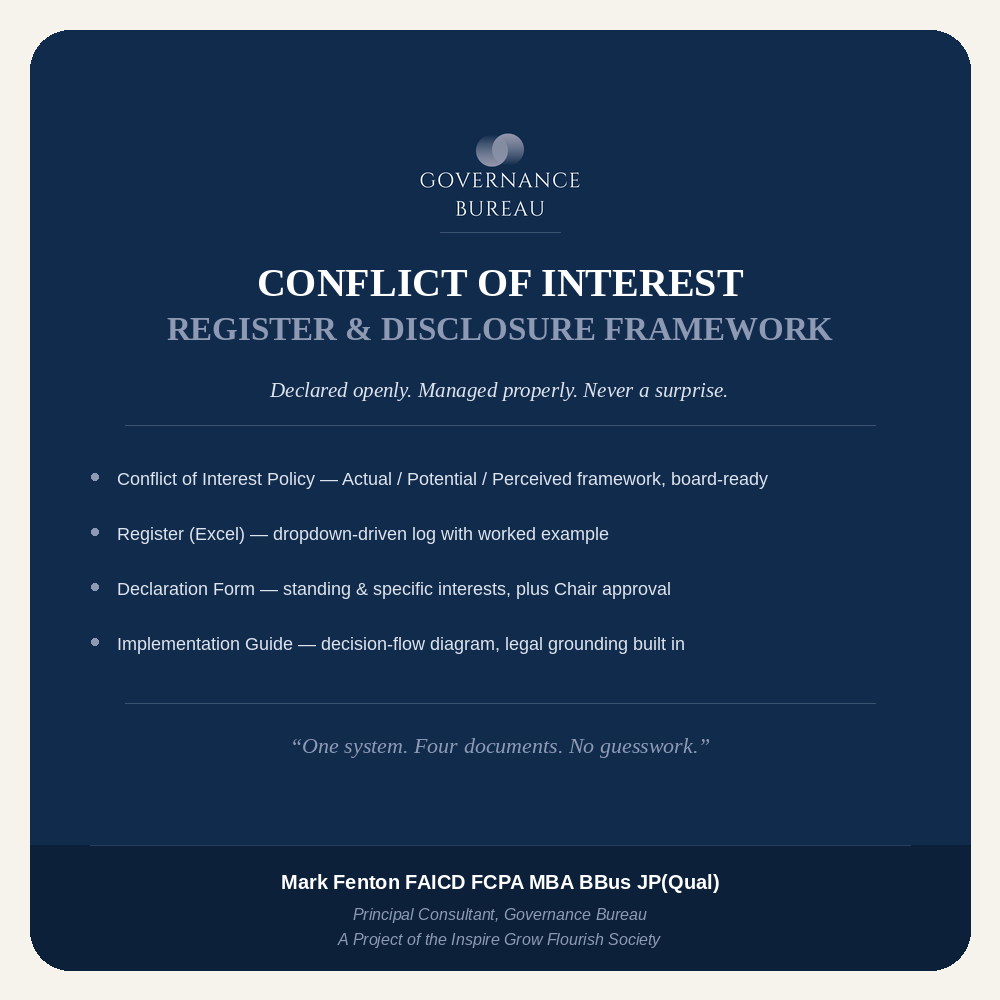
Conflict of Interest Register & Disclosure Framework
Governance instruments built from two decades chairing and serving on boards and Audit & Risk Committees — not templated from a search engine.
Conflicts of interest don't announce themselves. They surface quietly — a spouse's firm tendering for a contract, a director sitting on two boards with overlapping commercial interests, a committee member with a related-party relationship nobody thought to ask about until it mattered. Boards that handle this well aren't the ones with the longest policy. They're the ones with a process that makes disclosure routine, unambiguous, and grounded in what the law actually requires.
Exhibit G gives you that process: a policy, a working register, a declaration form, and an implementation guide — cross-referenced, consistently defined, and backed by the Corporations Act, ACNC Governance Standard 5, state associations legislation, ASIC guidance, and AICD practice standards. Built for NFP and for-profit boards alike.
What's Included
- Conflict of Interest Policy — defines conflicts using the Actual / Potential / Perceived framework, sets materiality criteria, a four-option management response table, a confidentiality clause, a voting/quorum requirement, and a concise Legal Basis section.
- Conflict of Interest Register (Excel) — a structured, organisation-branded log with dropdown-driven consistency (declaration type, materiality, action taken), a worked example row, and version-ready formatting.
- Director & Officer Declaration Form — captures standing and specific interests with conflict type, and includes a formal Chair Review & Approval sign-off separate from the declarant's own signature.
- Implementation Guide — the annual declaration cycle, a decision-flow diagram for handling a conflict mid-meeting, ready-to-use minute wording, common pitfalls, and a detailed Legal & Legislative Context section covering Corporations Act entities, listed and public companies, ACNC charities, state-incorporated associations, general law, and AICD guidance — illustrated with a real 2025 case.
Why This Matters
A conflict of interest that surfaces after the fact — in an audit, a media inquiry, or a funder review — costs far more than the ten minutes it takes to declare it properly at the time. Disclosure is only the first step: this exhibit also explains what boards and directors are required to do afterwards, and why disclosure alone doesn't discharge a director's duties.
Every defined term — conflict type, materiality outcome, management response — is used identically across all four documents, so your board gets one coherent system rather than four documents that happen to share a cover page.
Who It's For
Boards and committees — NFP or for-profit — that want a disclosure framework they can implement immediately, with the legal grounding to withstand scrutiny, without drafting one from scratch or adapting a generic template that wasn't built for board-level use.
Format
Policy and Implementation Guide provided as Word documents; Register provided as an Excel workbook; Declaration Form provided as a Word document. Fully editable — adapt naming, thresholds, and branding to your organisation. Each document opens with a note confirming it is a starting point, not a finished version — adapt and seek your own legal advice before formal adoption.