Welten (Worlds)
Welten (Worlds)
9 Variations on a lithography by M.C.Escher
for Piano Solo
15min.
Program Notes:
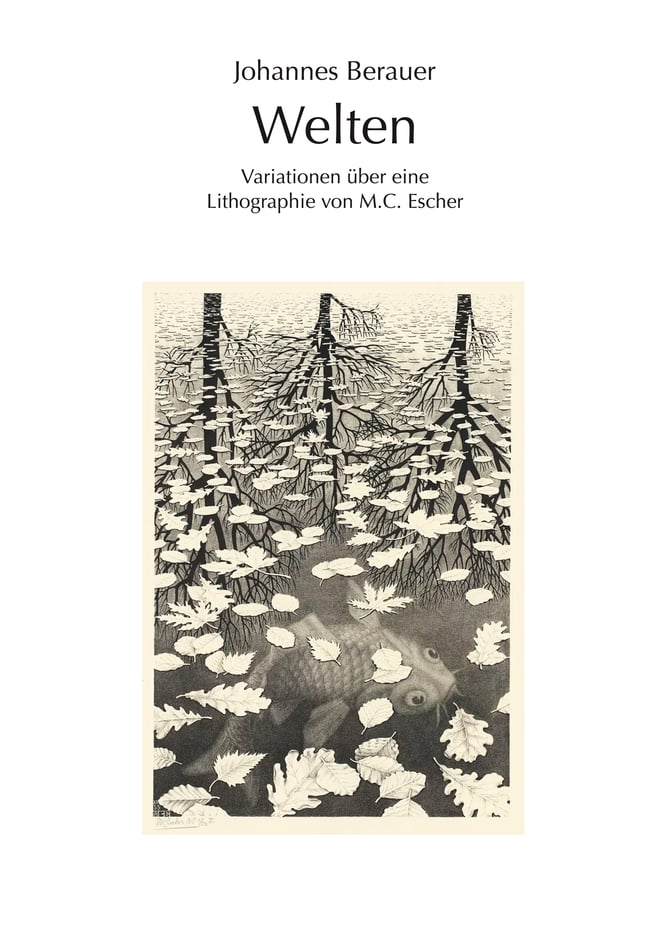
The piece Welten draws its inspiration from M.C. Escher’s lithography Three Worlds. I tried to catch the hauntingly beautiful atmosphere of this work of art, as well as the fascinating parallel existence of the three worlds ‚above‘ ‚on the surface’ and ‚below‘. In my opinion this is one of Escher’s most poetic works. We find typical elements of his style in its technique, the black and white approach or its symmetrical design. Yet other elements are lacking, such as the impossible geometry or what he called „the regular division of the plane“ where both positive and negative produce the same motif.
To me the picture raises the question of what is real. Out of the three worlds we only actually see the two dimensional water surface with its leaves directly. It marks the threshold between the other two water and air, which arguably are the „main“ worlds as they are three dimensional. Both the trees and the fish in the depth of the pond are actually mere reflections on the surface, which acts as a semi-transparent mirror.
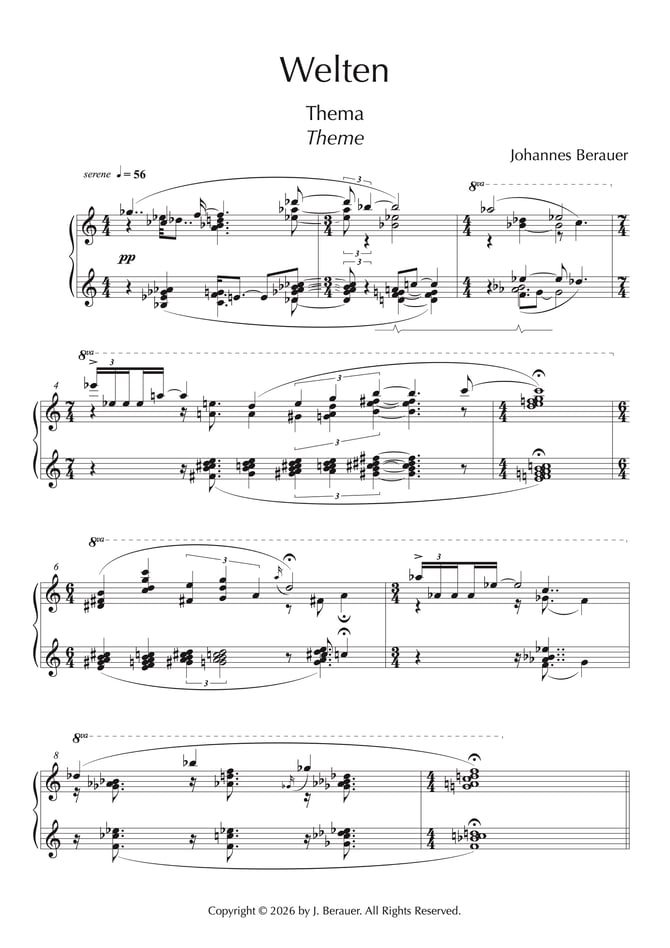
The piece is a set of variations on a tone row borrowed from Alban Berg’s Lyric Suite. The row is formed by 2 complementary and symmetrical hexachords. Any motif in hexachord 1 can be formed in hexachord 2 a tritone away with the complementary pitches to the full chromatic. Further each hexachord is symmetrical within itself allowing a motif to be inverted within the same hexachord as well. This provides a maximum of symmetry axis’s and the possibility to create a musical equivalent to Escher's „regular division of the plane“ concept in in his black & white drawings and studies (e.g. Day and Night). Lastly the hexachords with its pitch set [0,2,4,7,9,11] produce my beloved pandiatonical sounds so essential to may musical language.
Theme and Finale state the row melodically in its P, I, R and RI forms and also use it as harmonic skeleton, thus presenting the material and sound world of the composition. Like the lithography they follow a ternary form (ABA).
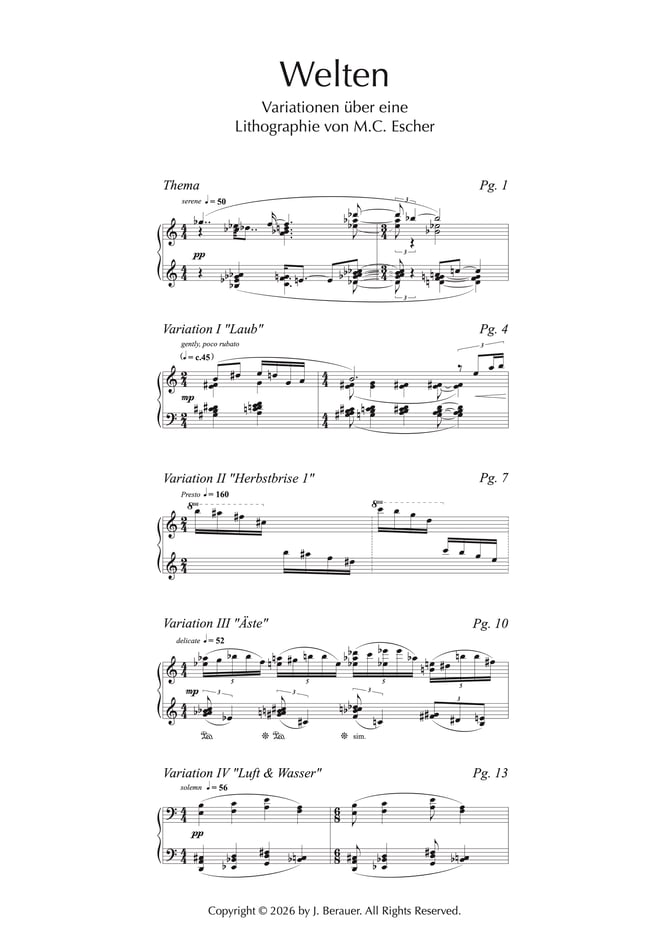
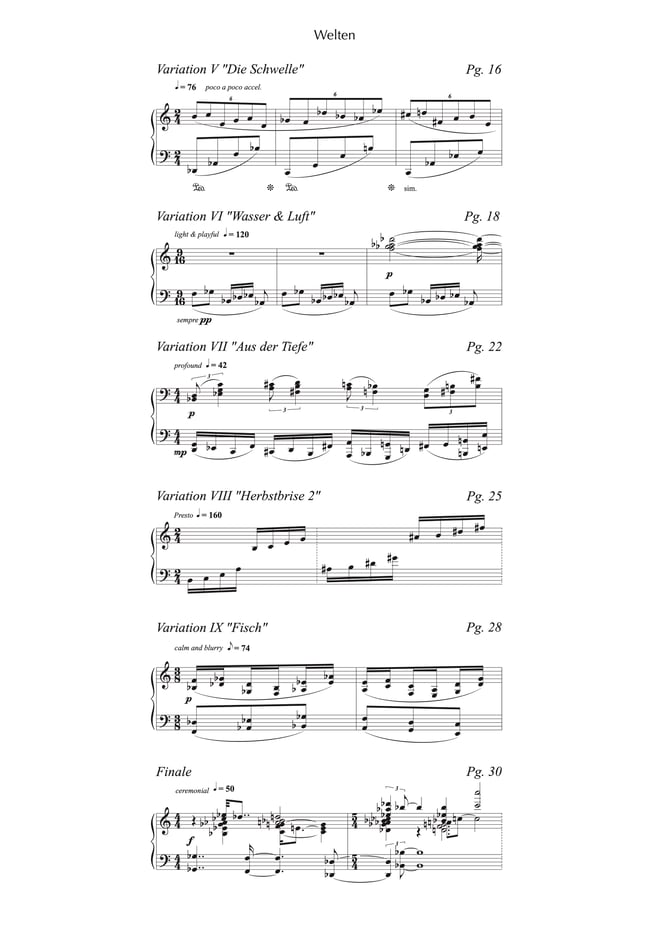
The nine variations (= 3 x 3) mirror on the center piece Variation V, which depicts the water surface. Through its bitonal harmonic design it merges „the above“ and „the below“. Other variations are exact inversions from itself (Variation II & VIII) or inversions in shape and pitch material only (Variation III & VII and IV & VI). Variation I & IX are free Impromtu like pieces that are tied to the row only in its harmonic construction, but otherwise feel seemingly improvised.
Apart from these technical considerations I tried to create first and foremost a poetic piece of music. The structure of a composition, much like in architecture, always has to remain under the surface, and should only be a vehicle to carry the expression. This piece is to be played most atmospherically, misty, hazy, gently, always trying to touch the in-between rather than the concrete.
Escher’s world, as highly organized and structured as it is, appears to be very organically grown. It seems almost surreal that he came to his results by trial rather than mathematics. It is this freedom within organization that characterizes true art to me.
Personally I find the retreat into this inner world of order very soothing in a time where the outside world seems chaotic and running out of boundaries. Immersing myself into Escher and translating him to music means soul nourishment providing strength and calmness in stormy times.
JB 27.6.2026

 Save
Save
 Share
Share
 Tweet
Tweet