
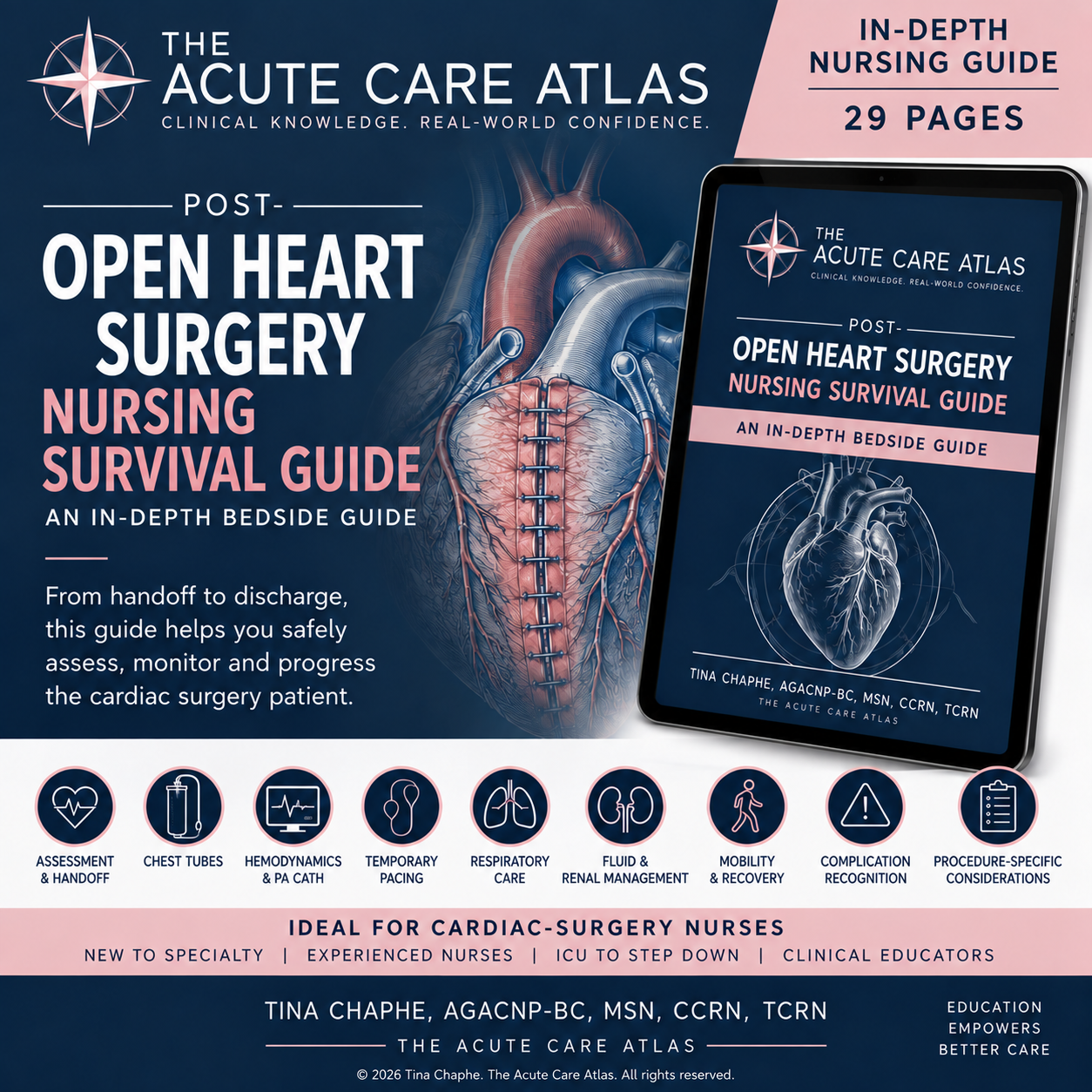
Post-Open Heart Surgery Nursing Survival Guide | An In-Depth Bedside Guide
Receiving a fresh cardiac-surgery patient on stepdown can feel very different from caring for a typical postoperative patient.
Chest tubes may remain. Temporary pacing wires may still be present. A PA catheter or invasive lines may still be in place. The patient may be actively diuresing, experiencing rhythm changes, mobilizing for the first time—or quietly developing bleeding, tamponade, low cardiac output, respiratory deterioration or renal dysfunction.
Post-Open Heart Surgery Nursing Survival Guide was created to bridge that gap.
This in-depth bedside guide teaches nurses not simply what to chart, but what the findings mean together.
It covers the early postoperative assessment, chest tubes, PA-catheter interpretation, temporary pacing, hemodynamics, rhythm surveillance, mobility, pulmonary recovery, fluid and renal management, bleeding, tamponade and low-output recognition.
Procedure-specific sections address CABG, aortic valve surgery, mitral repair/replacement, ascending aorta/hemiarch surgery and orthotopic heart transplantation.
The guide also incorporates the practical pattern-recognition pearls experienced CT-surgery clinicians develop over time—for example, recognizing that declining exercise tolerance can precede dramatic changes in resting vital signs.
What you'll learn
- How to receive and assess the POD 1–2 cardiac-surgery patient
- A structured cardiac-surgery handoff
- Chest-tube assessment and concerning drainage patterns
- PA catheter values, waveforms and common interpretation traps
- Temporary epicardial pacing wires, sensing and capture
- Hemodynamic pattern recognition
- Bleeding versus retained blood/tamponade
- Low cardiac output recognition
- Postoperative rhythm surveillance
- Respiratory recovery and pulmonary complications
- Fluid balance, diuresis, renal function and electrolytes
- Safe mobilization with tubes, wires and invasive lines
- Sternal protection without unnecessary immobilization
- CABG, AVR, mitral, aortic/hemiarch and OHT-specific nursing considerations
- Escalation patterns that should not wait for rounds
The guide deliberately teaches nurses to interpret trends rather than isolated numbers. Even its PA-catheter section warns against treating a single CVP as volume status and distinguishes falling CI/SvO₂ with high filling pressures from the same values with low filling pressures.
Intended audience
Cardiac-surgery stepdown nurses, ICU nurses transitioning to CT surgery, new-to-specialty cardiac nurses, nurse residents, experienced nurses seeking a refresher, clinical educators, and acute-care APPs who want a nursing-focused view of postoperative care.
Educational Use Disclaimer
This digital guide is intended for education and professional development only. It does not constitute medical advice and does not replace patient-specific assessment, professional clinical judgment, institutional policies or protocols, current medication references, manufacturer instructions for use, professional guidelines, credentialing requirements, or direction from the responsible clinical team. Clinical information and device guidance may change over time. Always verify current recommendations and follow applicable institutional policies and standards of care.
This product is independently developed and is not affiliated with or endorsed by any hospital, university, healthcare system, manufacturer, professional organization, or government agency.
Individual-Use License
Purchase includes a single-user license for the individual purchaser. Redistribution, resale, public posting, sharing of the digital file, uploading to shared drives or learning-management systems, institutional reproduction, or creation of derivative commercial products is prohibited without written permission from The Acute Care Atlas.
© 2026 Tina Chaphe. The Acute Care Atlas. All rights reserved.