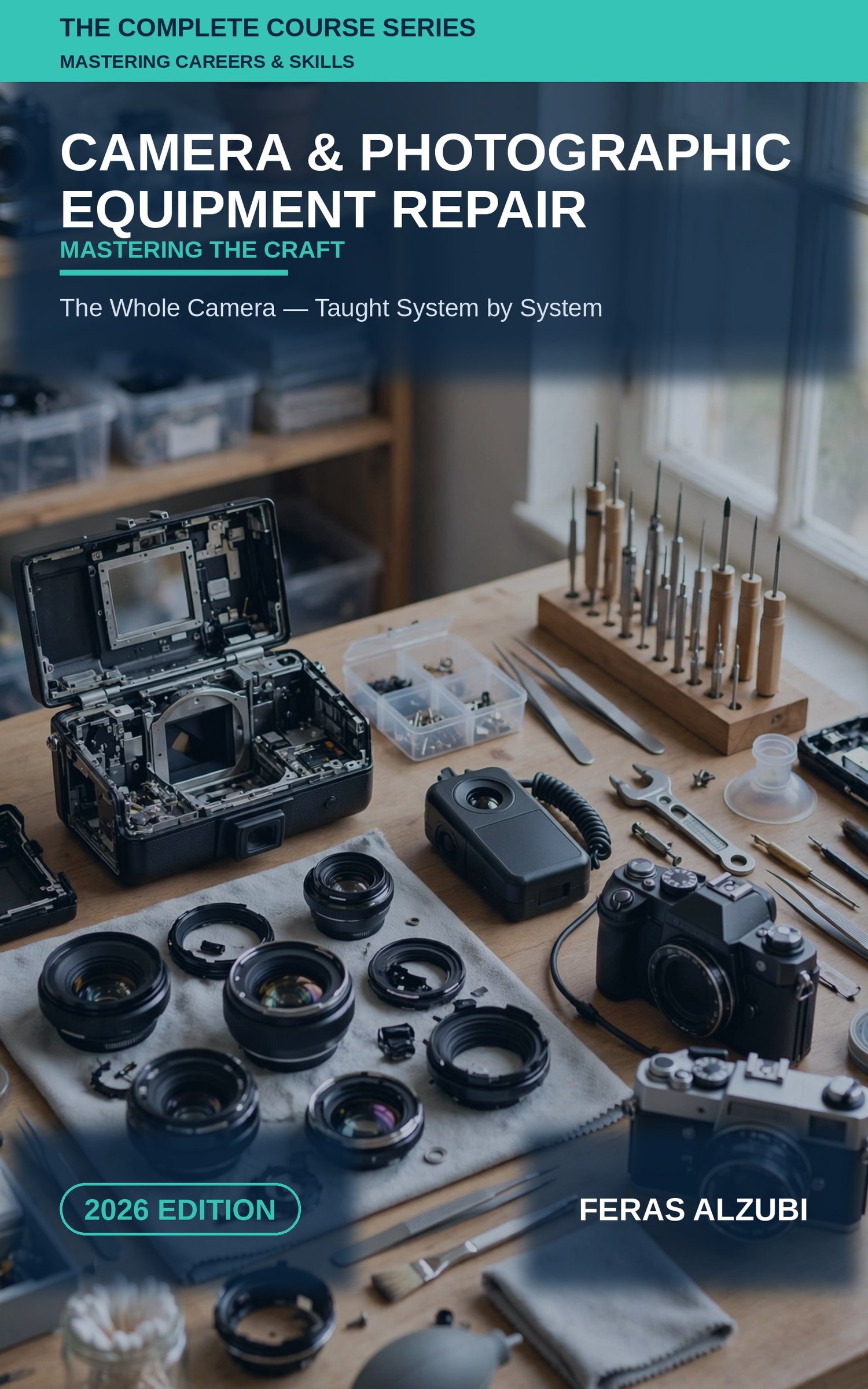
Camera & Photographic Equipment Repair: Mastering the Craft
Camera & Photographic Equipment Repair: Mastering the Craft — the whole camera
**What this book teaches.** The full trade of the camera and photographic equipment repairer — the occupation classified as SOC 49-9061, Camera and Photographic Equipment Repairers — taught A to Z in one volume, from first principles to the finished, tested repair. The foundations come first: the trade and its workshops; the bench safety and electrostatic-discharge discipline that stands in front of every job; the camera understood as a system of bodies, mounts, and records; and the light, optics, and exposure physics that every repair is finally judged against. Then the instrument in turn. Optics and mechanisms: lenses and their optical faults; aperture, focus, and zoom mechanisms; shutters of both great families, focal-plane and leaf; and the film camera's transport, bodies, and light seals. Then electronics and imaging: image sensors and the digital signal path; metering and autofocus systems; electronic control — boards, power, and firmware; and flash and lighting equipment with its stored-energy danger. The repair practice follows: cleaning and preventive service; diagnosis by a disciplined fault-finding method; disassembly, reassembly, and adjustment; and calibration and testing, where repairs are proved. The book closes with the working repairer's world: parts, donor bodies, and the parts problem; professional, cinema, and specialty equipment; the business of repair — intake, estimates, and records; and the career itself — training, manufacturer authorization, and the working life. Every system is taught so you can explain it, test it, and trust your conclusion — and the manufacturer's service documentation for the specific instrument always governs its values and procedures.
**Who it is for.** Apprentice repairers, bench technicians, and students of the trade who want the whole craft in one place, with names, systems, and reasoning for what their hands are learning, in the order the instrument itself is organized; working repairers who want to formalize and widen their knowledge — if you already service film bodies but not digital, or lenses but not shutters, the book fills the gaps habit leaves behind; photographers, cinematographers, and equipment owners who maintain their own gear and want to understand what their instruments are, why a repair takes the path it takes, and which work belongs on a trained bench; and the collectors and restorers of the film era's instruments, whose cameras are returning to work in the film revival. No general book replaces the manufacturer's documentation for the instrument in front of you — the book teaches the systems, the method, and the discipline.
**What's inside** (every count verified against the actual book):
- Complete course — 20 chapters in five parts, foundations to the career
- 340 practice questions — every answer explained, right and wrong
- 40-question diagnostic — scored by domain, with a routing worksheet
- 240 chapter questions — a 12-question check closes every chapter
- 60-question final review — sampling the whole trade, with routed re-study
- 40 labeled figures — system diagrams and instrument maps, two in every chapter
- 25 tables — bench data, sequences and reference data for the repairer
- 150-term glossary · 8 cheat sheets · 3 study plans — Plan A, the full read (12 weeks); Plan B, the experienced repairer (6 weeks); and Plan C, the film-to-digital bridge (8 weeks)
- Safety taught as structure — flash-capacitor discharge discipline, ESD control, spring, glass, and solvent discipline throughout
Every one of the 340 questions is original, written for this book, and every explained answer tells you why the right answer is right and why each wrong answer is wrong. The book's facts rest on verified sources, listed in a Sources & Verification Note at the back of the book: the O*NET 49-9061.00 occupation definition and documented scope, the no-license/no-certification credential landscape, the stored-charge, spring, glass, solvent, and ESD safety register, and the rule that manufacturer documentation governs. Safety is structural throughout — no procedure in the book outranks the safety discipline, and no item teaches reaching into a charged flash unit, forcing a mechanism, or blowing dust deeper into a body with uncontrolled air as correct.
Read the first chapter free — the sample on this page is Chapter 1 of this book, exactly as it appears in the full edition.
From the **Mastering Careers & Skills** library — complete A-to-Z professional teaching books for careers, trades, and certifications.
This book is an independent teaching work. It teaches the trade — this occupation has no government license and no industry certification of standing, and no credential comes from this book: competence is demonstrated at the bench, manufacturers train and authorize their own service networks for brand work, and this book does not itself confer a license, a certification, or an authorization.
**Refunds:** Please read the free sample chapter before you buy. This is a digital ebook, delivered instantly by download. If the file is defective, or you cannot open or download it and we cannot fix the problem, you will receive a full refund — email us within 14 days of purchase. Because the book is delivered instantly as a downloadable file, all other sales are final.
**How to read this book (EPUB format):** After checkout, download the EPUB file, then open it in any free ebook reader app. On iPhone or iPad: Apple Books — it is already on your device. On Android phones and tablets: Google Play Books (free: https://play.google.com/store/apps/details?id=com.google.android.apps.books) — upload the file in the app — or ReadEra (free). On a Windows or Mac computer: Thorium Reader (free: https://thorium.edrlab.org) or Adobe Digital Editions (free). On Kindle: use Amazon's free Send to Kindle (https://www.amazon.com/sendtokindle) to add the file to your Kindle library.