
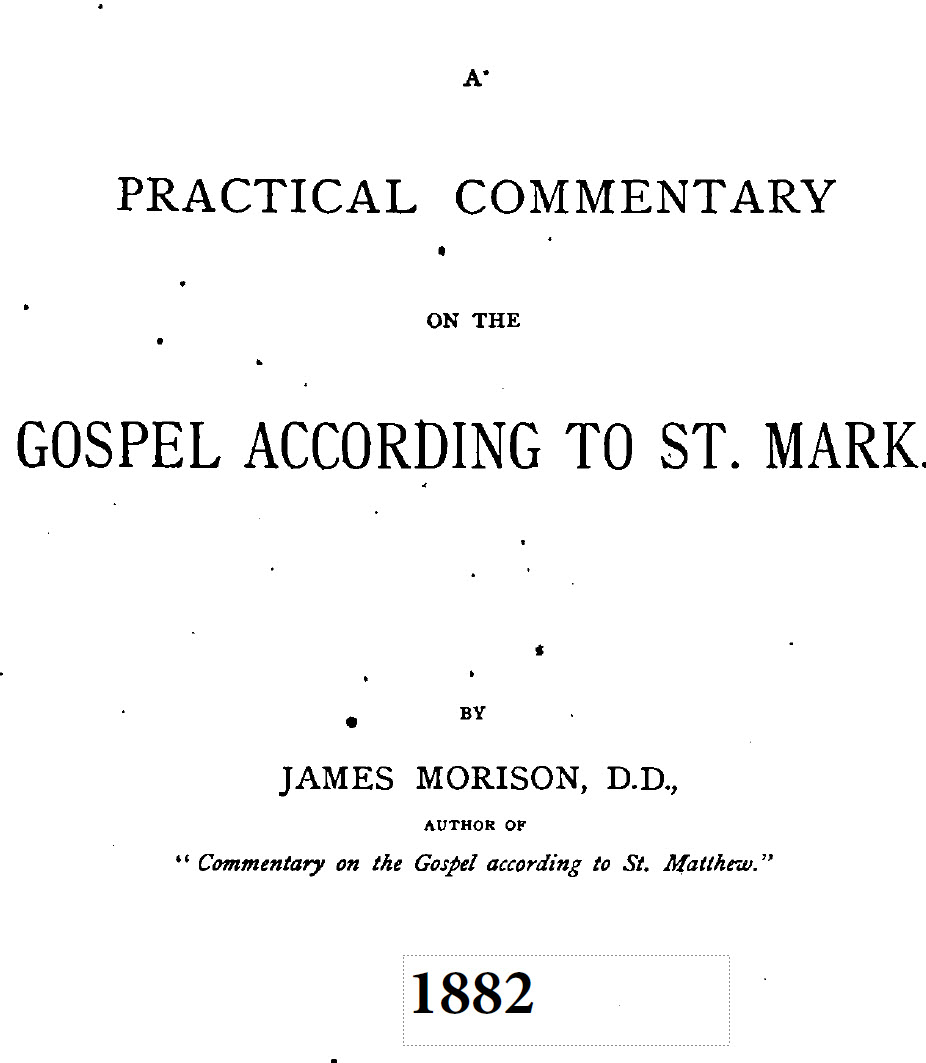
1882 James Morison, D.D., Practical Commentary on Gospel of Mark
THE ULTIMATE PAYHIP DIGITAL DOWNLOAD BUNDLE:
DR. JAMES MORISON’S COMMENTARY ON THE GOSPEL OF MARK
- The Scholar’s Profile: A biography and credibility summary of Dr. James Morison to establish his elite theological authority.
- The Mark 7:19 Masterstroke: A detailed theological explanation of how Morison brilliantly resolves this "thorny" passage without making Jesus look like a law-breaking apostate.
- The High-Converting PayHip Sales Copy: A polished, ready-to-paste sales advertisement designed to convert visitors into buyers.
PART 1: THE SCHOLAR AND THE PASTOR
Biography of Dr. James Morison (1816–1893)
James Morison, D.D. was one of the most brilliant, courageous, and influential theological minds of 19th-century Scotland. Born in Bathgate, West Lothian, he was the son of a Secession Church minister and received an elite classical and theological education at the University of Edinburgh.
1. The Heresy Trial That Shook Scotland (1841–1843)
In 1840, Morison was ordained as the pastor of the Clerk’s Lane Secession Church in Kilmarnock. However, his deep personal study of the Greek New Testament led him to reject the strict, limited-atonement Calvinism of his denomination. He began preaching the "Three Universalities" of God's saving grace:
- God the Father loves all people without exception.
- Jesus Christ died as an atoning sacrifice for all people.
- The Holy Spirit strives to bring all people to salvation.
This radical, love-centered gospel sparked a massive spiritual revival but also provoked the fury of church traditionalists. In 1841, Morison was put on trial for heresy. Defending his views purely from the Greek scriptures, he refused to recant and was suspended. Undeterred, his entire congregation followed him out of the denomination. In 1843, Morison, alongside a few other bold ministers, founded the Evangelical Union in Glasgow, which transformed the religious landscape of Scotland by making universal grace the cornerstone of Scottish theology.
2. Unrivaled Erudition and Textual Mastery
Morison spent the rest of his life in Glasgow as a pastor and the Principal and Professor of New Testament Exegesis at the Evangelical Union Theological Hall. He possessed a legendary command of biblical languages:
- Textual Precision: He did not rely on translations; he examined the earliest uncial manuscripts (including Codex Sinaiticus and Codex Vaticanus) himself.
- Ransacking the Classics: To understand rare Koine Greek words, Morison meticulously searched classical Greek poets, historians, and Jewish rabbinical literature to find their true historical usage, rather than relying on standard theological lexicons.
- Patristic Authority: He was deeply read in the early Church Fathers, routinely quoting Jerome, Origen, Epiphanius, Irenaeus, Tertullian, and Papias in their original languages to verify early ecclesiastical traditions.
3. Ultimate Proof of His Credibility
The crowning proof of Morison’s scholarly genius came in 1881. When the official British and American Revision Committees published the landmark English Revised Version of the New Testament (1881), Morison reviewed it and noted with quiet satisfaction that an overwhelming majority of the Revisionists’ manuscript emendations had already been anticipated in his own earlier commentary editions. His independent text-critical insights were so precise that they were validated by the elite scholars of the English-speaking world years after he had first published them.
PART 2: THE THEOLOGICAL MASTERSTROKE
How Morison Resolves the "Thorny" Puzzle of Mark 7:19
For centuries, Mark 7:19 has been a major battlefield for New Testament textual critics and theologians:
"Because it entereth not into his heart, but into the belly, and goeth out into the draught, purging all meats?" (KJV)
1. The Textual & Theological Dilemma
The final clause of this verse, "purging all meats" (KJV), translates the Greek participle "καθαρίζων" (katharizōn - purifying/cleansing).
The grammatical problem is intense: katharizōn is a masculine singular participle. However, the word "meats" (broma) is neuter plural, and "draught" (aphedrōna - latrine/sewer) is masculine singular, but separated from the participle.
To resolve this grammatical friction:
- The Late Scribes' Fix: Many late Greek manuscripts quietly altered the gender of the participle to the neuter "καθάριζον" (katharizon) to make the sentence run smoother, implying the body or digestion naturally purifies the food.
- The Modern Scholars' Fix (Tischendorf, Field, Farrar, and the ESV/NIV): Based on the oldest manuscripts (א and B) which retain the masculine katharizōn, modern scholars translate this as a parenthetical comment by the Evangelist Mark himself: "(Thus Jesus declared all foods clean)."
2. The Great Theological Danger: Jesus the "Apostate"
If the modern parenthetical translation is correct, it means Jesus, during His earthly ministry, suddenly abolished the Mosaic food laws on His own authority.
This creates a massive theological crisis:
- It makes Jesus an apostate to the Mosaic Covenant. Under the Law of Moses, the food laws were binding until sometime after the the heaven and earth disappear (Matt 5:18. That even is depicted in Revelation 22:1-2 (after the 1000 year milennium reigh of Christ on Earth). If Jesus abolished them prematurely, He violated the very Law He claimed He came to fulfill (Matthew 5:17).
- It makes the subsequent struggles of Peter (Acts 10) and the Early Church (Acts 15) over kosher laws completely nonsensical. If Jesus had explicitly and publicly declared all foods clean in Mark 7, Peter's extreme resistance in his vision of the sheet would have been a direct defiance of his Master's clear, public teaching.
3. Morison’s Brilliant Breakthrough: The "Anacoluthon"
In his commentary on Mark 7:19, Dr. James Morison completely bypasses this artificial parenthetical trap. He identifies the masculine katharizōn as a classic anacoluthon—a grammatical discontinuity where the sentence structure abruptly breaks off, a highly common feature of Mark’s raw, rapid, and inartificial Greek style.
Morison demonstrates that:
- The Mechanical "Cleansing": The masculine participle katharizōn grammatically and logically refers back to the "draught" (aphedrōna - the latrine/sewer).
- How the Latrine Purges Food: When a person eats, the body absorbs the pure, nutritive elements of the food. The remaining, impure, and indigestible refuse passes out into the "draught" (latrine), which physically and mechanically cleanses, isolates, and purges the impurities from the food.
- The Core Argument: Jesus is speaking as a practical moralist, not as a legal reformer. He is showing that food merely enters the physical mouth, passes into the stomach, and is mechanically purged by the sewer—it never touches the spiritual heart.
4. Why This Matters
Morison's explanation is a stroke of exegetical genius:
- It preserves the original Greek text of the earliest manuscripts (א and B) without requiring any forced grammatical gymnastics.
- It respects Mark's natural, inartificial style (the anacoluthon).
- It completely avoids the theological crisis of Jesus's supposed "apostasy." Jesus is not prematurely abolishing the Mosaic Law; He is simply using a vivid, physiological example to rebuke the Pharisees' obsessive, non-biblical traditions regarding ceremonial handwashing.
PART 3: HIGH-CONVERTING PAYHIP SALES COPY
(Copy and paste this directly into your PayHip store listing!)
Title:
Professor James Morison's Practical Commentary on the Gospel of Mark (6-Part PDF Bundle)
Price:
$10.00
Description:
Are you a preacher preparing for a sermon series on Mark? A Sunday school teacher looking to bring fresh depth to your lessons? Or a Bible student hungry for a commentary that doesn't dodge the hardest, most complex verses in the New Testament?
Look no further. You have just found one of the absolute masterpieces of New Testament exegesis: Dr. James Morison’s Practical Commentary on the Gospel of Mark (1882 Edition).
For just $10, you can instantly download this rare, legendary commentary, formatted into six perfectly optimized, fully readable PDF parts that are custom-designed to be highly searchable and lightweight on your devices.
WHO WAS DR. JAMES MORISON?
Dr. James Morison (1816–1893) was an intellectual giant of the Scottish pulpit. Suspendend from his church in 1841 for boldly preaching the universal, limit-free love and grace of God, he went on to found the Evangelical Union and became Scotland’s leading New Testament exegete.
His scholarly credibility is unrivaled:
- Manuscript Mastery: Morison worked directly from the earliest Greek codices (Sinaiticus and Vaticanus), often anticipating the textual corrections of the official 1881 Revised Version by decades!
- Exhaustive Research: He spent years "ransacking" classical Greek authors and ancient rabbinical literature to provide fresh, precise definitions of biblical words.
- Deep Patristic Grounding: His pages are packed with direct insights from early Church Fathers like Origen, Jerome, Epiphanius, and Augustine.
UNLOCK THE INSIGHTS THAT OTHER COMMENTARIES MISS!
Have you ever struggled to explain Mark 7:19? Did Jesus really declare all foods clean during His earthly ministry, effectively breaking the Mosaic Covenant before His crucifixion?
Most modern commentaries take the easy way out and claim Jesus abolished the law on the spot. Dr. James Morison exposes the danger of this view!
In this commentary, you will discover his famous "Anacoluthon" breakthrough. By looking at the original Greek grammar and Mark’s unique, rapid writing style, Morison proves that the "cleansing of all foods" is a description of the physical, digestive process of the body and the latrine, not a premature, covenant-breaking theological decree by Christ.
This single, brilliant insight alone is worth the price of the entire bundle!
WHAT YOU GET IN THIS $10 BUNDLE:
This digital download is carefully divided into six high-quality, fully readable PDF volumes to fit easily within memory limits and provide rapid loading times on your phone, tablet, or laptop:
- Part 1: Detailed Introduction & Biography of St. Mark – Explore the patristic evidence connecting Mark’s Gospel to the direct, eyewitness preaching of the Apostle Peter.
- Part 2: Commentary on Mark 1:17a to Mark 4:40a – Meticulous, verse-by-byte exposition of the early Galilean ministry.
- Part 3: Commentary on Mark 4:40b to Mark 8:10 – Deconstruct the miracles, the storms, the lakeside parables, and the deep textual secrets of Mark 7.
- Part 4: Commentary on Mark 8:10b to Mark 12:33 – Follow the journey to Jerusalem, the transfiguration, and the rising shadow of the cross.
- Part 5: Commentary on Mark 12:33b to Mark 16:9 – Meticulous analysis of the Olivet Discourse, the Last Supper, and the Crucifixion.
- Part 6: Meticulous Index & Exposition of the Ending of Mark – A brilliant defense of the authenticity of the last twelve verses of Mark (Mark 16:9-20).
Stop skimming the surface of the Gospel of Mark. Elevate your study, your preaching, and your personal faith with the golden standard of Scottish exegesis.