

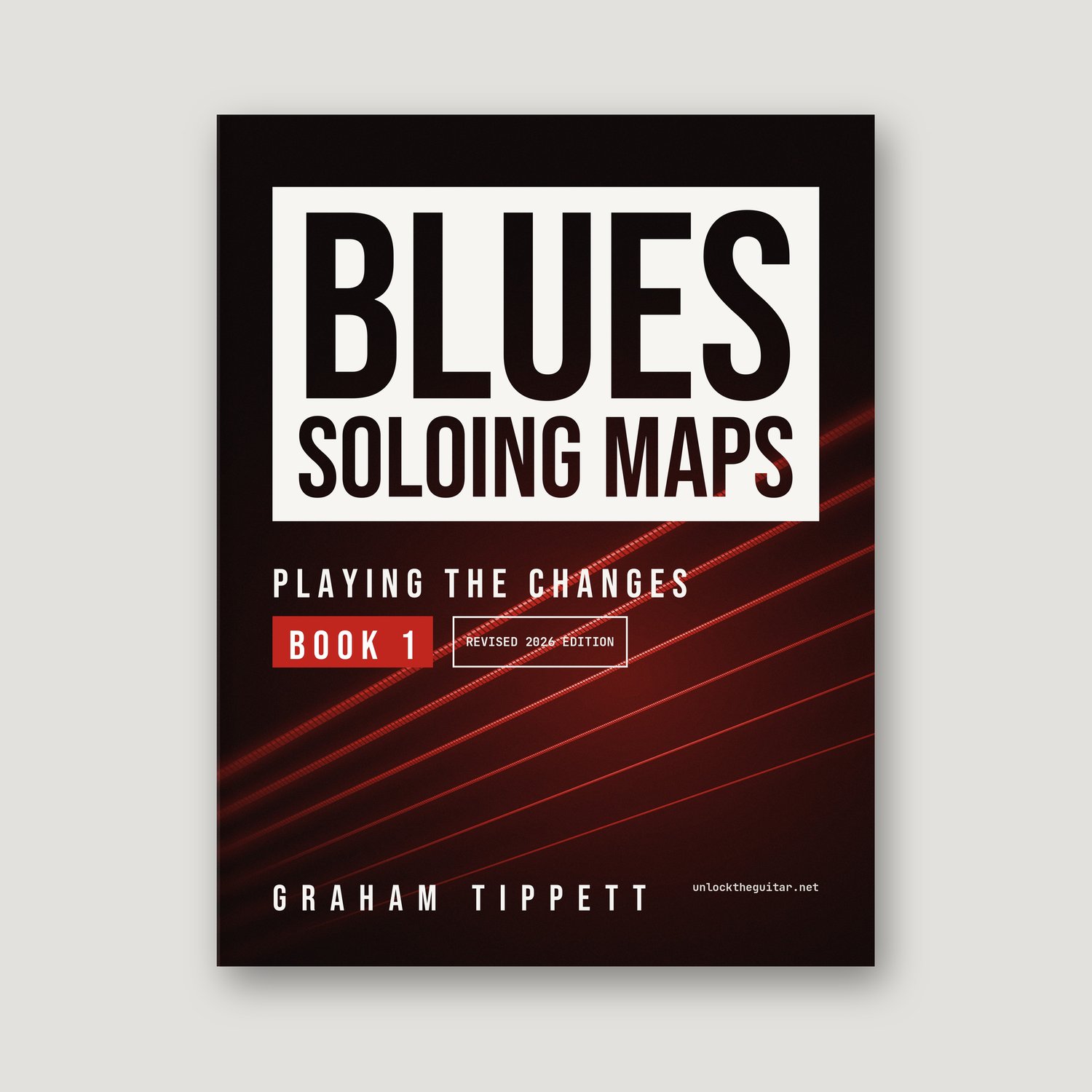
Blues Soloing Maps: Playing the Changes - Book 1
On Sale
$6.99
$6.99
Stop playing over the blues. Start playing the changes.
Most players solo over a 12-bar with one scale from start to finish. It works, which is why everyone does it, but it ignores the chords. The band moves to the IV chord and the solo carries on as if nothing happened.
This book gives you a map for each chord in the blues, all in the same area of the neck, so you can follow the changes without moving your hand. The whole method fits in one rule: keep the minor pentatonic as home, add each chord’s major pentatonic, and aim for that chord’s 3rd. C# over A7, F# over D7, G# over E7. The minor pentatonic stays, and with it the bends, the b3 and everything that makes it sound like the blues. You add the chord on top.
What’s in it
Revised 2026 edition. It’s been rebuilt from the ground up, with every diagram redrawn, one clear rule in place of the old mix of approaches, and new chapters on the 12-bar, guide tones, the key of E and practice. 18 pages, PDF, 8.5 x 11.
Most players solo over a 12-bar with one scale from start to finish. It works, which is why everyone does it, but it ignores the chords. The band moves to the IV chord and the solo carries on as if nothing happened.
This book gives you a map for each chord in the blues, all in the same area of the neck, so you can follow the changes without moving your hand. The whole method fits in one rule: keep the minor pentatonic as home, add each chord’s major pentatonic, and aim for that chord’s 3rd. C# over A7, F# over D7, G# over E7. The minor pentatonic stays, and with it the bends, the b3 and everything that makes it sound like the blues. You add the chord on top.
What’s in it
- The 12-bar laid out bar by bar, with the map to use and the note to aim for in each bar
- A map for each chord, with the chord shape drawn in the same position so the target note is under your fingers when the change comes
- Why the same note does a different job over each chord, and how to use that
- The guide tones (the 3rd and b7 of each chord) and the half-step moves between them, which is what playing the changes actually sounds like
- Where the blue note fits, and why it isn’t the key to the blues
- Maps above and below the main position
- The whole method in E, with open chords
- The 3rds to aim for in every common blues key
- A step-by-step practice order, starting with the one change that matters most
Revised 2026 edition. It’s been rebuilt from the ground up, with every diagram redrawn, one clear rule in place of the old mix of approaches, and new chapters on the 12-bar, guide tones, the key of E and practice. 18 pages, PDF, 8.5 x 11.