

Walk in Their Skin: A Tale of Two Men | Jim Valvano & Stuart Scott | Investigative Journalism Unit
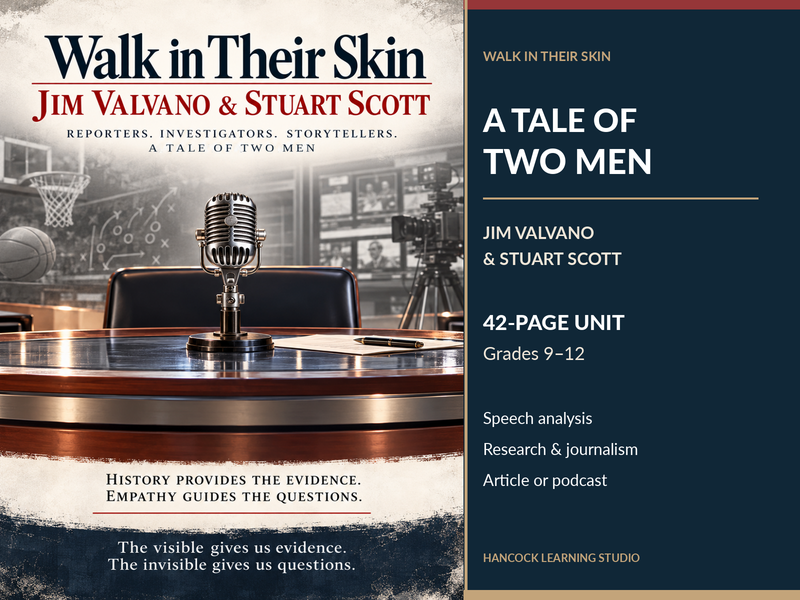
Walk in Their Skin: A Tale of Two Men
Jim Valvano & Stuart Scott | Investigative Journalism, Speech Analysis & Research Writing
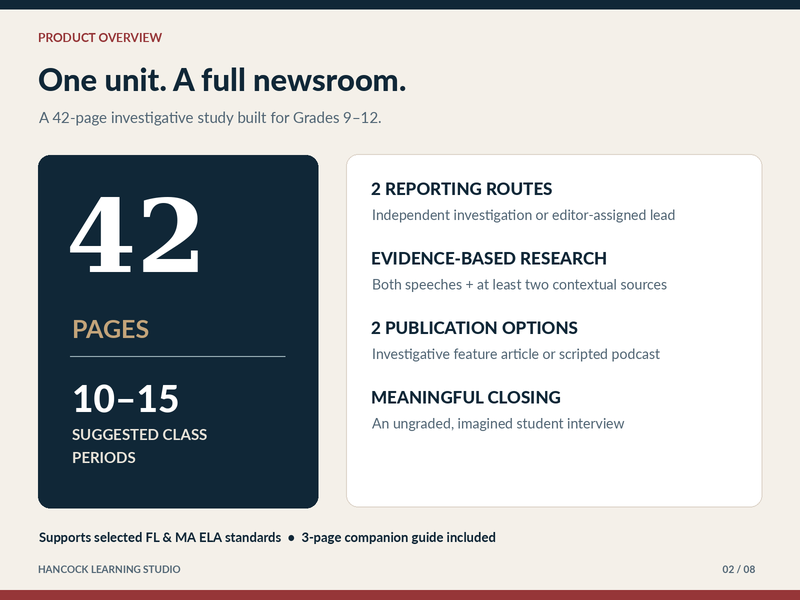
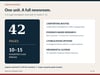
42-Page High School ELA Workshop | Grades 9–12
History provides the evidence. Empathy guides the questions.
Two men. Two speeches. Twenty-one years apart. One question: What does it mean to truly live?
In 1993, legendary basketball coach Jim Valvano delivered an unforgettable speech at the first ESPY Awards.
In 2014, sports broadcaster Stuart Scott accepted an award bearing Valvano's name and delivered a powerful message of his own.
But their stories are about more than illness, perseverance, or inspirational quotations.
Who were these men beyond the public spotlight? What did their words reveal? Where did their perspectives intersect—and where did they differ?
In this unique Walk in Their Skin study, students become investigative journalists.
Rather than receiving a predetermined interpretation, students investigate the historical record, examine two original speeches, evaluate evidence, question assumptions, and develop their own professionally reported story.
Bonus Companion Download: Every purchase includes the separate three-page Walk in Their Skin Parent/Teacher Guide, introducing the collection's origins, approach to historical empathy, and philosophy of evidence-based learning.
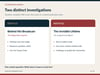
Two Reporting Routes — One Central Investigation
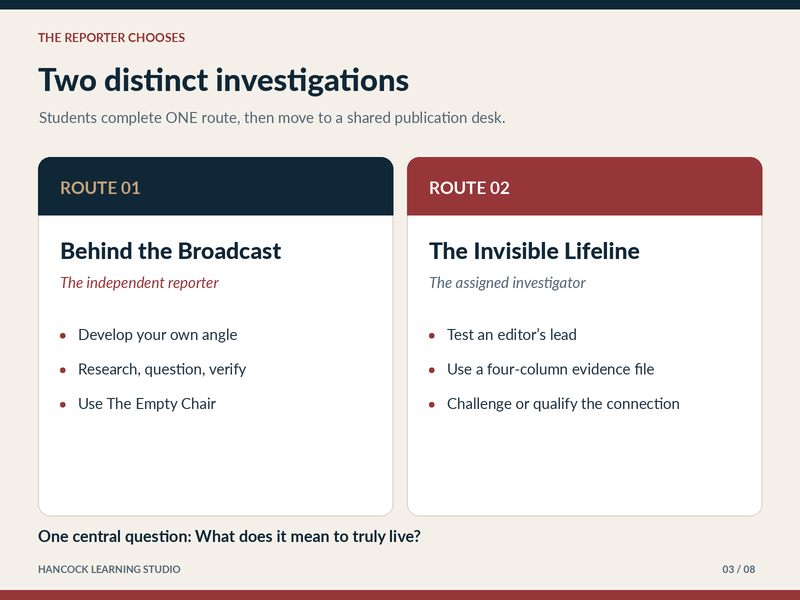
Students choose ONE of two distinct journalism assignments.
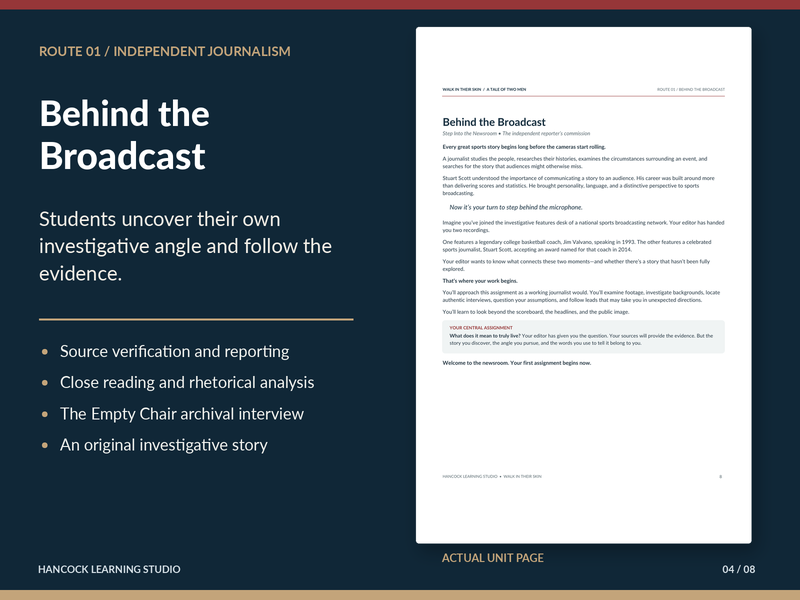
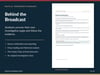
Route 1: Behind the Broadcast
The Independent Investigator
Students enter a fictional sports newsroom and develop their own investigative angle.
Working through seven reporting stages, they:
Verify primary and secondary sources.
Develop investigative questions and an editorial pitch.
Analyze significant passages and rhetorical choices from both speeches.
Test their assumptions against contrary evidence.
Complete The Empty Chair, an archival interview using original questions and authentic historical quotations.
Investigate the two men as individuals, beyond their public reputations.
Develop and revise a finished investigative report.
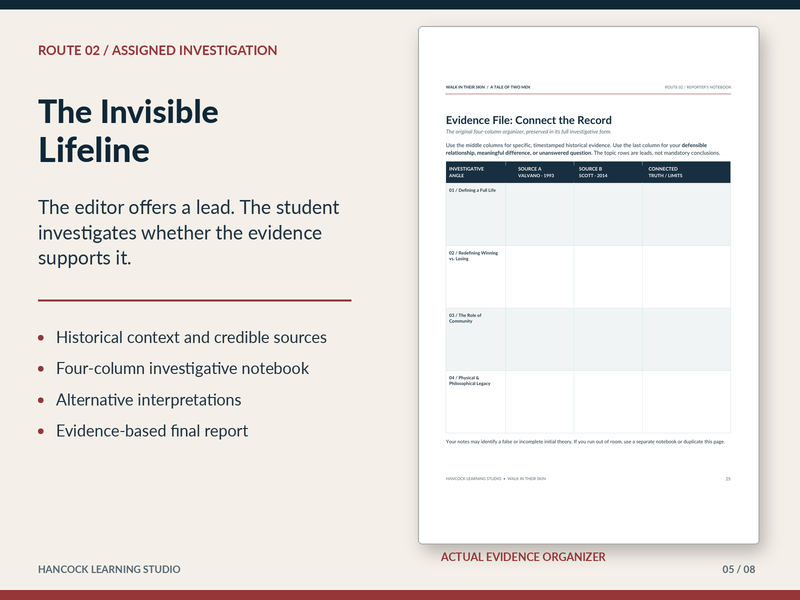
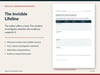
Route 2: The Invisible Lifeline
The Assigned Investigator
Students receive an editor's investigative brief examining the documented connection between Valvano's 1993 speech and Scott's 2014 address.
They use structured newsroom tools to:
Investigate the historical connection between the speakers.
Examine three optional investigative lenses.
Organize primary-source evidence in a four-column research notebook.
Identify contradictions, uncertainties, and alternative interpretations.
Develop an evidence-based editorial pitch.
Study a model introduction with journalistic technique notes.
Build an original investigative feature.
Both routes share the same academic expectations, but students retain control over their findings and conclusions.
Choose Your Final Publication
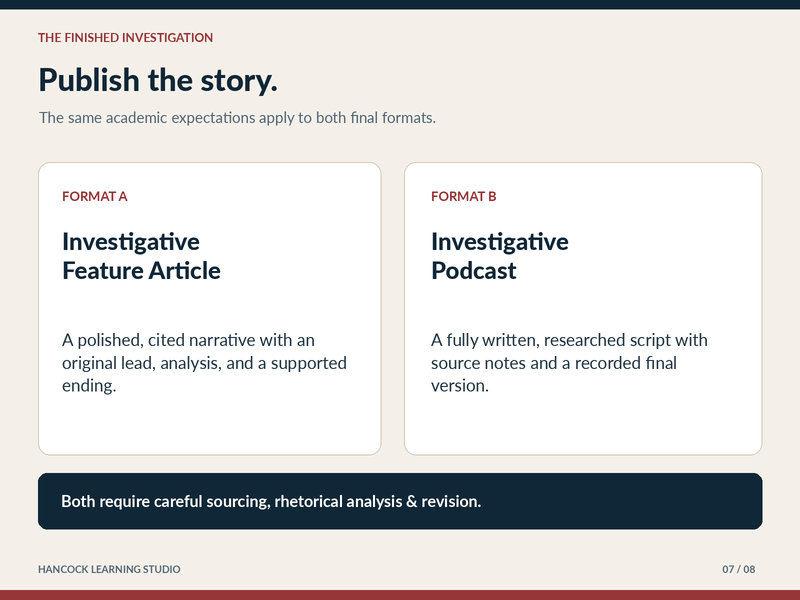
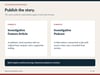
Students complete one of two substantial projects:
Option A — Investigative Feature Article
A 1,200–1,500-word journalistic feature with an original headline, engaging introduction, documented investigation, thoughtful analysis, and evidence-supported conclusion.
Option B — Investigative Podcast
A 9–12-minute recorded investigative report with a complete written script, source documentation, and editorial revision.
No specialized equipment or advanced editing software is required. Clear narration using a phone or computer is sufficient.
What's Included
Main Student Unit — 42-Page PDF
Access to both original ESPY speeches through links and QR codes.
Two differentiated investigative journalism routes.
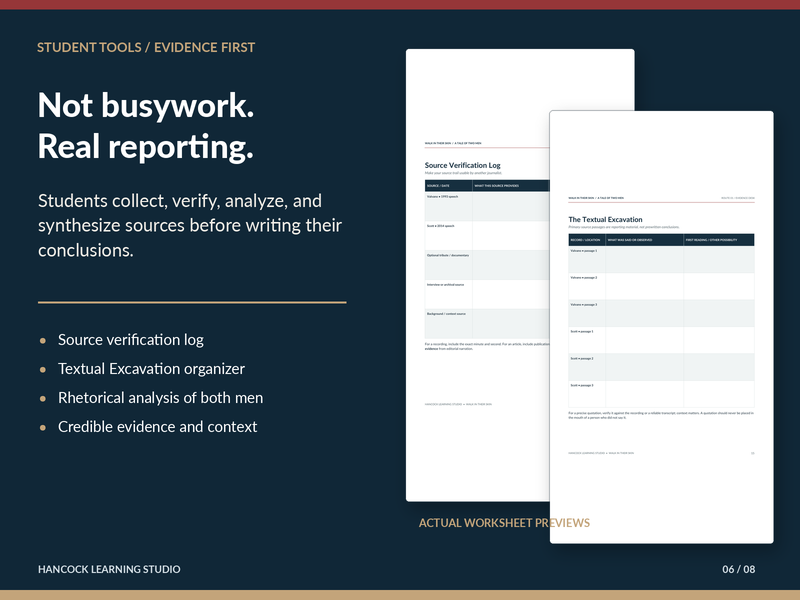
Research instructions and source verification logs.
The Textual Excavation — primary-source close reading.
The Editor's Pitch — developing an investigative angle.
The Empty Chair — evidence-based archival interview.
Four-column investigative evidence organizer.
Model journalistic writing and reporting techniques.
Feature planning and podcast scripting tools.
Editorial review and revision checkpoint.
Shared 16-point journalism assessment rubric.
Optional source-based Socratic Seminar.
Teacher/Parent implementation guidance.
Historical source references and credits.
The Interview Reversed — an ungraded concluding reflection.
Additional Download — 3-Page Walk in Their Skin Parent/Teacher Guide
This companion PDF is included with the purchase and can be downloaded separately from the main student unit.
The guide explains:
How Walk in Their Skin Began: The collection's origins in a homeschool high-school curriculum and its original Empathy unit.
Understanding Empathy: The distinctions between empathy, sympathy, and compassion—and why understanding another perspective does not require agreement.
History and Evidence: How students can investigate historical circumstances, a speaker's words, and an audience's experiences without inventing private thoughts or unsupported facts.
The Purpose Behind the Studies: Why the collection encourages curiosity, independent thinking, responsible interpretation, and meaningful writing.
Guidance for Parents and Teachers: The educational approach shared across the Walk in Their Skin collection.
Two PDFs are included: the 42-page investigative journalism unit and the three-page companion Parent/Teacher Guide.
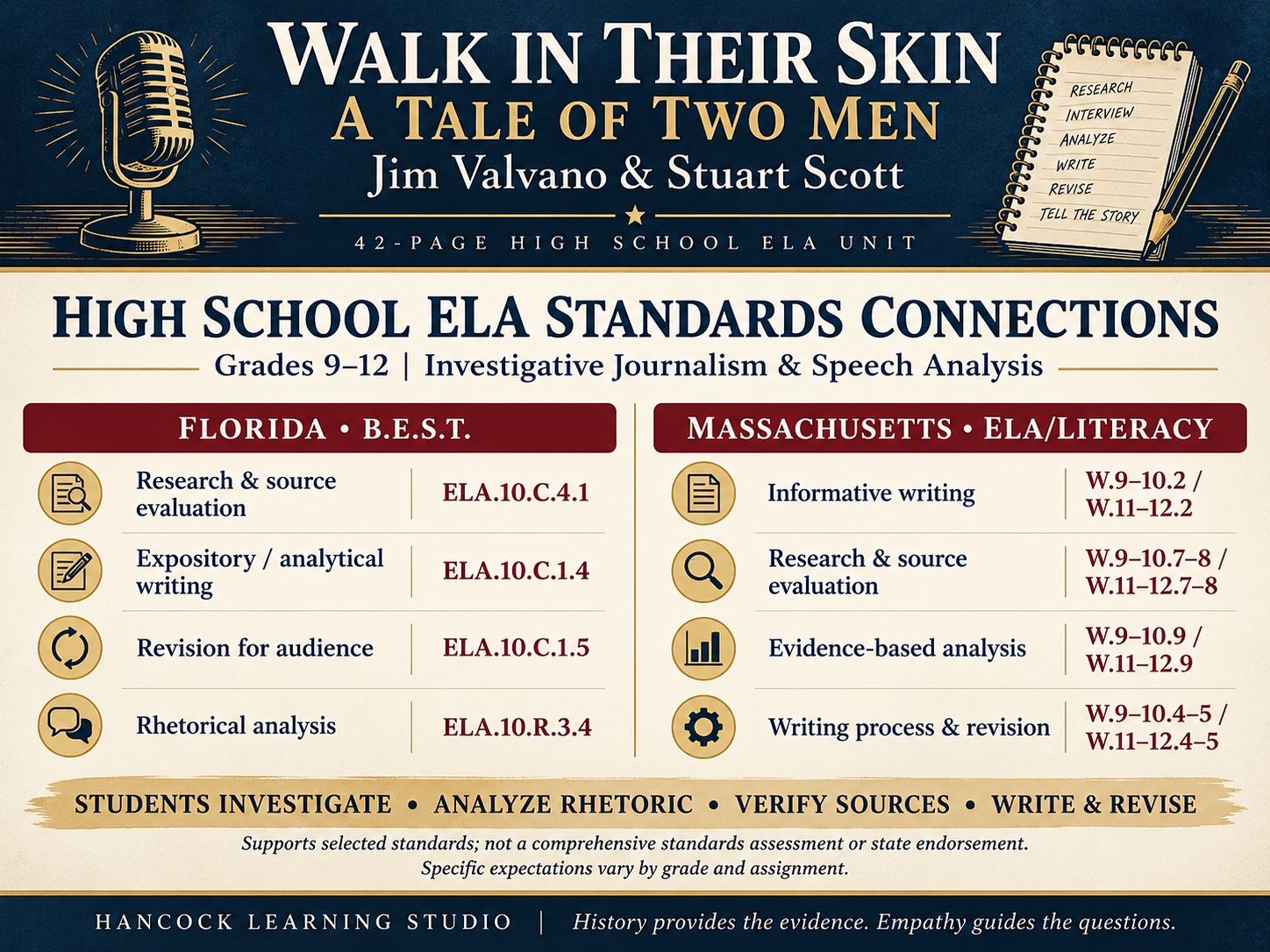
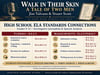
Florida & Massachusetts ELA Standards Connections
This unit supports selected Florida B.E.S.T., Massachusetts ELA/Literacy, and Common Core high-school standards through:
Investigative research and credible source evaluation.
Close reading and rhetorical analysis.
Informative and analytical writing.
Evidence-based interpretation and synthesis.
Examination of alternative perspectives.
Drafting, editing, and substantive revision.
Communication for a specific audience and purpose.
A separate product preview illustrates relevant Florida and Massachusetts curriculum connections.
These are instructional standards connections, not official state endorsement or comprehensive curriculum certification.
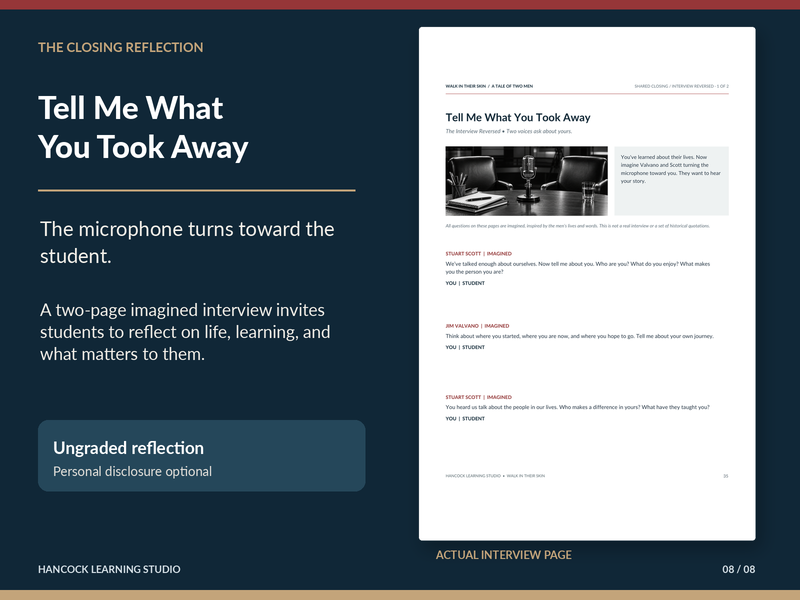
The Interview Reversed
After completing their investigation, students encounter an unexpected assignment.
The microphone turns toward them.
Through an imagined conversation with Valvano and Scott, students consider what they discovered, what questions remain, and how investigating another person's life might influence their understanding.
This concluding activity is ungraded, and personal disclosure is optional.
Resource Details
Grades: 9–12
Format: Two downloadable PDFs
Main Unit: 42 pages
Companion Parent/Teacher Guide: 3 pages
Total Included: 45 pages across two separate PDFs
Suggested Duration: 10–15 instructional periods, adaptable to independent study
Subjects: English Language Arts, Journalism, Research Writing, Speech Analysis, Character Education
Assessment: Shared 16-point journalism rubric
Price: $5.99
Please Note: External historical recordings, documentary footage, and speech transcripts are not included for redistribution. Links and QR codes provide access to the relevant source materials.
More Than a Speech Study
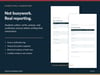
This is an opportunity for students to become researchers, investigators, writers, and storytellers.
They are not asked to agree with Jim Valvano or Stuart Scott, invent what either man privately felt, or reach a predetermined conclusion.
They are asked to look closely, question responsibly, and discover what the evidence allows them to say.
Students begin as learners. They finish as teachers.
The visible gives us evidence. The invisible gives us questions.
Hancock Learning Studio
Practical Resources for Real Learning.