

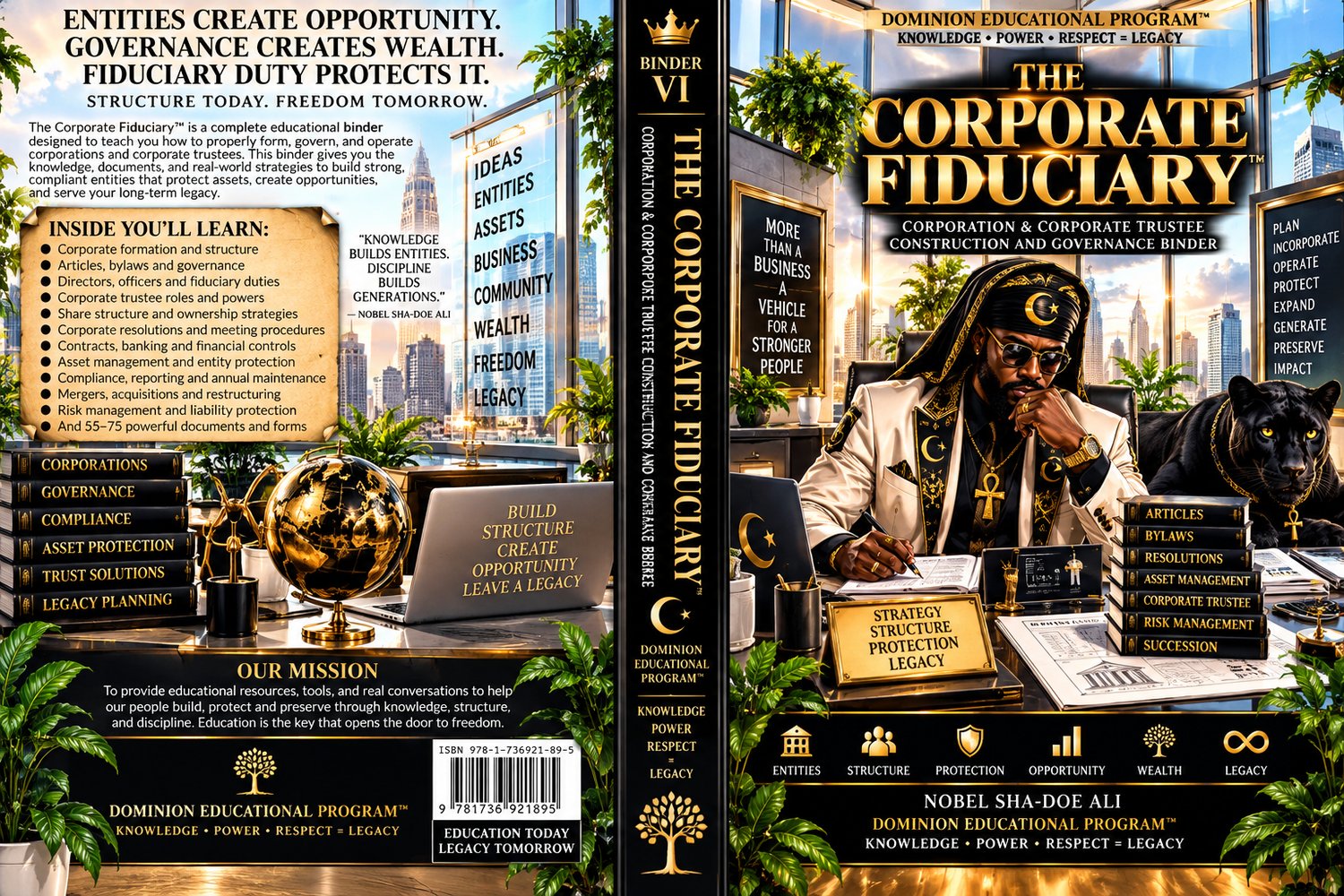
THE CORPORATE FIDUCIARY™
THE CORPORATE FIDUCIARY™
Corporation & Corporate Trustee Construction and Governance Binder
Binder VI — Dominion Estate Architecture Series™
By NobEL Sha-doe Ali
The Corporate Fiduciary™ is an in-depth educational system designed to teach students how corporations are formed, governed, capitalized, operated, documented, and—where legally authorized—used in fiduciary administration.
This binder attacks one of the biggest mistakes in advanced estate and business planning: confusing owning a corporation, controlling a corporation, serving as a corporate officer, owning assets through a corporation, and serving as a trustee. These are different legal capacities with different powers, duties, liabilities, tax consequences, and documentation requirements.
Students are taught to follow the Corporate Fiduciary Method™:
FORM → GOVERN → AUTHORIZE → QUALIFY → ACCEPT → ADMINISTER → INVEST → DISTRIBUTE → ACCOUNT → REPORT → REVIEW → SUCCEED
What You'll Learn
The Corporate Fiduciary™ takes students step-by-step through:
Corporate Formation & Structure • Articles of Incorporation • Bylaws • Capitalization • Share Classes • Shareholders • Directors • Officers • Fiduciary Duties • Corporate Resolutions • Meetings • Minutes • Banking • Contracts • Accounting • Internal Controls • Related-Party Transactions • Corporate Taxation • C Corporations • S Corporations • Payroll • Reasonable Compensation • Corporate Trustees • Trustee Eligibility • Trust-Business Regulation • Fiduciary Committees • Trustee Acceptance • Trust Administration • Beneficiary Rights • Investment Administration • Directed Trusts • Distributions • Trustee Compensation • Form 1041 • Fiduciary Accounting • Risk Management • Insurance • Compliance • Trustee Succession
A major focus of the book is learning the difference between:
CORPORATE CAPACITY
and
FIDUCIARY CAPACITY.
Creating a corporation does not automatically turn that corporation into a licensed trust company or authorize it to conduct regulated trust business. Students learn how to research the applicable state's corporate, trust, banking, fiduciary, licensing, and qualification laws before a corporation accepts a trustee position.
Corporate Governance From the Ground Up
Students learn how authority moves through a corporation:
SHAREHOLDERS → BOARD OF DIRECTORS → OFFICERS → EMPLOYEES/AGENTS
The binder explains who owns the shares, who owns corporate property, who establishes policy, who approves major transactions, who signs contracts, and how authority should be documented.
Students then build the corporate record system necessary to prove those decisions.
From Corporation to Corporate Fiduciary
The second half of the system goes deeper.
Students learn how to analyze a proposed corporate trustee arrangement by asking:
Who is the proposed trustee?
Is the corporation legally eligible?
What does the trust instrument authorize?
What state's law governs?
Where is the trust administered?
Does trust-company regulation apply?
Does licensing or qualification apply?
Who inside the corporation can make fiduciary decisions?
How will trust property remain separate from corporate property?
How will beneficiaries receive information?
How will every decision be documented?
The book also distinguishes a corporate trustee from a trust-owned corporation.
A trust owning stock in a corporation does not automatically make that corporation the trustee.
Fiduciary Administration
Students examine the practical responsibilities that arise after lawful acceptance of fiduciary office, including:
Duty of Loyalty • Prudence • Impartiality • Conflicts of Interest • Investment Decisions • Delegation • Directed Trusts • Special Assets • Beneficiary Requests • Distribution Standards • Loans • Property Use • Affiliate Transactions • Trustee Fees • Accounting • Tax Reporting
The objective is not merely to create documents.
It is to create an administrative record capable of proving why the fiduciary acted.
Corporate & Trust Tax Administration
The Corporate Fiduciary™ also teaches students not to confuse legal structure with tax treatment.
Students work through:
C Corporation Taxation • S Corporation Elections • Shareholder-Employee Compensation • Payroll • Distributions • Reimbursements • Loans • Related-Party Transactions • Trustee Fee Revenue • Form 1041 • Schedule K-1 • Principal and Income Accounting
The Dominion Corporate Taxable-Event Gate™ teaches students to identify the parties, capacities, ownership changes, consideration, basis, income, compensation, distributions, loans, gifts, reporting requirements, and supporting records before moving property or money.
70-Document Corporate & Fiduciary Vault
The system includes 70 educational construction records, worksheets, resolutions, policies, registers, checklists, and fiduciary administration tools covering the complete lifecycle of the structure—from incorporation and capitalization through trustee qualification, trust administration, accounting, compliance, and succession.
Students aren't simply given paperwork.
They're taught:
WHY IT EXISTS → WHEN TO USE IT → WHO AUTHORIZES IT → HOW TO COMPLETE IT → HOW TO EXECUTE IT → WHERE TO RECORD IT → WHAT HAPPENS NEXT
Build Something That Can Outlive You
The ultimate purpose of The Corporate Fiduciary™ is institutional continuity.
People retire. Officers change. Trustees resign. Founders die. Families grow. Businesses expand.
A properly constructed governance system preserves the authority, records, assets, responsibilities, institutional knowledge, and succession plan necessary for the structure to continue.
**ENTITIES CREATE OPPORTUNITY.
GOVERNANCE CREATES DISCIPLINE.
FIDUCIARY DUTY PROTECTS THE PURPOSE.**
DOMINION EDUCATIONAL PROGRAM™
Knowledge • Power • Respect = Legacy