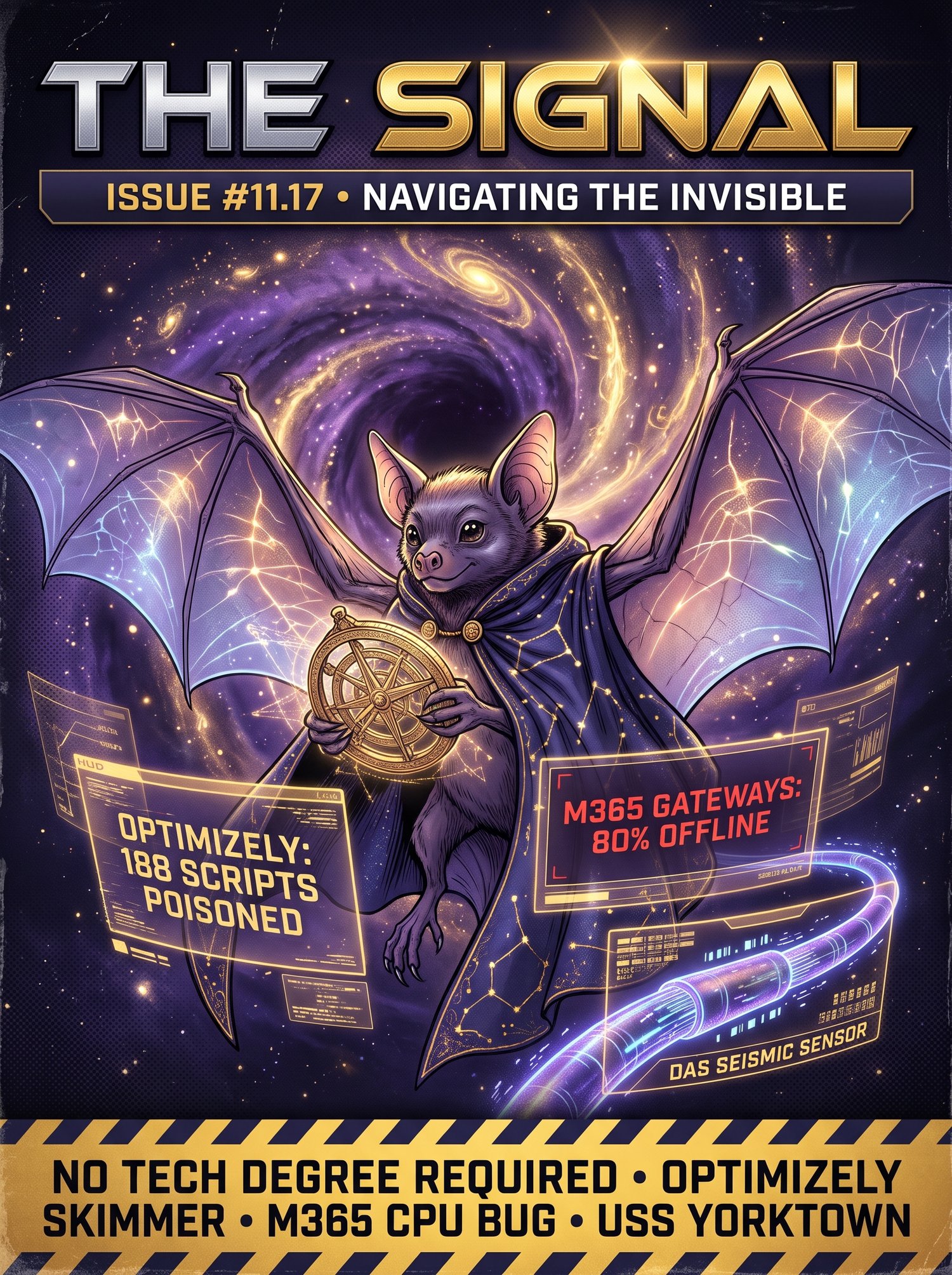

The Signal: Issue #11.17 — Navigating the Invisible
What happens when a single poisoned analytics script turns 178 trusted websites—including Zoom, CNN, BBC, Salesforce, and GitLab—into silent credit-card skimmers, while a months-old bug passes Microsoft's lab tests on weaker CPUs only to knock out over 80% of production Microsoft 365 gateways worldwide?
Welcome to Issue #11.17 (Navigating the Invisible — 17 November 2026) of The Signal, the illustrated workplace technology and cybersecurity field guide written for everyone at work—no tech degree required. Pairing cosmic navigator graphic-novel panels with plain-English technical breakdowns, this issue equips IT admins, security engineers, and everyday office teams with actionable defenses and historical engineering lessons:
The Big Story — The Optimizely 188-Script Supply-Chain Skimmer & Microsoft's 80% Gateway Meltdown: How attackers exploited Optimizely's Experimentation signup flow to inject 1688360[.]cc/track.js into 188 scripts across 178 organizations (skimming payment forms, hijacking crypto addresses, harvesting session cookies, and serving the Coruna and DarkSword iOS exploit kits); why a latent July thread-contention bug passed Microsoft's internal lab tests on weaker, fewer-core CPUs but froze over 80% of high-core production Microsoft 365 gateways (plus emergency Windows OOB updates KB5136483 / KB5136489 / KB5136487 / KB5136490 / KB5136493 for the 0x80041008 Slmgr.vbs bug and the 60-day Windows Server 2016 End of Support countdown); why Google Project Zero slashed its disclosure deadline to 30 days amid AI exploit agents and the Jieyou phishing LLM; how SANSAR Linux malware hooks NVIDIA's NVML library to report zero GPU load while mining crypto; and why six unpatched Danfoss AK-SM800A freezer flaws and re-registered 2019 Retadup C2 domains (15,000 infections) demand immediate network isolation.
The 10-Second Office Trick — Excel's "Phantom-Row Hunter" (Ctrl + End & Ctrl + Home): How to expose and delete the invisible stray cell in Row Z1234 that bloats a 150-row spreadsheet to 18 MB and causes the office printer to spit out 16 blank pages.
Word of the Day & Security Habit — First-Party Script Injection (Digital Skimming) & Out-of-Band Telemetry: How attackers hide beneath a green HTTPS padlock or hook kernel/GPU libraries (acpi_thermal_mgr.ko) to blind in-band dashboards, plus three high-impact habits: enforcing Content Security Policy (CSP), isolating industrial controllers from direct 4G/5G lines, and staging updates on multi-core production hardware.
Knowledge Waypoints — Three Free Open Archives: Explore 2,580+ free university courses at MIT OpenCourseWare, global multilingual policy and science archives dating back to 1933 at the UNESCO Digital Library (UNESDOC), and high-resolution Renaissance manuscripts at the Folger Shakespeare Library.
Future Tech — Distributed Acoustic Sensing (DAS): How shore-based optoelectronic interrogators use Rayleigh scattering to turn 100+ km submarine internet cables (including the Suez Canal's FLAG corridor and the Dunant cable) into tens of thousands of underwater earthquake, tsunami, and dragging-anchor sensors.
Pioneers of the Grid & Famous IT Crises: Celebrate the 56th anniversary of the computer mouse patent (U.S. Patent 3,541,541, 17 November 1970) with visionary Douglas Engelbart and master builder Bill English (1929–2020) (creator of the 1963 wooden prototype, stage director of the 1968 Mother of All Demos, and inventor of the 1972 Xerox PARC ball mouse), alongside data pioneer Herman Hollerith (1929), the 1869 opening of Egypt's Suez Canal, and the 21 September 1997 USS Yorktown (CG-48) "Smart Ship" Divide-by-Zero Crash, where a single unvalidated 0 entered into the RDBM database cascaded across 27 Windows NT consoles and left a Navy cruiser dead in the water for nearly three hours.