
Weather & Sky Signs — Reading Clouds, Wind, and Pressure Without Instruments
Before radar, people planned their lives around the weather using nothing but the sky. They were not guessing. The atmosphere advertises what it is about to do, often a full day ahead, and the signs are consistent enough to be learned.
This book teaches the reasoning, not the folklore. Why a halo around the moon genuinely means rain tomorrow. Why a cold front gives you twenty violent minutes and then the best afternoon of the week. Why a wind that shifts clockwise means it is over and counterclockwise means it is coming. Why cumulus clouds growing tall at eleven in the morning means you should be off the summit by one.
It covers pressure and what a falling barometer actually predicts, the four types of front and the exact sequence of cloud each one sends ahead of itself, the cloud families and how to name what you are looking at, mountain and wave clouds, halos and sun dogs, the humidity signs that work and the folk signs that don't, fog, valley and coastal weather, thunderstorms and lightning safety, and flash floods.
It is honest about limits. Sky reading is genuinely good at twelve to twenty-four hours and nearly worthless beyond two days. Use it alongside the forecast, for the thing the forecast cannot tell you: what is happening in the valley you are standing in, right now.
Adapted from public-domain United States government weather observation instruction and National Weather Service guidance, rewritten in plain English.
What's inside
- 42 pages, 15 chapters, 5 appendices, 15 diagrams
- Why weather moves west to east, and why that makes the sky readable
- Pressure, and the trend that matters more than the number
- Warm fronts, cold fronts, occlusions — and the cloud sequence each one sends
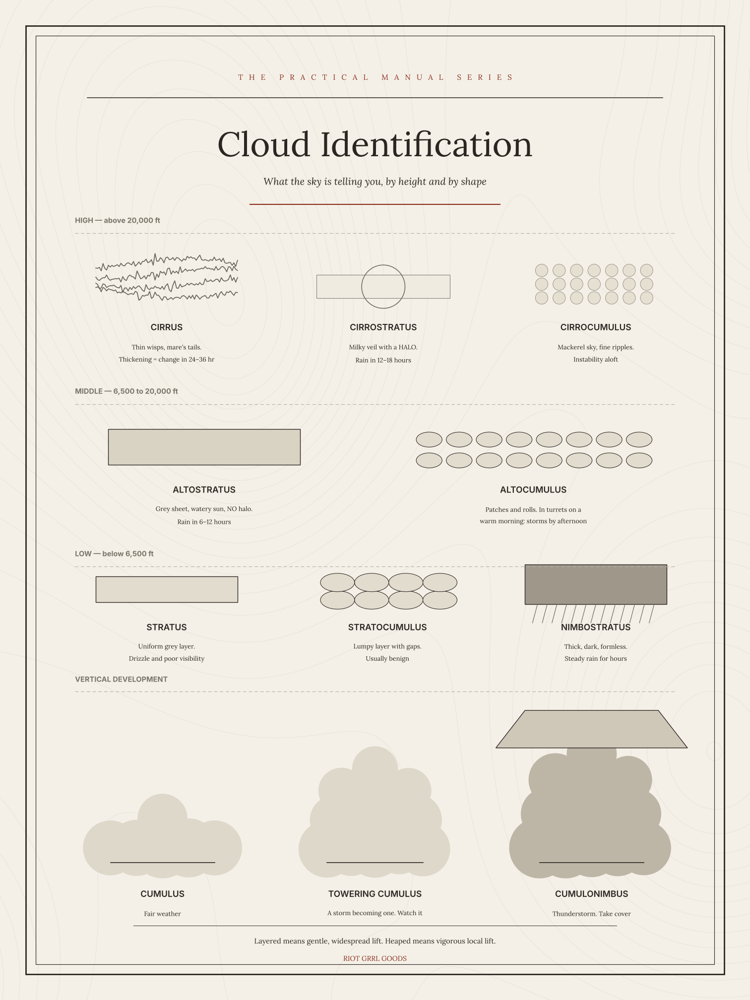
- The cloud families, with a full identification chart
- Reading sequences: the sky order that means rain tomorrow, and the one that means a storm this afternoon
- Lenticular clouds, cap clouds, and what mountain weather tells you
- Halos, sun dogs, coronas, and why red sky works where it works
- Humidity and folk signs — which are physically sound and which are not
- Fog types, and what each one predicts
- Valley winds, sea breezes, föhn winds, rain shadows
- Thunderstorms: the life cycle, recognition, and the 30/30 lightning rule
- Flash floods, winter storms, squall lines
- How to make your own forecast, with a combination table
- Seven practice drills and an observation log
Who it's for Hikers, climbers, paddlers, sailors, farmers, gardeners, and anyone who works outside and would rather know what is coming.
Note on scope Official warnings always take precedence. This is for anticipating ordinary weather and recognising immediate danger, and it says plainly that tornado recognition is not a skill a book can give you.
Format Instant PDF download. Letter size, prints cleanly at home, reads on any device. Yours forever, no subscription.