
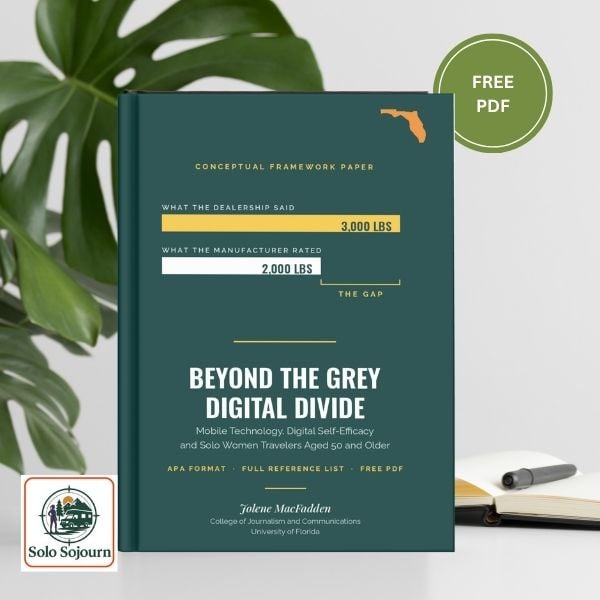
Beyond the Grey Digital Divide: Mobile Technology, Digital Self-Efficacy and Solo Women Travelers Aged 50 and Older (Free Academic PDF)
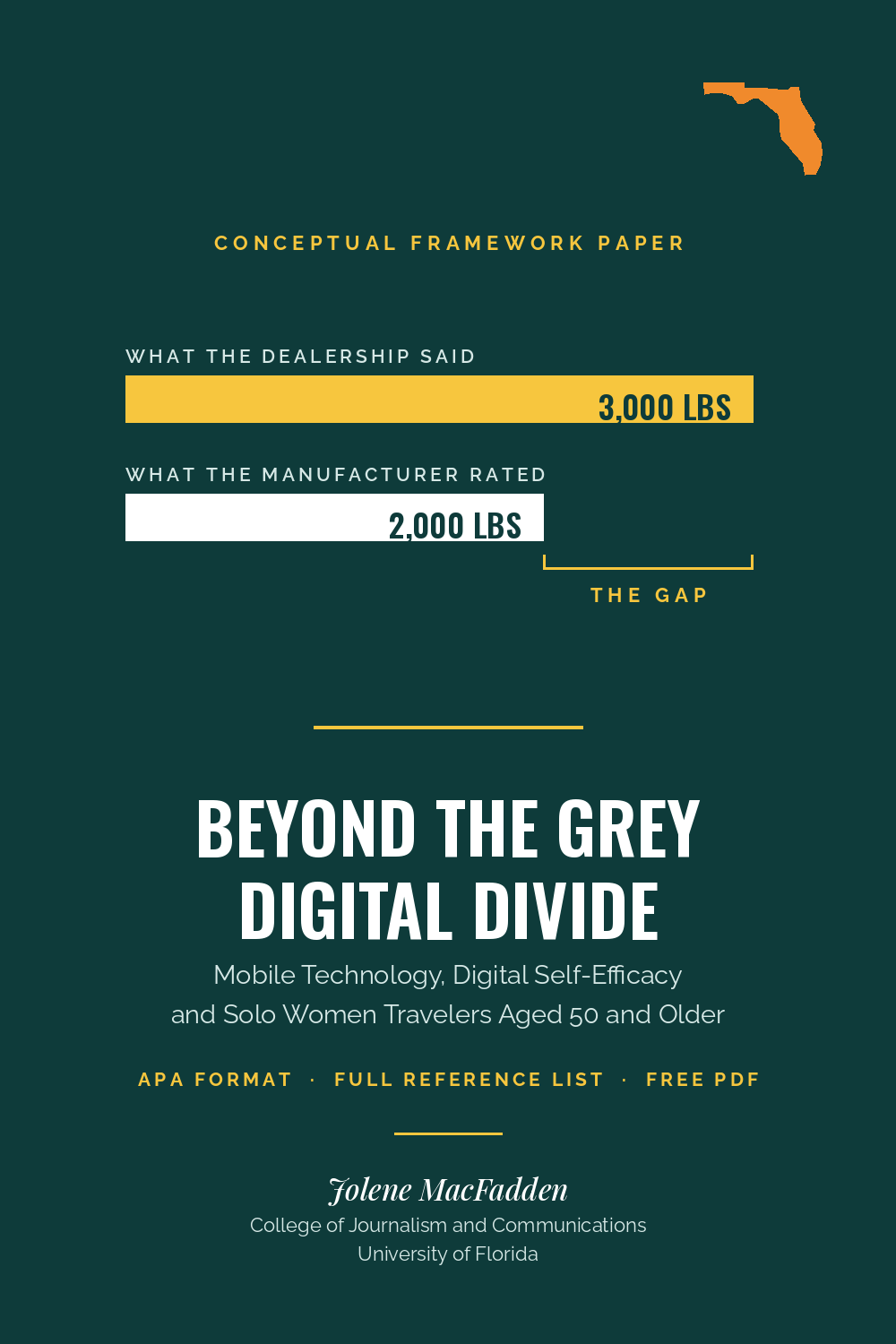
A dealership tells a woman her SUV can tow 3,000 pounds. The manufacturer's own guide specifies 2,000 for her exact trim.
That thousand-pound gap degrades braking and raises the risk of trailer sway. It is not a marketing quibble. It is the difference between a safe trip and a dangerous one, and the person protected is the one with the skill and confidence to find the primary source.
This paper argues that information asymmetry, for a woman traveling alone, is a safety problem rather than an inconvenience, and that closing it requires building capacity and community rather than simply delivering data.
What the paper does.
It connects three literatures that rarely address one another: evidence on the effectiveness of later-life online learning, second-level and grey digital divide scholarship, and solo female travel research on risk, fear, and travel intention. From that synthesis, it proposes a conceptual framework linking use of a mission-built mobile platform to three outcome constructs: digital self-efficacy, safety confidence, and social connectedness. It then translates the framework into three testable hypotheses and a mixed-methods design.
The central claim about the divide. The barrier for older adults is not access. It is skill, confidence, and social support, which means it is responsive to intervention rather than fixed by age. The harms are relational as well as informational, so remedies that build connection can address both at once.
On positionality. The author states her position explicitly, consistent with feminist and qualitative traditions. She is a practitioner-scholar with three decades in digital marketing, a woman past 60 who travels alone on public lands, and the builder of the platform under discussion. The risk of that dual standing is loss of critical distance, addressed through mixed methods and external review. The resource is access and credibility with a population usually studied from a distance and rarely consulted as expert on its own experience.
Who this is for. Researchers in tourism, gerontology, and communication. Public-lands agencies planning for an underserved and economically significant demographic. Technology designers building for older users. Graduate students looking for a worked example of a conceptual framework paper. And any reader who wants the argument underneath the practitioner guides.
Jolene MacFadden, College of Journalism and Communications, University of Florida. July 2026. The empirical study described operates under an approved institutional review board protocol, with a public-lands research partnership in progress.
Free. Instant PDF download. APA format with full reference list.
Suggested citation: MacFadden, J. (2026). *Beyond the grey digital divide: A conceptual framework for mobile technology, digital self-efficacy, and the empowerment of solo women travelers aged 50 and older.* Solo Sojourn Project.