
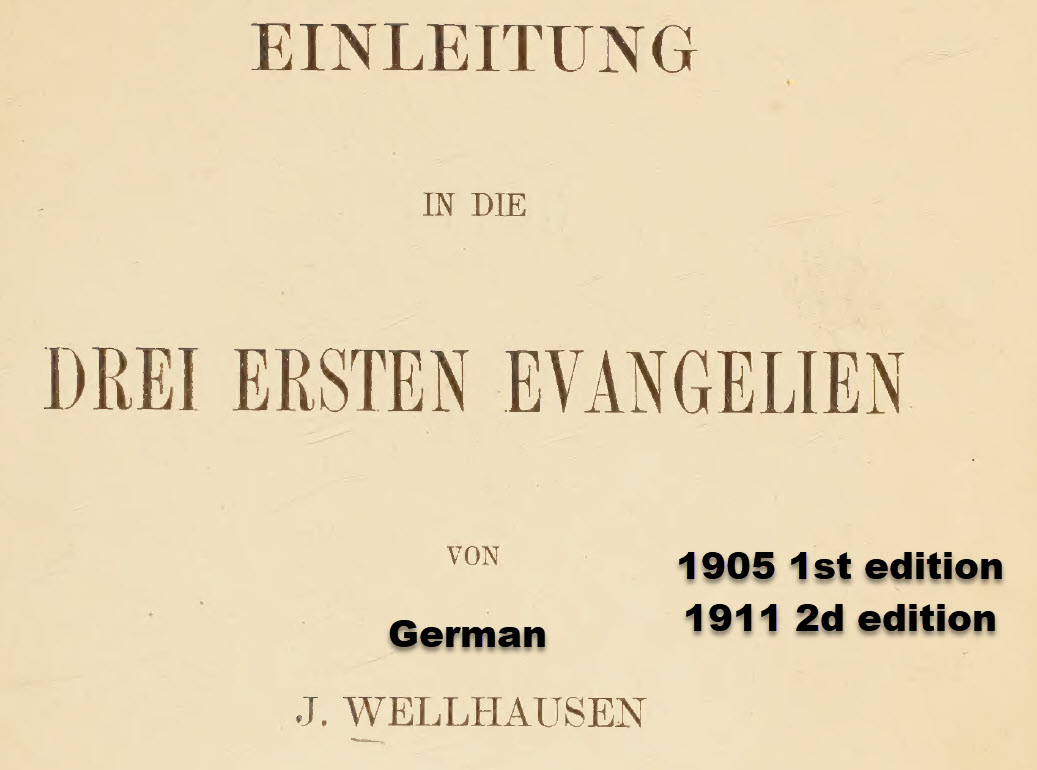
Wellhausen 1905 Einleitung & 1911 2d Edition
TITLE:
Julius Wellhausen: Einleitung in die drei ersten Evangelien (1905 1st Ed. & 1911 2nd Ed. Complete 3-Part Set) + 1905 Expositor Biography [AI & Notebook Ready]
DESCRIPTION:
Unearth the foundational text that transformed modern New Testament textual criticism and Aramaic Gospel studies!
This exclusive digital research package brings together Julius Wellhausen’s complete Einleitung in die drei ersten Evangelien in both its original 1905 1st Edition and his revised, groundbreaking 1911 2nd Edition—plus a rare 1905 Expositor biographical profile.
🌟 Why This Digitized Package Is Unique:
- Painstakingly OCR-Processed in Dual Languages: Fully searchable, high-accuracy OCR for both German and Greek textual apparatuses.
- Optimized & Compressed for AI Analysis: Re-sampled and compressed so you can upload it directly into Gemini Notebook / LLMs without running into file size limits or token bottlenecks.
- Pre-Split into 3 Modular Files (1911 Edition): Professionally divided into three clean volumes (001–061, 062–130, 131–176) specifically engineered for seamless AI scanning, semantic search, and prompt analysis.
👤 About the Author: Julius Wellhausen (1844–1918)
(Extracted from the 1905 Expositor Biography)
Born May 17, 1844, in Hameln on the Weser, Julius Wellhausen studied theology and Semitic philology at Göttingen under the legendary Heinrich Ewald. Wellhausen revolutionized Old Testament scholarship with his masterwork, Prolegomena zur Geschichte Israels (1878), establishing the famous Graf-Wellhausen hypothesis regarding the post-exilic date of the Priestly Code.
As noted in the 1880s–1900s Expositor profile, Wellhausen was far from a cold critic; he was a deeply religious scholar whose mastery of Hebrew, Aramaic, Syriac, and Arabic allowed him to uncover the living spiritual history behind sacred texts. Turning his formidable Semitic philology to the Gospels in his later years at Greifswald, Halle, and Marburg, Wellhausen shattered established paradigms by proving that an authentic Aramaic tradition lies directly beneath the Greek text of the Synoptic Gospels.
📚 Comparing the Two Editions (1905 vs. 1911):
- The 1905 1st Edition (Einleitung): Wellhausen’s initial investigation into textual criticism and Synoptic grammar. Here, Wellhausen originally posited the existence of a distinct, artificial "Jewish-Greek" (Judengriechisch) dialect created under Septuagintal influence.
- The 1911 2nd Edition (Einleitung - Revised & Expanded): A major academic "conversion." After further philological re-examination, Wellhausen publicly retracted his "Jewish-Greek" theory [p. 7]. Instead, he demonstrated that New Testament Greek is popular vernacular Koine wrapped around a predominant Aramaic original (Vorlage) that was translated into Greek, leaving clear Aramaic syntax and mistranslation errors that still "shine through" ("es schimmert noch durch", p. 9) [Passage 6, 8].
📖 Outline Summary of the 1911 Edition
The 1911 2nd Edition (Einleitung in die drei ersten Evangelien, 176 pages) is structured into 20 distinct chapters across three major divisions:
Part I: Textual Criticism & Language (§§ 1–4, pp. 1–32)
- § 1. Die handschriftliche Überlieferung (pp. 1–7): Analysis of manuscript transmission, contrasting the Alexandrian uncials (Vaticanus, Sinaiticus) with the Western text (Codex Bezae / D, Old Latin, and Old Syriac).
- § 2. Die Sprache der Evangelien (pp. 7–14): The Great Retraction. Wellhausen abandons his 1905 Judengriechisch hypothesis. He proves that NT Greek is popular lower-class Koine, while the awkward Semitic constructions reflect direct translation from Aramaic.
- § 3. Die aramäische Grundlage der Evangelien (pp. 14–34): Detailed catalog of Aramaic syntax, parataxis, asyndeton, word order, doublets (mathla / parables), and idiom transfers in Mark, Matthew, and Luke.
- § 4. Schluß (pp. 34–43): Demonstrates that written Aramaic manuscripts (Vorlage) existed prior to our Greek Gospels, citing physical translation errors between Matthew and Luke.
Part II: Literary Criticism & Source Relations (§§ 5–6, pp. 32–79)
- § 5. Markus (pp. 32–48): Establishes Markan Priority. Mark is the oldest, most primitive narrative framework used independently by Matthew and Luke.
- § 6. Markus bei Matthäus und Lukas (pp. 49–57): How Matthew and Luke adapted, rearranged, and polished Mark's raw narrative.
- § 7. Nicht aus Markus Stammendes bei Matthäus und Lukas (pp. 57–64): Analysis of the common Q source (Spruchquelle).
- § 8. Markus verglichen mit Q (pp. 64–79): Compares the isolated Apophthegmata of Mark with the composed thematic discourses in Q.
Part III: Historical & Theological Evolution (§§ 7–20, pp. 79–176)
- § 7 (9). Der jüdische und der christliche Messias (pp. 79–84): The development of Messianic self-consciousness.
- § 8 (10). Die Auferstehung Jesu (pp. 84–86): Resurrection traditions in early Christian faith.
- § 9. Die jüdische und die christliche Eschatologie (pp. 86–98): Apocalyptic expectations and the delay of the Parousia.
- § 10. Das Evangelium und Jesus von Nazareth (pp. 98–104): The historical Jesus vs. the post-resurrection kerygma.
- § 11. Das Hebräerevangelium (pp. 107–118): Examination of the apocryphal Aramaic Gospel according to the Hebrews (positing whether it is secondary to canonical Matthew).
- § 12. Zacharias Barachias (pp. 118–123): Historical-critical case study on textual corruptions.
- § 13. Der Menschensohn (pp. 123–130): Philological analysis of the Aramaic title Bar Nasha ("Son of Man").
- § 14. Der Todestag Jesu (pp. 130–134): Synoptic vs. Johannine chronology of Passover.
- § 15. Johannes der Täufer und Jesus (pp. 134–138): Historical relationship between John's movement and Jesus.
- § 16. Die Zwölf Jünger und die Apostel (pp. 138–147): Retrospective creation of the institutional "Twelve".
- § 17. Das Evangelium und das Christentum (pp. 147–153): Transition from Galilean Gospel to Hellenistic Christianity.
- § 18. Die evangelischen Erzählungen (pp. 153–157): Literary growth of miracle stories.
- § 19. Der evangelische Redestoff (pp. 157–170): How oral sayings were aggregated into written gospel texts.
- § 20. Corrolarium (pp. 170–176): Critique of contemporary scholarship (including Kirsopp Lake).
🔄 Wellhausen’s "Change of Heart": 1905 vs. 1911
The most significant feature of the 1911 2nd edition is Wellhausen’s public abandonment of his earlier "Jewish-Greek" hypothesis:
The 1905 Position (1st Edition, p. 34):
"Es gibt ein Judengriechisch, welches unter dem Einfluß der Septuaginta steht und sich kennzeichnet durch Aufnahme von allerhand Biblicismen."
(“There is a Jewish-Greek, which stands under the influence of the Septuagint and is characterized by the adoption of all sorts of biblicisms.”)
The 1911 Retraction (2nd Edition, p. 7):
"Die Beobachtungen zu einer allgemeinen Charakteristik der Sprache der synoptischen Evangelien, die ich in der ersten Ausgabe dieses Buches gesammelt habe, sollen hier nicht wiederholt werden. Sie gehn über den Zweck hinaus und stehn ihm im Wege. Denn meine Absicht ist, die Aufmerksamkeit auf die speziell semitischen Züge jener Sprache zu lenken." [Passage 8]
(“The observations toward a general characterization of the language of the Synoptic Gospels, which I collected in the first edition of this book, shall not be repeated here. They go beyond the purpose and stand in its way. For my intention is to draw attention to the specifically Semitic features of that language.”) [Passage 8]
The 1911 Conclusion (2nd Edition, p. 9):
"Der nächste Grund für die Behauptung, daß das Evangelium ursprünglich semitisch und zwar aramäisch war, ist historischer Art. Jesus selber sprach aramäisch... Durch die Umprägung ist das ursprüngliche Gepräge nicht verschwunden, es schimmert noch durch." [Passage 10]
(“The primary reason for the assertion that the Gospel was originally Semitic—and specifically Aramaic—is of a historical nature. Jesus Himself spoke Aramaic... Through the recasting [into Greek], the original impression has not vanished; it still shines through.”) [Passage 10]
📜 Wellhausen on the Old Syriac Manuscripts (Sinaiticus & Curetonian)
In § 1 (p. 1, Footnote 1) of both editions, Wellhausen explicitly highlights the discovery and ranking of the ancient Old Syriac Gospel manuscripts [Passage 52]:
German Original (1911, p. 1, Fn. 1):
"Die Syra liegt uns für die Evangelien in drei Phasen vor, in der Sinaitica, Curetoniana und Peschita (Syra S. C. und P.). Die Syra S. ist älter und weit wichtiger als die Syra C.; die Peschita ist nach einem späteren griechischen Text korrigiert. Ich bezeichne die Syra S. einfach als Syra." [Passage 52]
English Translation:
“The Syriac version [Syra] is available to us for the Gospels in three phases: the Sinaitica, Curetoniana, and Peshitta (Syra S., C., and P.). The Syra S. [Syriac Sinaiticus, discovered 1892] is older and far more important than the Syra C. [Curetonian]; the Peshitta is corrected according to a later Greek text. I designate the Syra S. simply as 'Syra'.” [Passage 52]
Wellhausen valued the Syriac Sinaiticus (Syr S) as a primary witness because it preserved the un-revised, "Western" textual tradition before ecclesiastical scholars harmonized or polished the Greek text [Passage 52, 56].
🎯 Overarching Theme of the 1911 Book (With Examples)
The overarching thesis of Wellhausen's 1911 Einleitung is that our canonical Greek Gospels represent a multi-layered historical and literary evolution, wherein a primary Aramaic oral and written tradition (Vorlage) was recast into popular Greek, and subsequently expanded and "Christianized" by later church editors.
Three Master Examples from Wellhausen:
Linguistic/Textual Proof of a Written Aramaic Manuscript (Vorlage):
- Luke 11:41 vs. Matthew 23:26 (p. 23): Matthew correctly translates דכו (dak kau / "Cleanse!"), whereas Luke reads "Give alms" (zakkau), which Wellhausen calls "sheer nonsense" (schierer Unsinn) [Passage 60]. Because ד (D) and ܙ (Z) are graphically almost identical in Aramaic script, Luke’s error proves he was physically misreading a written Aramaic consonantal manuscript [Passage 60].
Literary Priority of Mark over Matthew (p. 44):
- Mark 6:17–29 vs. Matthew 14:3–13 (p. 44): Mark introduces the execution of John the Baptist as a parenthetical flashback (Plusquamperfektum) to explain Herod’s fear [Passage 42]. Matthew copies Mark's flashback but forgets its parenthetical nature midway through, treating the old flashback as a live event that triggers Jesus's withdrawal [Passage 42]. This "clumsiness" (Oscitanz) proves Matthew was copying Mark as a text [Passage 42].
Historical "Christianization" of the Tradition (p. 72 & 84):
- In Mark, Jesus keeps His Messiahship secret, teaching publicly (exoterically) in simple parables [Passage 73]. In Matthew and Luke, post-resurrection church concepts ("church," "the heavenly Father," "Christian dogma") are projected backward into early Galilean discourses, transforming Jesus into an explicit, dogma-teaching Messiah from day one [Passage 73, 74].