

💙 WHY THE AUTISTIC BRAIN MAY STRUGGLE TO FILTER COMPETING SOUNDS
💙 WHY THE AUTISTIC BRAIN MAY STRUGGLE TO FILTER COMPETING SOUNDS
Understanding Auditory Filtering, Listening Effort and Sensory Overload
Research-Informed Autism Educational Poster | UK Edition | Nonspeaking Autism
🌻 Connection over correction. Understanding over expectation.
Imagine trying to listen to someone speaking while chairs scrape, people talk, traffic passes outside, lights hum and electronic devices beep.
For some autistic children, these competing sounds may be difficult to separate, ignore or prioritise.
What appears to be a normal classroom, supermarket or family gathering to one person may be exhausting or overwhelming for another.
Why the Autistic Brain May Struggle to Filter Competing Sounds is an illustrated educational poster exploring auditory filtering, listening effort, sensory sensitivity and practical ways to support autistic children in noisy environments.
The central message is:
A child may hear the sounds around them but still struggle to pick out the information they need.
This does not mean they are refusing to listen, ignoring instructions or deliberately being difficult.
It may mean that the listening environment is placing too many competing demands on their attention and sensory processing.
🧠 WHAT THIS POSTER EXPLORES
1. 🔊 What Is Auditory Filtering?
Auditory filtering describes processes that help people distinguish important sounds from background noise.
In everyday life, the brain must manage several streams of auditory information.
For example, a child in a classroom may need to:
- Listen to their teacher's voice.
- Ignore conversations happening nearby.
- Manage chairs scraping against the floor.
- Cope with traffic outside.
- Notice an alarm or other important signal.
- Process spoken instructions while completing a task.
These processes involve auditory perception, attention, memory and the wider listening environment.
For some autistic people, competing sounds may be especially distracting, intrusive or difficult to manage.
Hearing a sound and understanding speech in background noise are not the same skill.
2. 🌈 Why Competing Sounds May Feel Overwhelming
Auditory environments can become difficult for several reasons.
Background noise may remain noticeable
Sounds that other people barely register may continue to attract attention or cause discomfort.
Sudden sounds may feel intrusive
A hand dryer, chair scrape, alarm or unexpected shout may be startling or distressing.
Listening may require additional effort
Trying to follow one voice in a busy room may demand considerable concentration.
Sensory demands can accumulate
Noise combined with bright lighting, movement, social demands, tiredness or uncertainty may make an environment harder to manage.
Experiences vary
Not every autistic child experiences sound sensitivity, and difficulties can change depending on the situation, health, fatigue and other factors.
🎧 EVERYDAY SOUNDS THAT MAY COMPETE FOR ATTENTION
The poster illustrates familiar sounds that may contribute to a busy auditory environment.
💬 Conversations
Multiple people speaking at once may make it harder to identify which voice to attend to.
🪑 Chairs Scraping
Sudden, sharp or unpredictable scraping sounds may feel particularly intrusive.
🚗 Traffic
Engines, horns and passing vehicles can create continuous or changing background noise.
🚻 Hand Dryers
Hand dryers may produce intense, unexpected sounds in enclosed spaces.
🏫 School Chatter
Classrooms, corridors, dining halls and playgrounds can contain several overlapping sound sources.
💡 Humming Lights
Some lighting and electrical equipment may produce audible humming or buzzing.
⏰ Beeping Devices
Electronic alerts, timers and alarms can interrupt attention and increase discomfort.
The impact of a sound depends on more than its measured volume.
Pitch, repetition, unpredictability, duration, competing noise and the person's individual sensory experience may all matter.
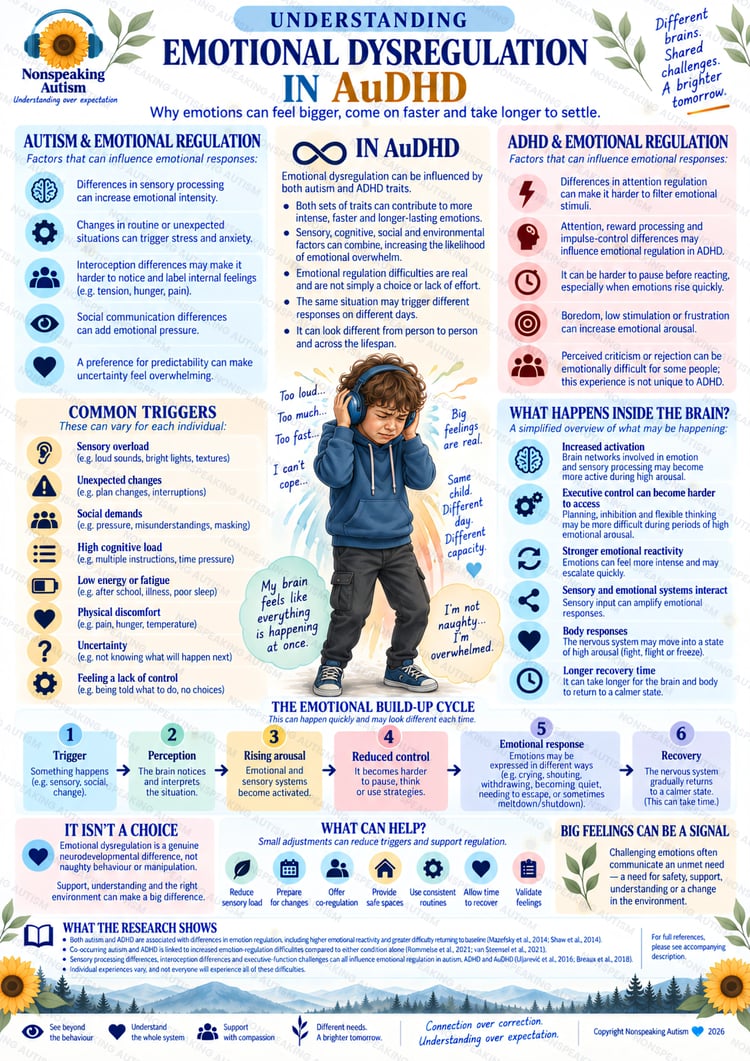
💛 WHAT AUDITORY OVERLOAD MAY LOOK LIKE
A child experiencing difficulty with competing sounds may:
- Cover their ears.
- Become distressed in noisy places.
- Find it difficult to focus on one voice.
- Move away from a busy environment.
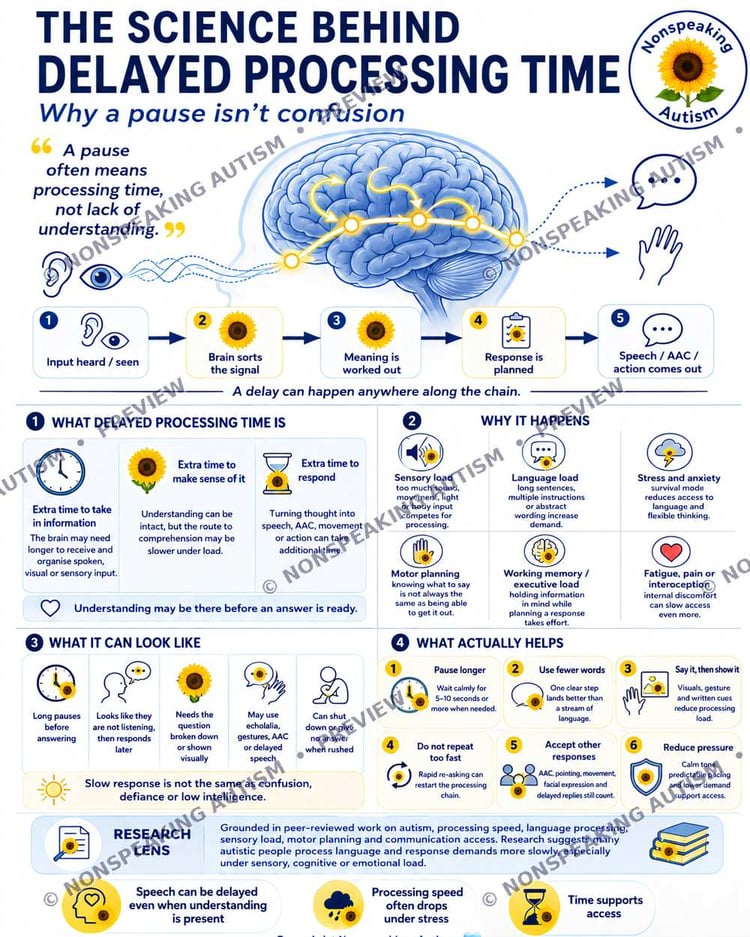
- Need more time to process spoken information.
- Become quieter or less responsive.
- Show signs of fatigue after sound-heavy activities.
Experience meltdown-like or shutdown-like distress.
These are possible signs, not diagnostic indicators.
Similar responses may also occur because of pain, illness, anxiety, communication barriers, hearing difficulties or other unmet needs.
A child who appears to be ignoring an instruction may not have been able to access it clearly in the first place.
Before repeating an instruction more loudly, consider whether the listening environment needs to change.
🌻 A SIMPLE WAY TO UNDERSTAND LISTENING EFFORT
Imagine trying to hear one person clearly while every other sound in the room seems equally noticeable.
You may still hear the speaker.
You may even understand some of their words.
But separating the conversation from everything else may require much more effort.
For some autistic people, noisy environments can create this kind of listening challenge.
This is an educational analogy, not a literal description of how every autistic brain processes sound.
The important question is not simply whether the child can hear. It is whether they can comfortably access and process the information being presented.
🌿 WHAT MAY HELP?
🔇 1. Reduce Background Noise
Where possible:
- Reduce unnecessary conversations during instructions.
- Turn off avoidable background sound.
- Minimise scraping and sudden noises.
- Offer quieter working areas.
- Consider classroom acoustics and seating arrangements.
Reducing competing sounds may improve access without requiring the child to work harder.
🎧 2. Offer Ear Defenders When Needed
Ear defenders may help some children manage noisy environments.
They should be available as an individual accommodation rather than a reward.
Respect the child's preferences and consider situations where hearing important speech, alarms or environmental cues is necessary.
💬 3. Reduce Spoken-Language Demands
When an environment is noisy:
- Use clear, concise instructions.
- Avoid giving several instructions simultaneously.
- Allow additional processing time.
- Support spoken information with visual or written communication.
- Keep AAC available and accessible.
Do not assume a child has understood an instruction simply because they appeared to hear it.
🕒 4. Offer Quiet Recovery Time
Listening effort can be tiring.
A child may benefit from:
- Access to a quiet space.
- Breaks after noisy activities.
- Reduced demands during recovery.
- Opportunities to rest without pressure to explain their distress.
🪑 5. Consider Seating and Positioning
Some children may prefer seating away from noisy doors, corridors, equipment or busy group areas.
Others may benefit from positioning that makes the speaker easier to see and hear.
Ask the individual where possible rather than assuming one arrangement will suit everyone.
📋 6. Use Predictable Routines and Visual Supports
Advance information about potentially noisy events may help some children prepare.
Visual timetables, accessible communication and meaningful choices can reduce uncertainty and improve participation.
The goal is not to make a child tolerate every environment. It is to make environments more accessible.
🏫 WHY THIS MATTERS IN UK SCHOOLS
A noisy classroom can create barriers that are easily mistaken for problems with attention, motivation or behaviour.
A pupil may understand the lesson but struggle to follow spoken instructions while other children are talking.
They may need to leave a busy assembly, wear ear defenders during particular activities or access a quieter space.
These supports should be considered as part of individualised SEND provision and reasonable adjustments where applicable.
Teachers, teaching assistants, SENCOs, families and relevant professionals can work together to identify:
- Which environments are most difficult.
- Whether noise interferes with communication or learning.
- What accommodations the pupil prefers.
- Whether visual or AAC support improves access.
- When recovery time is needed.
- How adjustments can be reviewed without placing unnecessary demands on the child.
A child's communication, participation and wellbeing should matter more than appearing to tolerate a noisy environment.
🔬 RESEARCH-INFORMED: WHAT THE SCIENCE SUGGESTS
Research into autism and auditory processing examines several related but distinct areas.
These include:
Auditory sensitivity: How sounds are detected and experienced.
Auditory filtering: How relevant sound information is selected or prioritised.
Speech-in-noise understanding: How spoken language is recognised when competing sounds are present.
Attention and listening effort: The cognitive resources involved in following auditory information.
Sensory overload: Distress or difficulty coping when environmental and individual demands become too great.
Studies suggest that some autistic individuals experience differences across these areas, but findings vary considerably.
No single auditory filtering mechanism explains every autistic person's experience.
The illustrated brain and coloured auditory pathways on this poster are conceptual artwork, not a medical scan or an anatomically precise map of an individual's auditory processing.
📚 SELECTED RESEARCH AND GUIDANCE
Robertson, C. E., & Baron-Cohen, S. (2017). Sensory perception in autism. Nature Reviews Neuroscience, 18, 671–684.
https://doi.org/10.1038/nrn.2017.112
Ben-Sasson, A., et al. (2019). Update of a meta-analysis of sensory symptoms in ASD: A new decade of research. Journal of Autism and Developmental Disorders, 49, 4974–4996.
https://doi.org/10.1007/s10803-019-04180-0
National Institute for Health and Care Excellence (NICE). Autism spectrum disorder in under 19s: support and management (CG170).
https://www.nice.org.uk/guidance/cg170
Further Resources - National Autistic Society – Autism and sensory processing: https://www.autism.org.uk/advice-and-guidance/about-autism/sensory-processing - Derbyshire Healthcare NHS Foundation Trust – Recommendations for use of Ear Defenders: https://www.derbyshirehealthcareft.nhs.uk/download_file/view/3091/1908 Research & References Sections 1 & 2 – Auditory filtering, sensitivity and overload: - Song, C., Ma, R., Ni, W., Peng, X., Li, X., Shi, R., Zhang, Y., & Li, Y. (2024). Pupillometry reveals hyper-arousal in response to auditory stimuli in autistic children. Journal of Zhejiang University SCIENCE B, 25(11), 996–1008. https://doi.org/10.1631/jzus.B2300462 - Tavassoli, T., Marco, E. J., & Puts, N. (2026). Sensory reactivity in autism: integrating behavioural, affective, physiological, and neural dimensions. Current Psychiatry Reports, 28(1), 36. https://doi.org/10.1007/s11920-026-01682-4 Sections 3 & 4 – Listening effort and focusing on one voice: - Zanin, J., Tomlin, D., & Rance, G. (2024). Effectiveness of noise cancelling earbuds in reducing hearing and auditory attention deficits in children with autism. Journal of Clinical Medicine, 13(16), 4786. https://doi.org/10.3390/jcm13164786 Section 5 – What may help: - Kwong, T. C., Yuan, H.-L., Mung, S. W. Y., Chu, H. K., Lai, Y. Y. C., Chan, C. C. H., et al. (2025). Intervention technology of aural perception controllable headset for children with autism spectrum disorder. Scientific Reports, 15, 5356. https://doi.org/10.1038/s41598-025-89609-6 - Derbyshire Healthcare NHS Foundation Trust (2018). Recommendations for use of Ear Defenders (BL/ER/POT:2018).
in autism. Educational only, not a diagnosis. Song et al. (2024) • Zanin et al. (2024) • Kwong et al. (2025) • Tavassoli et al. (2026)
Research Snapshot Note
The poster also lists Song et al. (2024), Zanin et al. (2024), Kwong et al. (2025) and Tavassoli et al. (2026).
Their full bibliographic details have not been independently verified here. They should be checked before the poster is advertised as having a fully verified reference list.
Evidence Note: This resource explains possible mechanisms and experiences. It does not establish an individual child's auditory processing profile, diagnose a hearing condition or demonstrate that one support strategy will work for everyone.
Sources:
- Song et al. 2024 (PMC)
- Tavassoli et al. 2026 (Crossref)
- Zanin et al. 2024 (MDPI)
- Kwong et al. 2025 (Scientific Reports)
- Derbyshire Healthcare NHS FT – Ear Defenders
- NAS – Sensory processing
👨👩👧 WHO IS THIS RESOURCE FOR?
This poster may be useful for:
- Parents and carers of autistic children
- Autistic children and young people
- Teachers and teaching assistants
- SENCOs and SEND teams
- Mainstream and specialist schools
- Early years practitioners
- Occupational therapists
- Speech and language therapists
- Educational psychologists
- Autism support workers
- Professionals supporting nonspeaking and minimally speaking pupils
It can be used for staff awareness, family discussions, classroom planning, sensory-support conversations and individualised educational support.
📦 WHAT YOU RECEIVE
💙 PAID DIGITAL DOWNLOAD
1 × Why the Autistic Brain May Struggle to Filter Competing Sounds educational poster
The poster includes:
- An illustrated explanation of auditory filtering
- Everyday examples of competing sounds
- Possible reasons noisy environments may feel overwhelming
- Signs of increased listening effort and sensory distress
- A simple listening-effort analogy
- Practical support and environmental adjustments
- An important individual-differences reminder
- A research snapshot
Digital product only. No physical item will be shipped.
The final customer file should be supplied without promotional watermarks.
Print dimensions and resolution should be confirmed against the actual download before advertising it as A2 or 300 DPI.
⚠️ IMPORTANT DISCLAIMER
This resource is for educational and informational purposes only.
It is not a diagnostic tool, audiological assessment, medical treatment, occupational therapy assessment or substitute for individualised professional advice.
Auditory difficulties can have multiple causes. Persistent hearing concerns, ear pain, sudden changes in response to sound or difficulties understanding speech may warrant assessment by an appropriate healthcare professional or audiologist.
Not all autistic people experience auditory filtering difficulties, and no one support strategy is suitable for everyone.
©️ COPYRIGHT & PERMITTED USE
Copyright © 2026 Nonspeaking Autism. All rights reserved.
Permitted for personal, home, classroom, school and individual professional educational use.
Not permitted for resale, redistribution, commercial reproduction, public file sharing, uploading to other platforms or
inclusion in another digital product without written permission.
Please share the Payhip product link rather than distributing the digital file.
🌻 THE MESSAGE BEHIND THE RESOURCE
Sometimes the difficulty is not the instruction.
Sometimes it is everything competing with the instruction.
A child should not have to reach sensory overload before their environment is adjusted.
Reduce the noise. Respect the sensory experience. Support communication and recovery.
💙 Connection over correction. Understanding over expectation.
Nonspeaking Autism © 2026