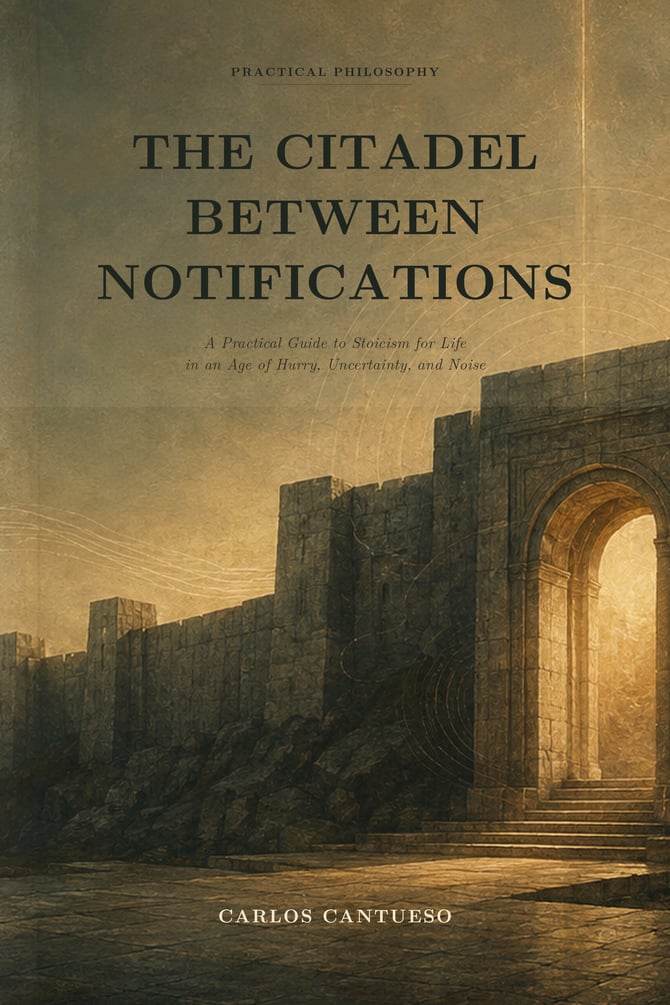
The Citadel Between Notifications
Life now arrives as a stream of alerts, deadlines, comparisons, and demands for an immediate response. We are more connected than ever, yet often less able to direct our own attention, distinguish what depends on us, or act from a stable sense of purpose. The Citadel Between Notifications returns to the ancient Stoics not as museum pieces, but as demanding and practical companions for life in a hyperconnected age.
Drawing on Epictetus, Seneca, and Marcus Aurelius, Carlos Cantueso explains the essential Stoic disciplines: examining the impressions that seek our assent, educating desire around what is truly within our power, and acting justly within the human community. Their insights are brought into conversation with distinctly contemporary pressures: anxiety, digital distraction, professional uncertainty, compulsive comparison, anger, grief, pain, consumerism, ambition, and the hunger for approval.
This is not a manual for emotional numbness, passive resignation, or withdrawal from the world. Stoic serenity is presented as a consequence of clearer judgment and better action, not as an escape from responsibility. Technology is not treated as an enemy, nor is adversity romanticized. The aim is more exacting: to recover the inner freedom from which we can respond intelligently, set humane limits, resist manipulation, and remain useful to others without being governed by every stimulus.
Alongside abundant references to the classical authors, the book offers critical commentary, concrete exercises, journal prompts, a seven-minute daily practice, and a structured thirty-day program. Readers learn to pause between event and verdict, apply the dichotomy of control without self-deception, use the reserve clause, rehearse adversity without catastrophizing, and convert Stoic principles into habits of attention and conduct.
The inner citadel is not a bunker. It is the governed point of return from which a person can meet work, relationships, uncertainty, loss, and public life with greater lucidity, courage, justice, and self-command.

 Save
Save
 Share
Share
 Tweet
Tweet