

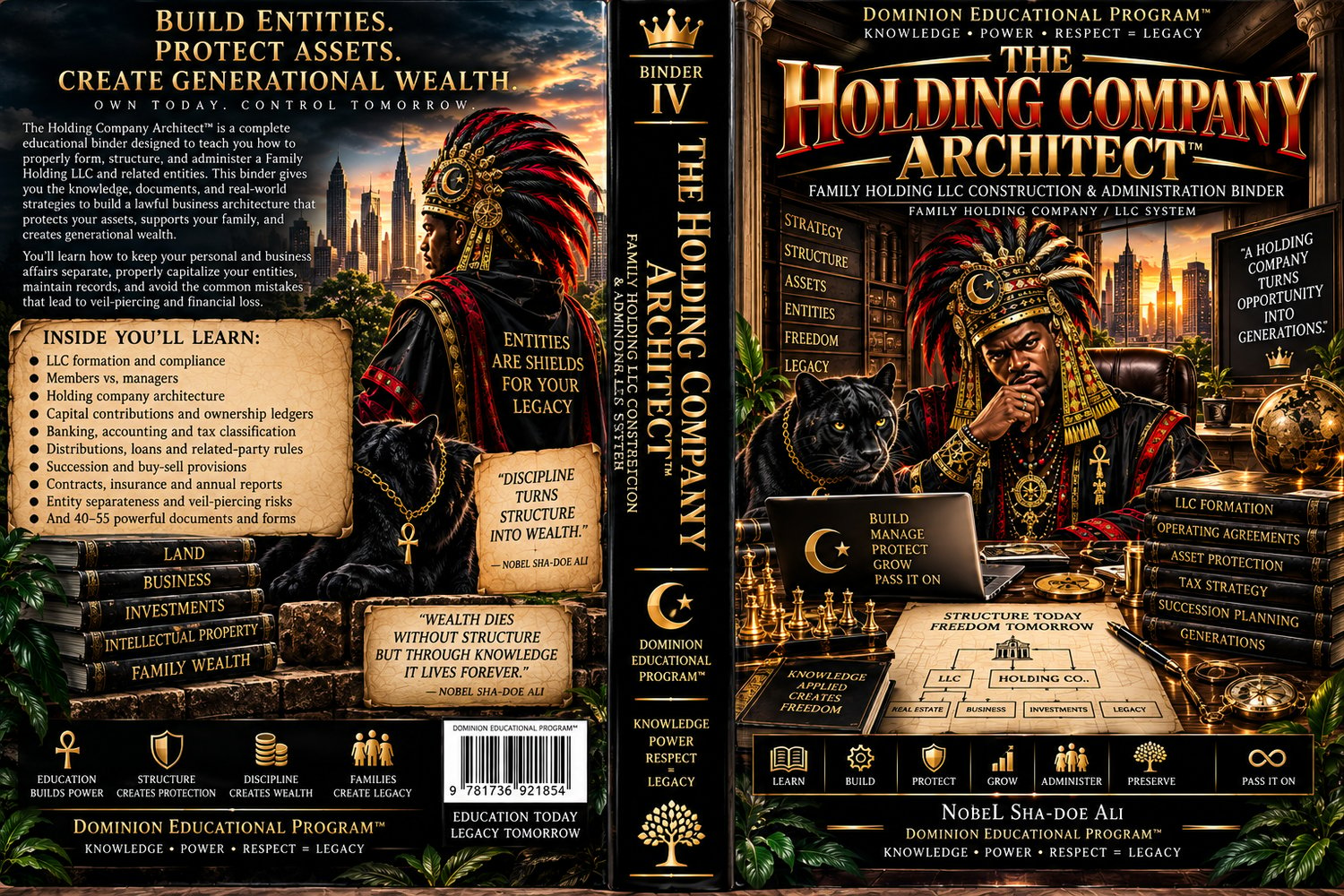
THE HOLDING COMPANY ARCHITECT™
THE HOLDING COMPANY ARCHITECT™
Family Holding LLC Construction & Administration Binder
Binder IV — Dominion Estate Architecture Series™
By NobEL Sha-doe Ali
Build the structure. Respect the structure. Document the structure.
The Holding Company Architect™ teaches students how to construct and operate the ownership layer of a family business and estate architecture using a properly organized Limited Liability Company.
This is not simply an LLC formation guide.
Forming an LLC may take only a few filings. Operating one correctly is the real work.
Students are taught how to move from a newly formed company to an organized system with clearly documented ownership, management, capitalization, banking, accounting, voting, contracts, distributions, loans, related-party transactions, subsidiary interests, succession, and recordkeeping.
What You'll Learn
The binder breaks down members versus managers, including the difference between member-managed and manager-managed LLCs, and teaches students how an operating agreement establishes the company's internal governance subject to applicable state law.
Students study:
LLC Formation • Holding Companies • Operating Agreements • Members & Managers • Capital Contributions • Membership Interests • Ownership Ledgers • Voting • Manager Authority • Banking • Accounting • Expense Reimbursements • Loans • Promissory Notes • Distributions • Related-Party Transactions • Intercompany Agreements • Property-Use Agreements • Intellectual Property • Subsidiaries • Contracts • Tax Classification • Insurance • Transfer Restrictions • Buy-Sell Planning • Succession • Dissolution
A major portion of the binder addresses one of the most misunderstood areas of business structuring:
ENTITY SEPARATENESS & VEIL-PIERCING RISK
Students learn why merely creating several LLCs does not automatically create meaningful separation.
The system examines risk factors involving commingling personal and company money, undocumented transactions, weak accounting records, personal use of company accounts, related-party transactions, misleading creditors, sham transactions, improper signatures, undocumented loans and distributions, and failure to maintain clear ownership and operational records.
Because veil-piercing and alter-ego doctrines are heavily dependent upon state law and specific facts, the binder does not pretend there is one nationwide checklist that guarantees liability protection. Instead, students are taught how to locate and analyze their jurisdiction's actual LLC statutes and controlling cases.
The Holding-Company Architecture
Students learn to distinguish between:
THE FAMILY / OWNERS
↓
FAMILY HOLDING LLC
↓
OPERATING LLCs / SUBSIDIARIES
↓
BUSINESS • PROPERTY • INTELLECTUAL PROPERTY • INVESTMENTS
The objective is not to create entities merely because a complicated organizational chart looks impressive.
Every entity must have a job.
Students learn to ask:
What does this company own?
Who owns the company?
Who manages it?
Who can sign contracts?
How was it capitalized?
How does money enter and leave?
How is the transaction recorded?
How is it taxed?
Who succeeds the manager?
What happens to the ownership interest when an owner dies?
Federal Tax Classification
The binder also teaches an essential distinction:
AN LLC'S LEGAL FORM IS NOT THE SAME AS ITS FEDERAL TAX CLASSIFICATION.
Students are introduced to the federal framework under which an LLC may be treated as a disregarded entity, partnership, C corporation, or—when eligibility requirements are satisfied and the proper election is made—S corporation.
That distinction helps prevent one of the biggest mistakes in entity education: assuming that simply creating an LLC determines exactly how the business will be taxed.
52-Document Company Record System
The book contains a comprehensive 52-document educational vault, including models and working tools for:
Formation • Articles/Certificate Research • Organizational Consent • Operating Agreement Construction • Manager Appointment • Authorized Signers • Membership Ledgers • Capital Contributions • EIN Preparation • Banking • Accounting Policies • Expense Reimbursements • Conflict Disclosures • Related-Party Transactions • Loans • Promissory Notes • Intercompany Agreements • Property Use • Distributions • Annual Compliance • Entity-Separateness Audits • Transfer Restrictions • Buy-Sell Planning • Succession • Dissolution
Students are taught not merely what document to use, but:
why it exists, who has authority to execute it, what evidence should support it, how it should be recorded, what tax questions it may create, and where it belongs in the company record system.
The Dominion Transaction Gate™
Before money, property, debt, ownership, services, or intellectual property moves between a family member, holding company, subsidiary, trust, or related entity, students learn to identify:
OWNERSHIP → AUTHORITY → TRANSACTION TYPE → VALUE → TAX → CONFLICT → BANK TRAIL → ACCOUNTING → DOCUMENTATION → PROOF
The purpose is simple:
DON'T JUST CREATE AN LLC. LEARN HOW TO OPERATE ONE.
THE HOLDING COMPANY ARCHITECT™ is designed to transform the LLC from a piece of paper filed with the state into a documented, administered, understandable ownership system capable of supporting business operations, family succession, and long-term estate architecture.
DOMINION EDUCATIONAL PROGRAM™
Knowledge • Power • Respect = Legacy