




OTH Discharge Upgrade
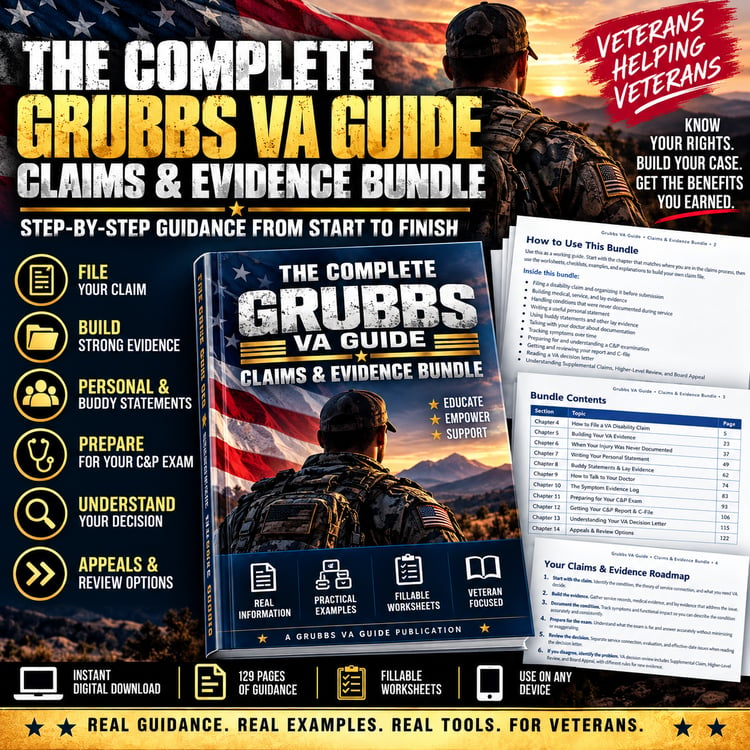
Grubbs VA Guide: The Complete OTH Discharge Upgrade & VA Benefits Series
Your past does not have to define your future. Understand your options, build your evidence, and take the next step toward a stronger future.
An Other Than Honorable (OTH) discharge can leave veterans with difficult questions about their military records, VA benefits, health care, education opportunities, and future options. If you received an OTH discharge, you may be wondering whether you can qualify for VA benefits, request a discharge upgrade, or have your military service record reviewed.
The Grubbs VA Guide OTH Discharge Upgrade Series was created to help veterans understand these complicated processes in clear, practical, easy-to-follow language.
This educational series breaks down the difference between a military discharge upgrade and a VA Character of Discharge (COD) review, explains how to identify the appropriate process, and walks you through the evidence and preparation that may support your case.
You do not have to navigate the process blindly. The first step is understanding your options.
🇺🇸 WHAT YOU WILL LEARN
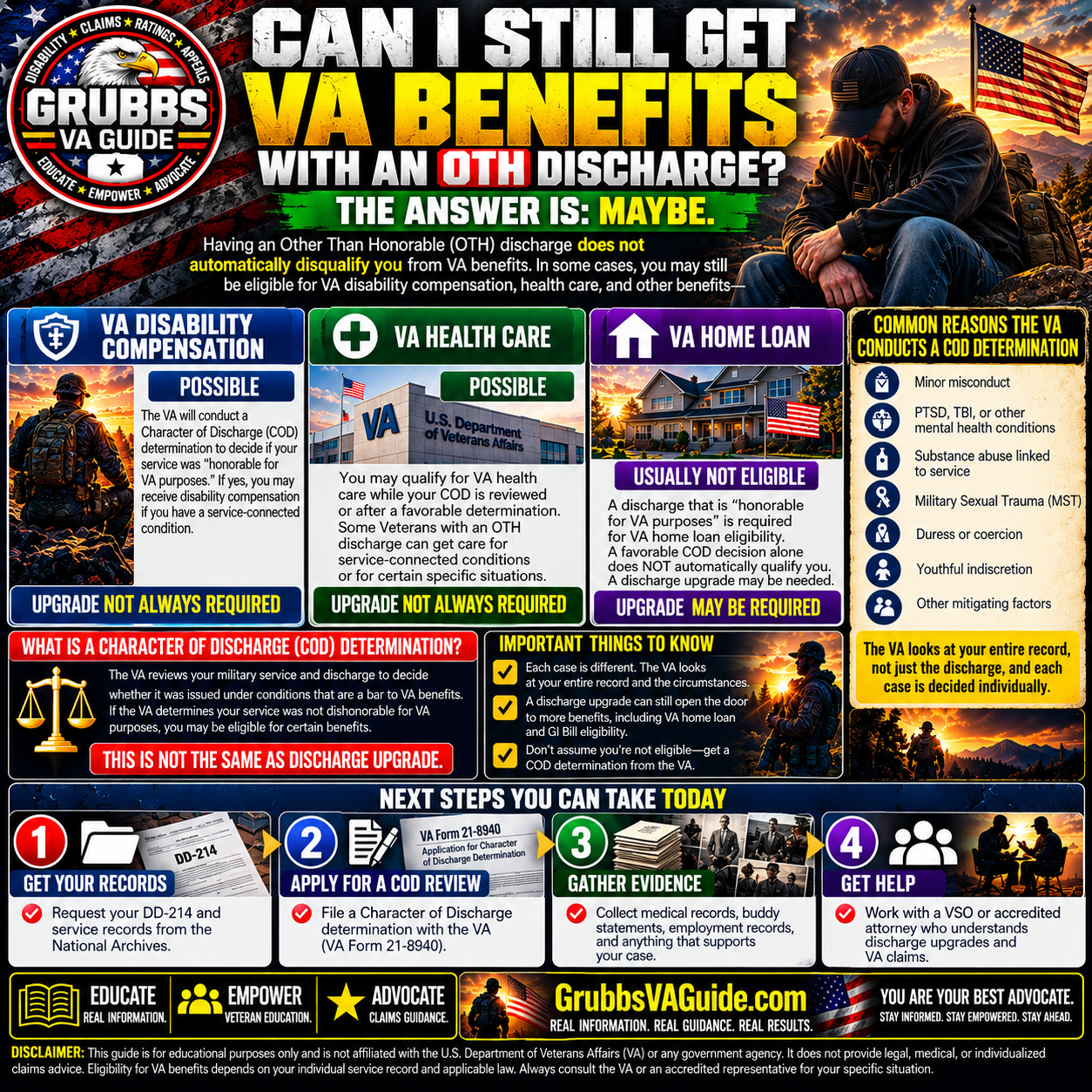
1. Can You Still Receive VA Benefits With an OTH Discharge?
Learn why an OTH discharge does not automatically mean that every VA benefit is permanently out of reach. Understand the VA's Character of Discharge process, why the circumstances surrounding your service and separation matter, and how the VA determines whether your service meets the requirements for particular benefits.
Discover why veterans should not assume they are ineligible without understanding their individual circumstances and applicable VA rules.
2. How to Request a Character of Discharge Review
Understand the purpose of a VA Character of Discharge review and how it differs from a military discharge upgrade.
Learn what the VA may consider, what records and evidence may be relevant, and how a COD determination can affect eligibility for certain VA benefits.
Important distinction: A favorable COD decision does not change your military discharge characterization or automatically make you eligible for every VA benefit.
3. How to Apply for a Military Discharge Upgrade
Explore the general discharge-upgrade process and learn why choosing the correct military review board matters.
The series introduces the role of Discharge Review Boards (DRBs) and Boards for Correction of Military Records (BCMRs), including the Navy and Marine Corps Board for Correction of Naval Records (BCNR).
Learn how to identify the relief you are requesting, locate the appropriate application instructions, gather relevant documents, and prepare an organized submission.
4. PTSD, TBI, MST, and Other Mitigating Circumstances
Understand why evidence of mental health conditions, traumatic brain injury, military sexual trauma, substance-use disorders, trauma, or other relevant circumstances may matter in certain discharge review cases.
Learn how to organize medical records, treatment history, service records, and personal statements to explain the connection between relevant circumstances and the events that led to your discharge.
The goal is to help you understand how to present documented facts and mitigating circumstances—not to assume that a diagnosis automatically qualifies you for an upgrade.
5. Free Organizations That Help Veterans
Learn where to begin looking for assistance without immediately paying a private company.
Explore potential sources of help, including Veterans Service Organizations (VSOs), state and county veterans offices, recognized nonprofit organizations, and other qualified representatives.
Understand what to ask before accepting assistance, how to verify an organization's role, and why you should be cautious of anyone promising a guaranteed result.
6. Common Myths About OTH Discharges
Separate common misconceptions from the actual review processes.
Learn why an OTH discharge does not automatically establish eligibility for every VA benefit, why a COD review is not the same as an upgrade, and why each veteran's circumstances must be evaluated individually.
This section helps you approach the process with realistic expectations and a better understanding of your available options.
7. DRB vs. BCMR/BCNR: Which Board Should You Contact?
Understand the basic differences between a Discharge Review Board and a Board for Correction of Military Records.
Learn about the general 15-year DRB application window, why correction boards may be relevant in other circumstances, and why branch-specific rules, deadlines, jurisdiction, and exceptions must be checked before filing.
Choosing the correct process can help you avoid preventable application mistakes.
8. How to Build a Strong Discharge Upgrade Evidence Package
Evidence can be an important part of explaining your circumstances and supporting the relief you request.
Learn how to organize potentially relevant materials, including:
- Military personnel and disciplinary records.
- Medical and mental health documentation.
- Personal statements explaining your experiences and circumstances.
- Buddy statements and character references.
- Evidence of rehabilitation, treatment, education, employment, and post-service conduct.
- Documentation of mitigating circumstances and relevant service history.
The guide emphasizes organization, accuracy, consistency, and making sure your evidence addresses the specific issues involved in your case.
9. How to Write a Powerful Personal Statement
Learn how to structure a personal statement that explains your military service, the circumstances surrounding your discharge, relevant mitigating factors, accountability where appropriate, and the steps you have taken since leaving service.
The series provides a practical framework for organizing your thoughts, using specific examples, and explaining why you believe the requested relief is warranted.
Your statement should reflect your own experiences and be truthful, specific, and consistent with the available evidence.
10. What If Your Discharge Upgrade Is Denied?
A denial can be discouraging, but it does not always mean every possible avenue has been exhausted.
Learn how to read the decision, identify the board's reasons, determine whether additional evidence may address those concerns, and investigate whether reconsideration, another appropriate review process, or qualified assistance may be available.
The next step depends on the decision, applicable procedures, deadlines, and your individual circumstances.
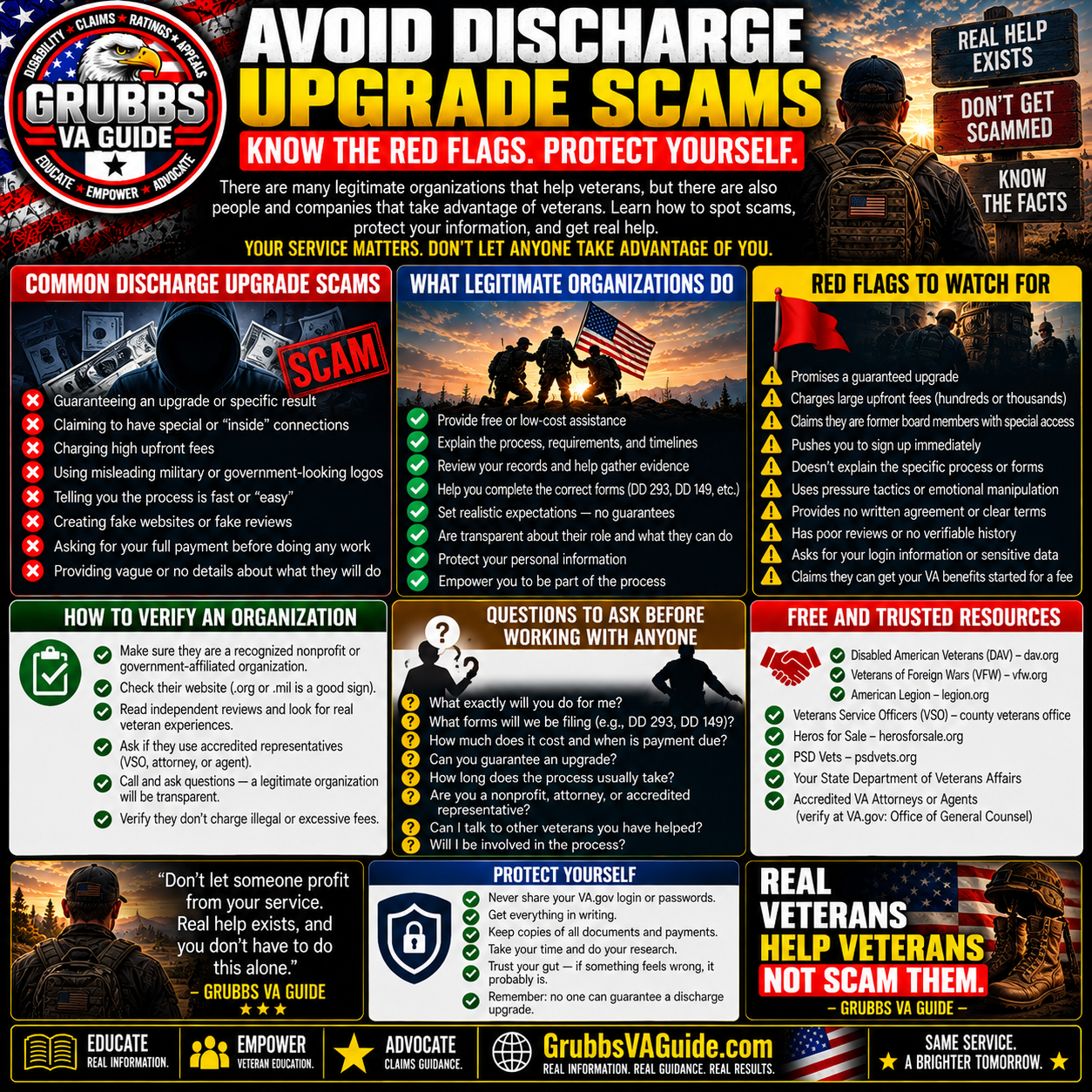
11. How to Avoid Discharge Upgrade Scams
Veterans deserve honest information and transparent assistance.
Learn to recognize warning signs such as guaranteed upgrades, pressure tactics, misleading claims of special connections, unclear fees, and requests for sensitive information without a legitimate reason.
Discover ways to verify organizations and representatives, protect your personal information, and find legitimate resources before paying for assistance.
12. Your OTH Action Plan
Bring the information together into a practical starting roadmap.
Learn how to:
1. Review your DD-214 and discharge information.
2. Request relevant military and medical records.
3. Identify whether a COD review, discharge upgrade, or another process may fit your goal.
4. Gather and organize supporting evidence.
5. Prepare the appropriate application and personal statement.
6. Submit your materials according to the applicable instructions.
7. Track correspondence and respond to requests.
8. Review the decision and understand possible next steps.
The objective is to help you move from confusion toward an organized, informed plan.
13. What to Do After an Upgrade or COD Decision
Understand the steps that may follow a favorable decision and why different decisions can have different effects.
Learn why an approved discharge upgrade may change your military records, while a favorable COD determination concerns VA benefit eligibility and does not itself change your DD-214.
Explore the importance of retaining decision letters, checking updated records, contacting the appropriate VA office, and applying separately for benefits when required.
The series also explains why eligibility for education, health care, disability compensation, home loans, and other programs depends on the rules applicable to each benefit.
🎯 WHO IS THIS SERIES FOR?
This series may be useful for:
- Veterans who received an Other Than Honorable discharge.
- Former service members trying to understand possible VA benefit eligibility.
- Veterans considering a discharge upgrade.
- Veterans unsure whether to pursue a DRB, BCMR, or BCNR application.
- Veterans gathering records, medical documentation, or supporting statements.
- Veterans who have received a denial and want to understand possible next steps.
- Family members who want to help a veteran research options and organize documentation.
- Anyone looking for an accessible introduction to the relationship between military discharge reviews and VA benefit eligibility.
💪 WHY GRUBBS VA GUIDE?
Military records, VA regulations, and discharge review procedures can be difficult to understand. This series is designed to break the information into manageable steps, explain important distinctions, and help veterans prepare more effectively.
Inside the series, you will find:
- Clear, organized educational explanations.
- Step-by-step process overviews.
- Evidence-gathering guidance.
- Personal statement preparation tips.
- Practical checklists and action steps.
- Explanations of important differences between review processes.
- Guidance for identifying free and reputable sources of assistance.
- Reminders about deadlines, documentation, and case-specific requirements.
The mission of Grubbs VA Guide is simple:
Educate. Empower. Advocate.
Every veteran deserves access to understandable information about the processes that may affect their future.
🚀 TAKE THE FIRST STEP
You cannot change the past, but you can take informed steps to understand your records, explore your options, and prepare your case.
Start by learning the rules that apply to your circumstances, obtaining the relevant records, and identifying the appropriate review process. Build your evidence carefully, ask questions, and seek qualified assistance when necessary.
Your discharge does not tell your entire story. Your service, circumstances, personal growth, and documented evidence may all be relevant to understanding your options.
Visit "GrubbsVAGuide.com" (https://GrubbsVAGuide.com) for more veteran-focused information, resources, and educational guides.
Follow Grubbs VA Guide on Facebook and Instagram for additional educational content, updates, and practical guidance.
GRUBBS VA GUIDE — REAL INFORMATION. REAL GUIDANCE. REAL RESULTS.
Important disclaimer: This series is for educational and informational purposes only. It is not legal advice and does not guarantee a discharge upgrade, a favorable Character of Discharge determination, or eligibility for any VA benefit. Military review boards and VA benefit programs apply different rules. Procedures, deadlines, forms, and eligibility requirements vary by branch, case, and benefit. Always verify current requirements through official government resources or a qualified representative before filing.