
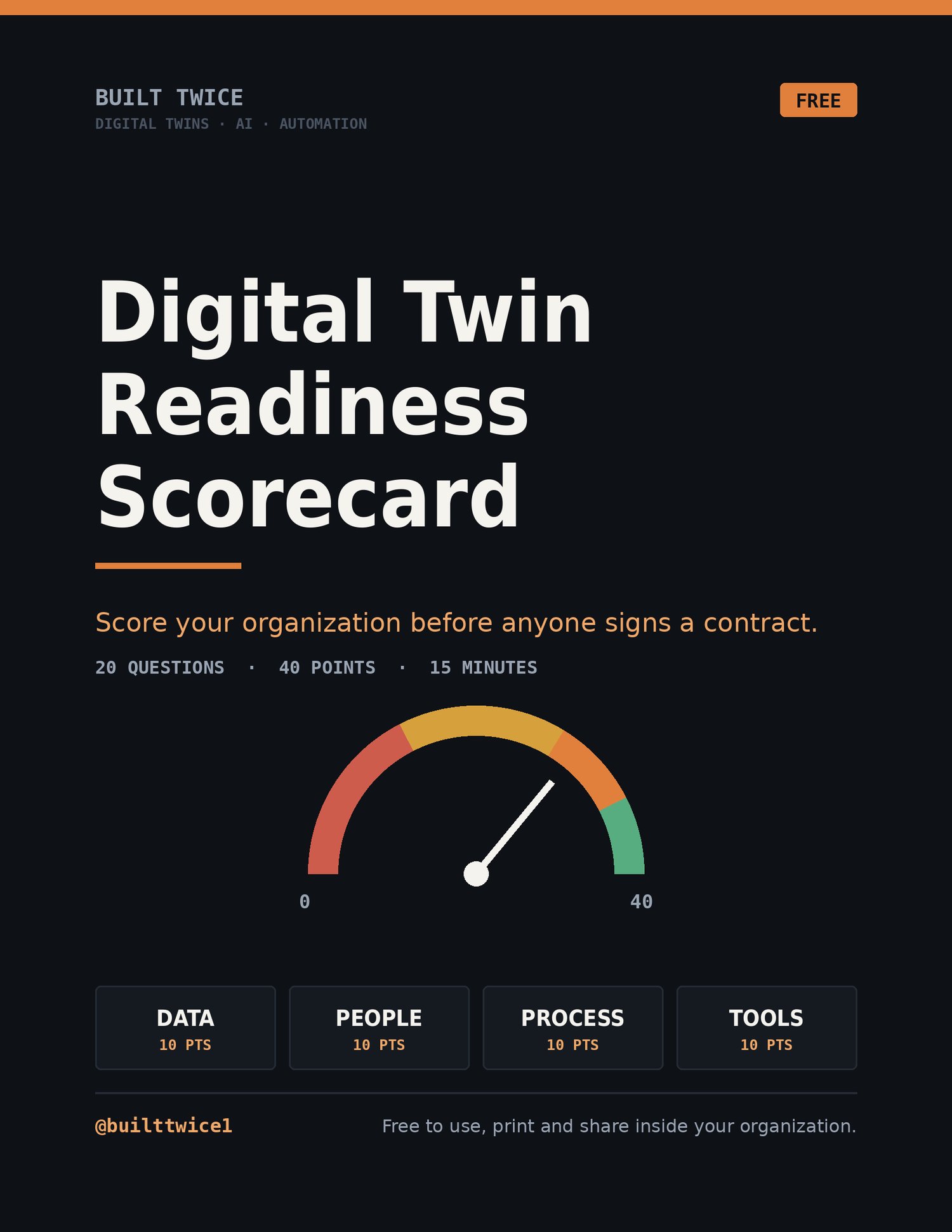
Digital Twin Readiness Scorecard
Most digital twin projects fail before anyone writes a line of code.
Not because the technology is bad. Because the organization buying it couldn't answer basic questions about its own data, and nobody checked first.
This scorecard is that check. Twenty questions across four dimensions, scored honestly, in about fifteen minutes.
The four dimensions
- Data — whether the information a twin would run on actually exists, and whether anyone can find it
- People — whether anyone owns this, and whether the people who'd use it are ready
- Process — whether the way you work would feed a twin, or fight it
- Tools and systems — whether what you already own can carry this, and whether your data stays yours
Why this one is different
Every question has three written descriptions — what a 2 looks like, what a 1 looks like, what a 0 looks like. So when two people score it separately, they land on the same number instead of arguing about what "mostly" means. Where they do disagree, that gap is usually the real finding.
What you get with your score
Four score bands, each with a specific first action. Not "improve your data maturity" — an actual next move, appropriate to where you landed. A low score isn't a failing grade; it means the money is better spent somewhere cheaper first, and the scorecard tells you where.
It closes with a page for writing down your three lowest-scoring questions. Those are your first three pieces of work, in order, and they're almost always cheaper than the software you were about to buy.
Who it's for
Building owners, developers, asset managers, facility directors, plant managers and operations leads. Written to work for hospitals, schools, offices, data centres, factories, utilities and campuses.
No modelling experience needed. No software required. No vendor is named, recommended, or paid for a mention.
What's in the download
9-page PDF plus an editable Word version, so you can add your own questions or drop the ones that don't apply. Print it, fill it in, argue about it with your team.
Why it's free
Because the people who most need to run this check are usually the ones with no budget to ask anyone. Use it, share it inside your organization, adapt it. If it saves you from one bad purchase, that's the whole point.