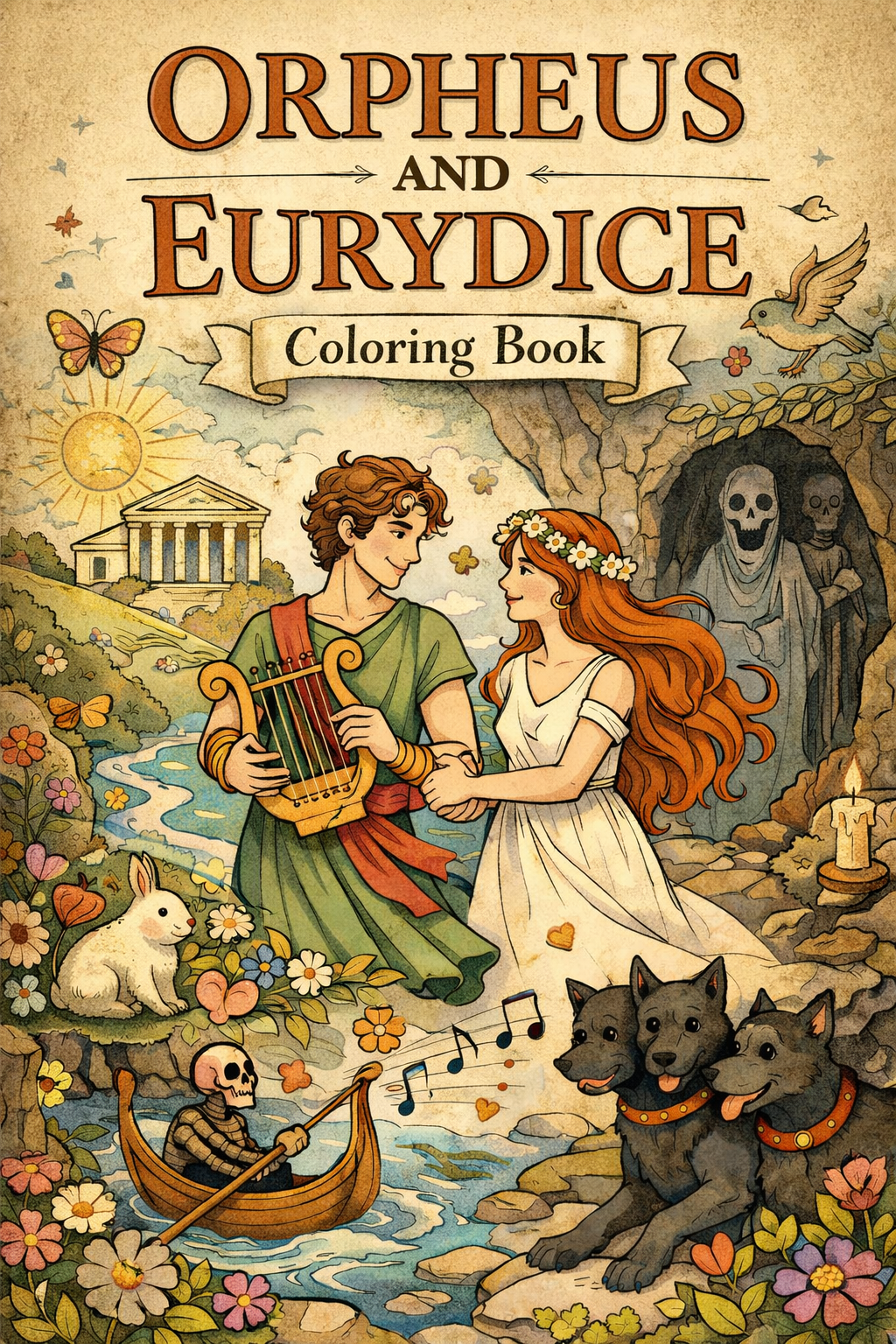
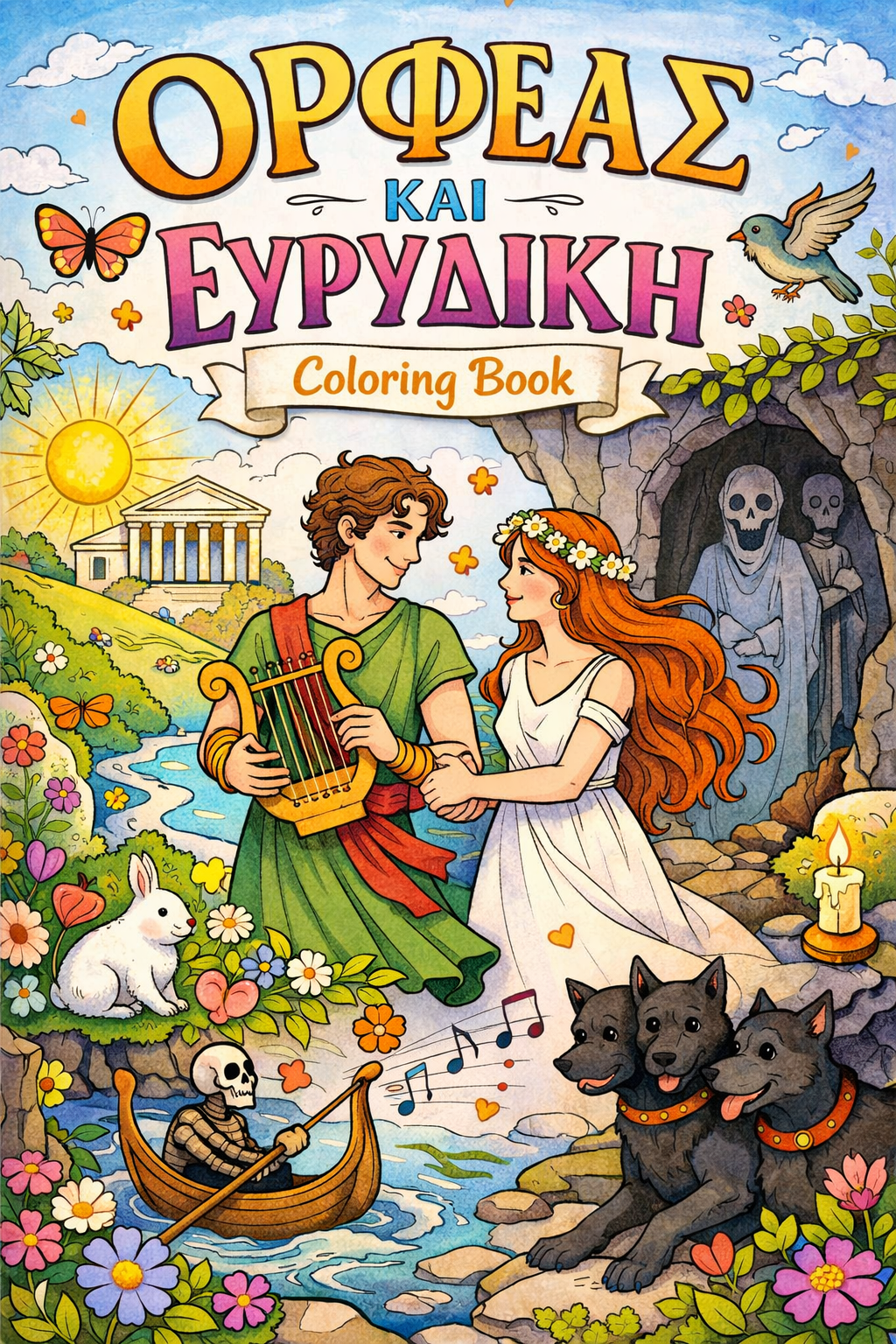
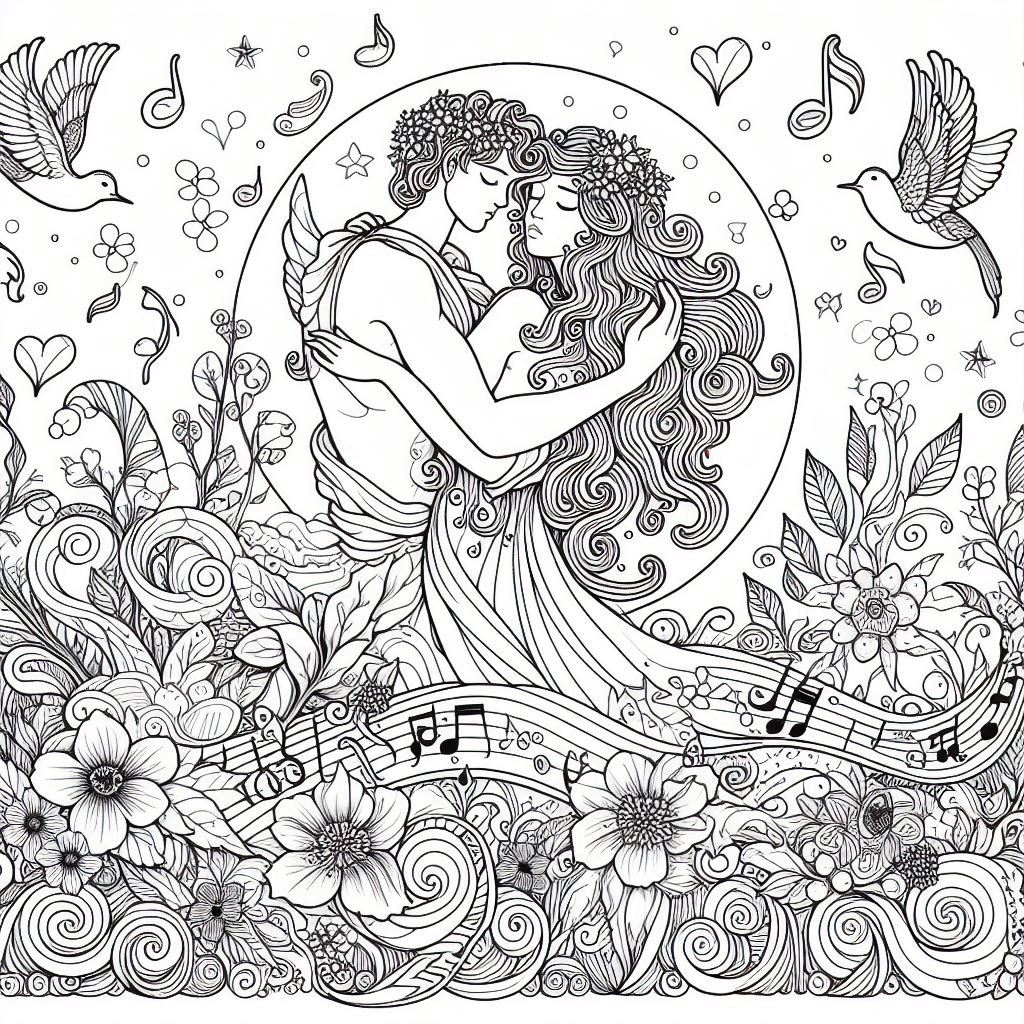




Orpheus and Eurydice, 64 designs, coloring ebook, digital printable product, instantly download
Orpheus and Eurydice, 64 designs, coloring ebook, digital printable product, instantly download.
Orpheus and Eurydice: The Myth of Love, Art, and the Limits of Hope
The myth of Orpheus and Eurydice is one of the most poignant and enduring love stories of Greek mythology. It is a tale that unites music and magic, devotion and loss, hope and tragic human weakness. For more than two millennia, poets, philosophers, painters, composers, and filmmakers have returned to this story, finding in it a timeless meditation on love, death, and the power—and limits—of art.
At its heart, the myth asks a haunting question: Can love overcome death? And if not, what remains when hope fails?
Orpheus: The Divine Musician
Orpheus was no ordinary mortal. According to myth, he was the son of Apollo, god of music, poetry, and prophecy, and Calliope, the Muse of epic poetry. From his divine heritage, Orpheus inherited a gift beyond compare: his music could enchant all creation.
When Orpheus played his lyre, trees bent their branches to listen, rivers slowed their flow, wild beasts grew gentle, and stones themselves were said to move closer to his song. His music was not mere entertainment—it was a cosmic force that restored harmony to the world.
In ancient Greek thought, music was deeply connected to order, the soul, and the structure of the universe. Orpheus embodied this belief: he was art made flesh.
Eurydice: The Beloved and the Loss
Eurydice, a beautiful nymph, became the great love of Orpheus’s life. Their marriage was joyful, blessed by song and celebration. Yet, like many Greek myths, happiness was fragile and short-lived.
Shortly after their wedding, Eurydice was wandering through a meadow when she was pursued—by Aristaeus in some versions of the myth. As she fled, she stepped on a venomous snake, which bit her heel. The poison worked swiftly, and Eurydice died, descending into the shadowy realm of the Underworld.
For Orpheus, her death was unbearable. His grief echoed through mountains and valleys as he sang laments so sorrowful that even the gods were moved.
The Descent into the Underworld
Unwilling to accept Eurydice’s fate, Orpheus made an unprecedented decision: he would descend alive into the Underworld to reclaim her.
This journey alone marks Orpheus as extraordinary. The Underworld, ruled by Hades and Persephone, was a realm from which no mortal was meant to return. It was guarded by monsters, shadows, and divine laws that could not be broken lightly.
Yet Orpheus carried with him his lyre.
As he played, miracles occurred:
Cerberus, the three-headed hound guarding the gates, lay down and slept.
The tormented souls paused their suffering to listen.
The Furies, spirits of vengeance, wept.
Even the relentless wheel of Ixion slowed.
For the first time, the Underworld knew beauty.
The Bargain of the Gods
At last, Orpheus stood before Hades and Persephone. He did not argue with logic or force. He sang.
His song told of love stronger than death, of a heart torn in two, of a life rendered meaningless without its other half. Persephone, queen of the dead and goddess of spring, was moved to compassion. Even Hades, stern and unyielding, was touched.
They granted Orpheus a single chance.
Eurydice would be allowed to return to the world of the living on one condition:
Orpheus must walk ahead of her and not look back until they had both reached the upper world. If he turned, even once, she would be lost forever.
This condition was not cruelty—it was a test of faith.
The Fatal Glance
Orpheus began the ascent, leading Eurydice through the dark passageways toward the light of the living world. He could hear her footsteps faintly behind him, but he could not see her. Doubt crept into his heart.
Was she truly there?
Were the gods deceiving him?
Had he imagined the sound?
Just as he reached the threshold of daylight, fear overcame trust. Orpheus turned his head.
For a brief moment, he saw Eurydice—reaching for him, her face filled with love and sorrow. Then she faded back into the shadows, whispering a final farewell.
This time, there was no second chance.
Orpheus After Eurydice
Devastated beyond measure, Orpheus returned to the world alone. He rejected the love of others and wandered in solitude, singing songs of mourning that haunted forests and hillsides.
In some versions of the myth, Orpheus is eventually torn apart by Maenads, followers of Dionysus, enraged by his rejection of earthly passion. Even then, legend says his severed head continued to sing as it floated down the river Hebrus, and his lyre was placed among the stars as the constellation Lyra.
Art survived where life could not.
Symbolism and Interpretation
The myth of Orpheus and Eurydice is rich with layers of meaning:
Love and Loss
At its core, the story is about the pain of losing a beloved and the desperate human desire to reverse death itself.
Art Versus Death
Orpheus’s music can soften hell but cannot ultimately conquer it. Art consoles, elevates, and gives meaning—but it cannot abolish mortality.
Faith and Doubt
The fatal glance backward symbolizes human weakness. Orpheus fails not because he lacks love, but because he lacks absolute trust.
The Human Condition
Greek myths often show that even the greatest gifts do not free humans from tragedy. Orpheus is nearly divine, yet painfully human.
Orpheus and Eurydice in Culture
This myth has inspired countless works:
Virgil and Ovid gave the most famous literary versions.
Monteverdi’s opera L’Orfeo (1607) is one of the earliest masterpieces of opera.
Gluck, Rilke, Cocteau, and modern filmmakers and musicians have all reimagined the story.
Contemporary interpretations often explore themes of memory, trauma, and artistic obsession.
Each retelling asks anew: Was Orpheus wrong to look back—or was that moment the most human act of all?
Conclusion: A Love That Echoes Forever
The myth of Orpheus and Eurydice endures because it reflects something deeply human: the longing to hold onto love even when loss is inevitable. Orpheus teaches us that beauty can reach the darkest places, that art can soften even death’s domain—but also that some boundaries cannot be crossed.
And yet, perhaps the true immortality of Eurydice is not her return to life, but her survival in song, story, and memory.
As long as Orpheus sings, Eurydice is never entirely lost.