

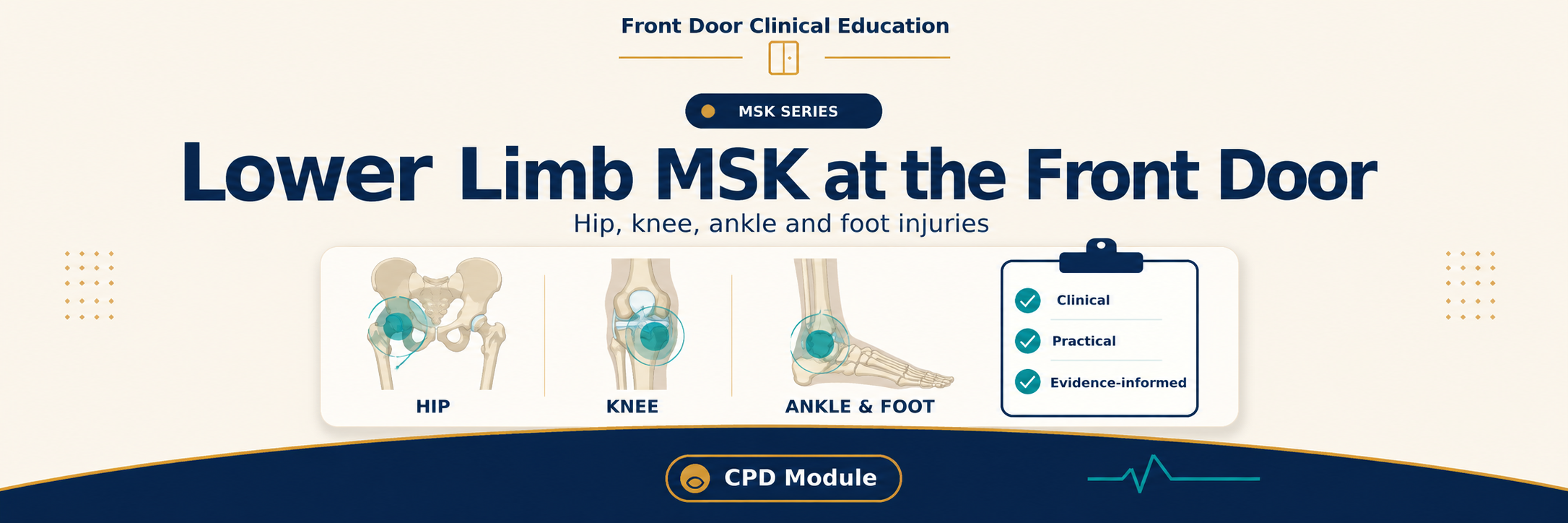
Lower Limb MSK at the Front Door
Assess lower limb injuries with greater structure, confidence and clinical reasoning
Lower limb musculoskeletal presentations are common across urgent care, emergency care, primary care, minor injuries and front-door assessment — but deciding who needs imaging, who can safely be managed conservatively and which apparently minor injuries need closer attention is not always straightforward.
Lower Limb MSK at the Front Door is a focused clinical education module designed to help clinicians develop a practical and structured approach to assessing common lower limb presentations.
Rather than simply focusing on whether an X-ray shows a fracture, this course considers the whole assessment: mechanism, examination, clinical decision rules, imaging, commonly missed injuries, management, documentation and safety-netting.
The emphasis throughout is on applying clinical reasoning to the patient in front of you.
Who is this course for?
This module is suitable for clinicians working in:
- Urgent Treatment Centres
- Emergency Departments
- Minor Injury Units
- Primary Care
- Out-of-hours services
- Ambulance and community services
- Same Day Emergency Care
- Other front-door assessment environments
It may be particularly useful for paramedics, ACPs, ANPs, nurses and other clinicians who assess patients with acute musculoskeletal presentations.
What will you learn?
By the end of this module, you should be able to:
- Apply a structured approach to lower limb MSK assessment
- Use mechanism of injury to guide your differential diagnosis
- Perform a focused and clinically useful examination
- Recognise important red flags and must-not-miss presentations
- Identify commonly missed lower limb injuries
- Apply appropriate clinical decision rules
- Make more considered imaging decisions
- Develop an appropriate initial management plan
- Provide clear and effective safety-netting
- Document lower limb MSK assessments more effectively
What does the course cover?
The module takes a practical front-door approach to lower limb assessment, including:
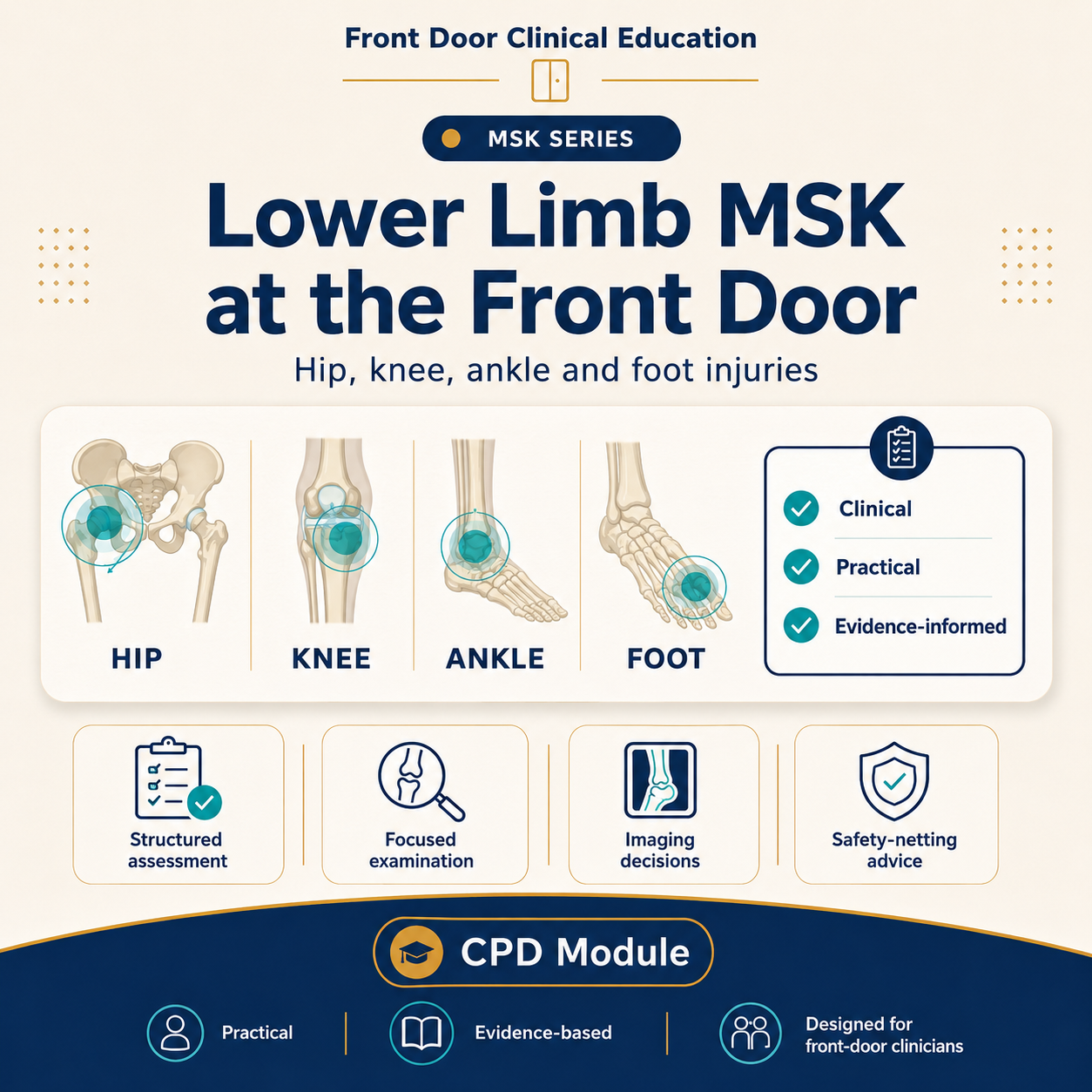
- Hip and proximal femur presentations
- Knee injuries
- Tibia and fibula injuries
- Ankle injuries
- Foot injuries
- Mechanism-based assessment
- Neurovascular assessment
- Ottawa decision rules
- Imaging considerations
- Commonly missed fractures and soft tissue injuries
- Red flags
- Initial management
- Documentation
- Discharge advice and safety-netting
Practical CPD for real clinical practice
This isn't designed to turn every clinician into an orthopaedic specialist.
It is designed to make the first assessment safer, more systematic and more clinically useful.
The focus is on the decisions clinicians regularly have to make at the front door:
What could this be?
What do I need to examine?
Does this patient need imaging?
What must I not miss?
Can I safely discharge them?
What should I tell them to come back for?
Included with the course
Your purchase includes:
- Full recorded teaching module
- Downloadable supporting resources
- Practical clinical assessment tools
- Knowledge-check questions
- Certificate of completion
Learn at your own pace and revisit the material whenever you need a refresher.
Part of the MSK at the Front Door Series
This module forms part of the MSK at the Front Door series from Front Door Clinical Education.
The series takes a practical approach to common musculoskeletal presentations, helping clinicians combine mechanism, examination, imaging decisions and clinical reasoning rather than relying on radiology alone.
Clinical education. Made for the front door.