
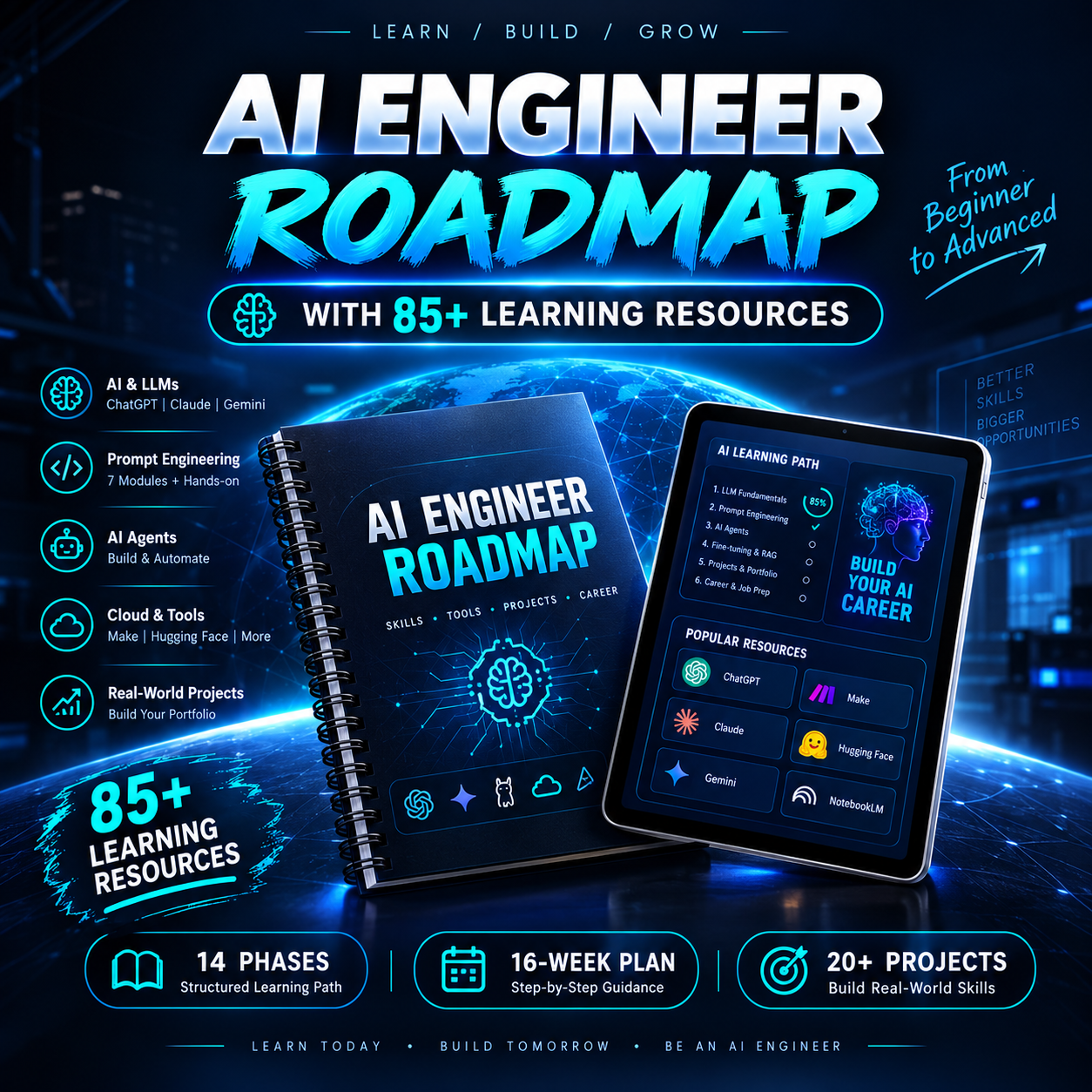
AI Engineer Roadmap with Learning Resources
AI Engineer Roadmap: From Python to AI Agents
The Complete 16-Week Learning Plan + AI Learning Resources + AI Agents Resource Vault
Stop collecting random tutorials. Start learning with a clear plan.
Learn how modern AI applications are built—from programming foundations and LLM APIs to embeddings, vector databases, Retrieval-Augmented Generation (RAG), AI agents, evaluation, security, and deployment.
The AI Engineer Roadmap is a practical, code-first learning bundle designed to help you organize your learning, build meaningful projects, and develop a portfolio that demonstrates your technical skills.
Instead of jumping between disconnected tutorials, you'll have a structured curriculum, hands-on project specifications, progress checklists, and curated resources to guide your next steps.
What Makes This Bundle Different?
Learning AI can feel overwhelming. New frameworks appear constantly, tutorials cover different topics, and building a basic chatbot is only the beginning.
Real-world AI applications require more than connecting an API to a user interface. You also need to understand retrieval quality, structured outputs, token costs, latency, tool permissions, evaluation, security, and deployment.
This bundle brings the learning path and supporting resources together in one organized place.
You'll get:
- A 29-page AI Engineer Roadmap PDF with 14 structured learning phases and a 16-week plan.
- A 3-page AI Learning Resources PDF featuring 25 curated tracks covering courses, video playlists, frameworks, and engineering tools.
- An editable AI Agents Resource Vault DOCX containing 62 curated links to videos, GitHub repositories, industry guides, books, research papers, courses, and newsletters.
The goal isn't to promise instant expertise. It's to help you study with direction, practice deliberately, and build projects you can explain and demonstrate.
Inside the 14-Phase AI Engineering Roadmap
Phase 0 — Prerequisites & Setup | Weeks 1–2
Prepare your development environment and review Python or JavaScript/TypeScript fundamentals, HTTP/REST, JSON, Git, environment variables, and basic data handling.
Practice: Build a command-line public API tool and a small REST API.
Phase 1 — AI Engineering Foundations | Weeks 2–3
Understand transformers, attention, tokens, context windows, temperature, knowledge cutoffs, and why language models can hallucinate.
Practice: Create a plain-English LLM explainer and a personal technical glossary.
Phase 2 — Pre-Trained Models & Providers | Week 3
Explore model providers and compare capabilities, latency, costs, privacy considerations, and suitable use cases.
Practice: Build a structured comparison sheet using prompts across multiple providers.
Phase 3 — Working with LLM APIs | Weeks 3–4
Study API requests, streaming responses, token estimation, validated JSON outputs, retries, and error handling.
Practice: Build a streaming chatbot with cost tracking and a validated text summarizer.
Phase 4 — Prompt Engineering | Weeks 4–5
Learn system instructions, prompt templates, zero-shot and few-shot approaches, prompt chaining, and failure logging.
Practice: Create a versioned prompt library and test it against edge cases.
Phase 5 — AI Safety, Security & Ethics | Week 5
Explore prompt injection, jailbreaks, sensitive-data leakage, layered guardrails, moderation, least-privilege tools, and compliance awareness.
Practice: Prepare a red-team report documenting attacks, risks, and possible mitigations.
Phase 6 — Open-Source Models & Local Inference | Week 6
Explore model cards, licensing, quantization, Hugging Face, Transformers.js, and local inference using Ollama.
Practice: Swap a hosted-model chatbot for a local model and experiment with a lightweight sentiment analyzer.
Phase 7 — Embeddings & Semantic Search | Week 7
Learn vector representations, cosine similarity, dot products, embedding APIs, Sentence Transformers, and benchmark concepts.
Practice: Build a semantic search prototype over a small document collection.
Phase 8 — Vector Databases | Week 8
Explore approximate nearest-neighbor indexes, metadata filtering, hybrid search, upserts, and re-indexing strategies.
Resources cover technologies such as Chroma, Qdrant, Pinecone, Weaviate, and pgvector.
Practice: Build a searchable collection with category and date filters.
Phase 9 — Retrieval-Augmented Generation (RAG) | Weeks 9–10
Study document ingestion, structure-aware chunking, reranking, query rewriting, citations, and retrieval evaluation.
Practice: Build a document Q&A application with page citations, refusal handling, and an automated retrieval evaluation script.
Phase 10 — AI Agents & Tool Use | Weeks 11–12
Understand fixed workflows, ReAct-style loops, tool schemas, the Model Context Protocol (MCP), memory, sandboxing, and human approval checkpoints.
Practice: Build a research agent that uses tools such as web search, a calculator, and a note saver, with execution and cost limits.
Phase 11 — Multimodal AI | Week 13
Explore vision models, speech-to-text, text-to-speech, image processing, media token budgets, and user consent.
Practice: Build a structured receipt scanner and experiment with voice-based RAG question answering.
Phase 12 — Evaluation, Deployment & Developer Tools | Week 14
Study golden datasets, schema checks, LLM-as-judge approaches, tracing, model routing, server-side API key handling, rate limits, and cloud deployment.
Practice: Add observability, a cost dashboard, and deployment to a RAG application.
Phase 13 — Capstone Project & Career Preparation | Weeks 15–16
Choose a capstone direction, document your architecture, evaluate real outputs, and prepare to explain your design decisions.
Practice: Publish a deployed capstone with an architecture diagram, a short demo, and an evaluation report.
The 16-week schedule is a suggested learning plan, not a guarantee of mastery or employment. Your progress will depend on your starting skills, available time, and practice.
Bonus 1 — AI Learning Resources Directory
Spend less time searching and more time learning.
The companion AI Learning Resources PDF brings together curated tracks and direct links to learning materials across important areas of AI engineering.
Explore resources related to:
- Python and data analytics
- Machine learning and deep learning
- Generative AI and transformers
- Agentic AI and AI engineering
- Claude Code and AI-assisted development
- Model Context Protocol (MCP)
- RAG frameworks and retrieval systems
- FastAPI and application development
- LLM evaluation and LLMOps
- LiteLLM, Mesh API, and related tooling
- AI tracing and observability
- Forward Deployed Engineering (FDE)
- AWS, Azure, and Google Cloud learning paths
Use the directory alongside the main roadmap to find relevant tutorials, playlists, documentation, and tools as you progress through the curriculum.
Bonus 2 — Building AI Agents Resource Vault
Go deeper into AI agents with a dedicated collection of learning resources.
The editable Word document organizes 62 links into the following categories:
- 8 video lectures
- 12 GitHub repositories
- 5 industry guides from Google, Anthropic, and OpenAI
- 7 engineering books
- 7 foundational academic papers
- 14 specialized courses
- 6 practitioner newsletters
Use these resources to explore agent architecture, tool calling, reasoning workflows, implementation patterns, frameworks, and the ideas behind modern agentic systems.
Because this file is editable, you can add your own notes, mark useful resources, and personalize your learning collection.
Key Features & Benefits
A structured 16-week plan
Know which topics to study and which projects to attempt next instead of choosing tutorials at random.
14 learning phases
Move from foundations to LLM applications, RAG, agents, evaluation, and deployment in a logical sequence.
20+ hands-on project prompts
Turn concepts into practical exercises and potential portfolio projects.
“Done When” checklists
Review your progress against specific implementation goals before moving forward.
Curated video and bootcamp directory
Find relevant learning tracks across programming, frameworks, AI agents, cloud platforms, and AI operations.
62-link AI Agents vault
Explore repositories, technical guides, books, papers, courses, and practitioner newsletters in one organized document.
Production-minded engineering topics
Learn why cost controls, observability, retrieval evaluation, security, and reliable outputs matter beyond a basic chatbot demo.
Flexible learning approach
Use Python as your primary language, or adapt many concepts to JavaScript/TypeScript where appropriate.
Exactly What You'll Receive
Your download contains three digital files:
1. AI_Engineer_Roadmap.pdf
- 29-page AI engineering guide
- 14 learning phases
- Suggested 16-week study plan
- Prerequisite self-check
- Phase-by-phase project specifications
- Documentation and reference pointers
- “Done When” verification checklists
2. amresh_ai_learning_resources.pdf
- 3-page AI learning resource directory
- 25 curated learning tracks
- Links covering programming, AI engineering, frameworks, evaluation, cloud, and related tools
3. Building AI Agents.docx
- Editable Word document
- 62 categorized AI Agents resources
- Videos, repositories, industry guides, books, papers, courses, and newsletters
Format: PDF + PDF + editable DOCX
Delivery: Digital download after purchase
Physical product: Not included
Who Is This For?
This bundle may be useful for:
- Software developers who want to build AI-powered features and explore AI engineering.
- Computer science students who want a structured, project-driven study plan.
- Self-taught programmers who need an organized learning sequence.
- Data analysts and aspiring ML practitioners who want to explore the application-engineering side of AI.
- Indie hackers and technical builders who want to build more robust LLM-powered products.
- Developers preparing a portfolio who want practice projects they can implement, document, and evaluate.
Who Should Not Buy This?
This bundle may not be the right fit if:
- You want a no-code course with no programming or debugging.
- You expect a job guarantee, placement service, or guaranteed salary increase.
- You want a complete video course taught from beginning to end.
- You primarily want to train large foundation models from scratch or study advanced mathematical theory.
- You prefer passive reading over hands-on experimentation.
This is a learning roadmap and resource collection—not a substitute for practical experience, independent study, or professional feedback.
How to Use the Bundle
Step 1 — Check your foundations
Review the prerequisite checklist. If you need more practice with programming, APIs, JSON, or Git, start with Phase 0.
Step 2 — Set a realistic weekly schedule
Use the 16-week calendar as a guide. Adjust it to your existing knowledge and available time.
Step 3 — Study the roadmap and companion resources together
Read the relevant phase, use the learning directory to find supporting material, and consult the AI Agents vault when you reach agent-related topics.
Step 4 — Build as you learn
Implement the suggested projects instead of relying on videos alone. Track your code and notes in GitHub.
Step 5 — Verify your understanding
Use the “Done When” checklists to identify gaps. Revisit topics that you cannot explain or implement confidently.
Step 6 — Document your capstone
Where possible, include an architecture diagram, a working demo, evaluation results, known limitations, and a clear explanation of your engineering decisions.
Frequently Asked Questions
Do I need prior AI or machine learning experience?
You do not need to be an AI expert to begin. However, programming and API fundamentals are important. Start with Phase 0 if you need to strengthen them.
Which programming language should I use?
Python is the recommended primary language for this learning path. Developers familiar with JavaScript/TypeScript can adapt many of the application-building concepts to their preferred stack.
Is this a complete video course?
No. It is a structured PDF roadmap supported by curated learning-resource directories. The linked courses and videos are external materials.
Are the external resources free?
Many links point to free documentation, repositories, videos, papers, and learning materials. Some books, courses, cloud services, and model API usage may require payment. Check each provider's current terms and pricing.
Does this bundle guarantee that I will become job-ready in 16 weeks?
No. The 16-week schedule is a suggested plan based on approximately 8–10 hours of study per week. Outcomes depend on your prior knowledge, consistency, project quality, and ability to demonstrate your skills.
Will the links always work?
External websites and resources can change, move, or become unavailable. Verify access and licensing with the original provider.
Can I edit the files?
The AI Agents resource vault is provided as an editable DOCX. The roadmap and resource directory are PDFs.
Can I share or resell the files?
The intended use is personal learning. Do not redistribute, publicly upload, or resell the files unless you have explicit permission or the applicable license allows it. Check the license terms supplied with your purchase.
How will I receive the files?
You will receive digital download access to the three listed files through the storefront after completing your purchase.
A Better Way to Start Learning AI Engineering
You do not need to master every framework or follow every new trend.
You need a clear learning sequence, reliable references, hands-on practice, and a way to check whether your projects actually work.
The AI Engineer Roadmap bundle brings those pieces together so you can spend less time organizing scattered resources and more time learning, building, testing, and documenting your work.
Get the roadmap, explore the resources, and start building your next AI project.
Digital product. No physical item, job placement, or guaranteed career outcome is included.