


Complete Identity Repair Journey — Digital PDF Trio
Level 1 Digital Bundle 2
Trauma affects more than the way we feel in the moment. It influences what gets our attention, what gets remembered, what gets discounted, and the evidence our brain uses to build a story about who we are.
That’s why the Identity Repair Journey is built around reflection.
This is a progressive journaling system that teaches you how to capture what’s actually happening in your life, step back from it at regular intervals, and gradually build a fuller body of evidence about yourself.
And before the word journaling makes you picture months of writing essays, this system is designed around shorthand. Single words, short phrases, symbols, and memory fragments are enough. You’re leaving your brain small cues to return to later when you reflect, without turning the process into another exhausting assignment.
The journey begins with seven days, expands to thirty, and then moves into a ninety-day system followed by a quieter Cycle-Down Month. The structure grows with you through repetition because repetition is how the brain learns.
By the end, you’ve practiced the method long enough to understand how it works, know what helps you, create tools of your own, and continue without needing to buy another journal from me.
You’re learning a journaling system you can eventually make your own.
Bundle savings: Save $9 when you purchase the complete digital Identity Repair Journey together instead of buying the three journals separately.
Format: Printable PDF journals. You can also use them on a tablet or phone with a PDF annotation/markup app. The files are not built with interactive fillable fields.
Why This Journaling System Is Different
A lot of journals give you prompts. The Identity Repair Journey teaches you a method of reflection.
You record real life as it happens — good, bad, difficult, ordinary, confusing, successful — and then periodically widen the lens so one painful day, stressful interaction, or emotionally loud experience doesn’t get to become the entire remembered story.
The reflection rhythm gradually expands from:
daily experience → weekly reflection → monthly reflection → 90-day reflection
At each level, you return to the same three anchors:
Wins & Positive Encounters
Insights & Patterns
Moving Forward
Over time, accumulation becomes easier to see: what keeps happening, what has changed, what you’re handling differently, what other people consistently notice about you, and what you want to carry forward.
You’re not being asked to manufacture positive evidence. You’re building a more complete record.
Built for the Way CPTSD Affects Memory and Self-Perception
Complex trauma makes painful, threatening, or shame-filled experiences especially easy to retain. That can leave us sincerely believing things like:
nothing is changing,
I always mess this up,
I never handle anything well,
or people don’t really see anything good in me.
Meanwhile, evidence that contradicts those beliefs is often minimized, discounted, or simply harder to retrieve later.
The Identity Repair Journey gives that evidence somewhere to live.
You capture experience while it’s still recent, then return to it across wider spans of time. A difficult day becomes part of a week. The week becomes part of a month. Eventually, three months of lived evidence can be viewed together.
That’s where this becomes identity repair.
A Top-Down Way Into Interoception
The journey begins with my CPTSD-Safe Daily Check-In™, which was designed as a top-down interoception practice.
If body-first exercises leave you staring at a blank page or wondering what you’re supposed to feel, you have other entry points. You can begin with the situation, a thought, an emotion, or an unmet need.
The Emotion Wheel and Cognition Sheet help you move between those pieces until your internal experience becomes easier to recognize. The 7-Day Check-In specifically allows the process to work in either direction — emotion to cognition or cognition to emotion — depending on what feels more accessible.
The Science Underneath the System
I built the original version of this system for myself in 2020 and began writing about it in 2021. I still use it today.
As trauma and memory research has continued developing, it has increasingly helped explain why the method I built works the way it does.
The system brings together processes that matter in complex trauma: memory, repetition, interoception, reward learning, negative weighting, self-perception, and the brain’s ability to update from new evidence.
Trauma trains the brain through repetition. Identity repair uses repetition too.
Instead of relying on memory to retrieve the right evidence at the right moment, the journal preserves cues you can deliberately return to. Repeated reflection gives the brain access to a broader record of what actually happened — not only the experiences survival mode made easiest to remember.
Stage 1: CPTSD-Safe Daily Check-In™
7 Days — Learn the Rhythm
The 7-Day Check-In is the smallest version of the system and the easiest place to begin.
Each day, you use the CPTSD-Safe Emotion Wheel and Trauma-Informed Cognition Sheet to notice emotions, unmet needs, beliefs, and the positive cognition you want to begin strengthening. You’re also invited to notice compliments or positive feedback when they happen.
There isn’t a full Compliment Capture section yet. Seven days is intentionally small, and I don’t want positive evidence becoming another quota you think you’ve failed to meet.
At the end of the week, you complete your first reflection and begin noticing repeated beliefs, emotional patterns, unmet needs, positive beliefs that briefly felt true, nervous-system responses, and moments when you felt more connected to yourself.
Seven days gives you enough repetition to experience the method before committing to a longer practice.
Stage 2: Recent Evidence
30 Days — Gather Enough Evidence to See Patterns
Once the rhythm is familiar, Recent Evidence expands it across a full month.
Your check-ins now capture both what’s happening inside you — emotions, needs, thoughts, beliefs, nervous-system responses — and what’s happening around you — events, interactions, situations, moments, and context.
The shorthand structure becomes even more important here. A few words can be enough to jog your memory later, reducing pressure and fatigue while giving you useful material for reflection.
Compliment Capture Becomes a Full Evidence Tool
A month gives you enough time to begin collecting positive feedback without forcing it.
When someone compliments you, appreciates something about you, reflects something positive back to you, or you experience a moment of pride, you capture it. You don’t have to believe it yet or make it mean anything immediately.
At the end of the month, you look for repetition.
What qualities keep showing up? What are other people consistently seeing? Where does that external evidence differ from the story you’ve learned to tell about yourself?
That makes Compliment Capture the third recurring tool in the Identity Repair Journey alongside the Emotion Wheel and Cognition Sheet.
Weekly Reflection Becomes Monthly Reflection
Throughout Recent Evidence, you periodically step back and review the week through the same three anchors:
Wins & Positive Encounters
Insights & Patterns
Moving Forward
At the end of thirty days, those weekly reflections become the evidence for your first monthly reflection.
You don’t have to reconstruct the entire month from memory because you’ve already been leaving yourself a trail. Small wins begin adding up, patterns become easier to see, and things that seemed isolated start connecting.
Recent Evidence also includes a companion video walkthrough to help you understand the structure, use it without turning reflection into a performance, and adapt it to your nervous system and your life.
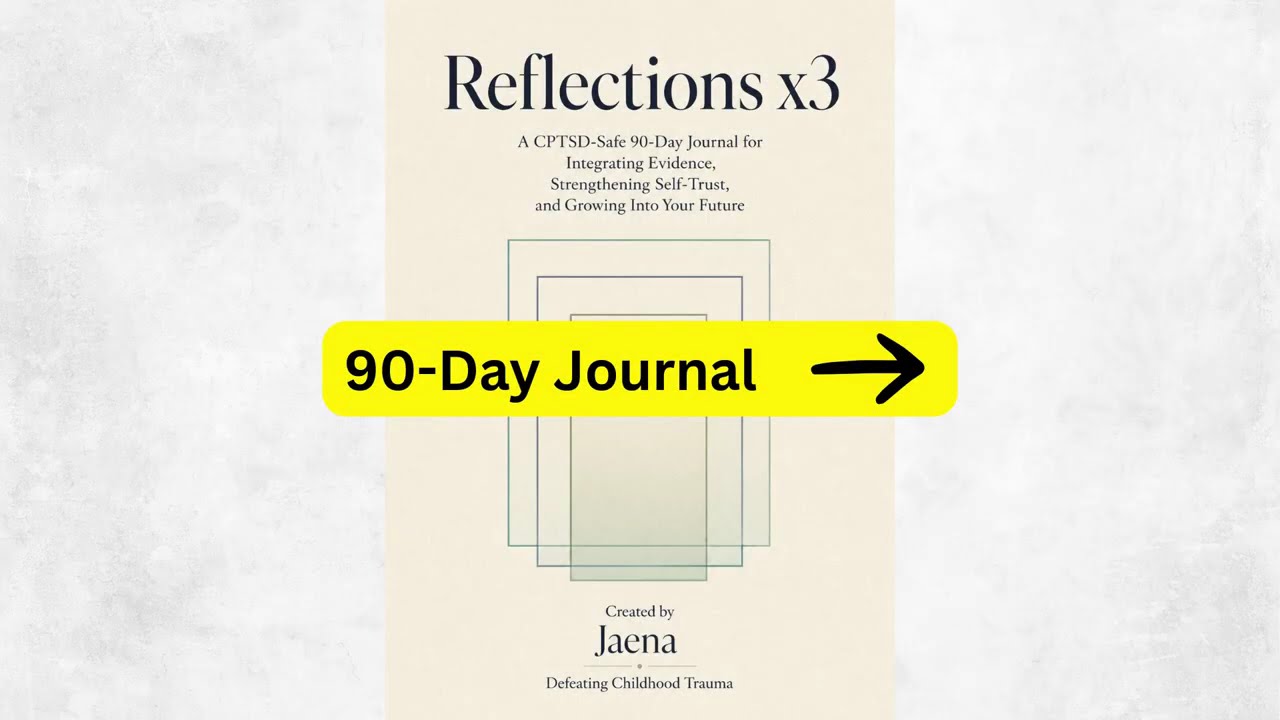
Stage 3: Reflections x3™
90 Days — Integrate, Personalize, and Graduate
By the time you reach Reflections x3, you’ve already practiced the rhythm through seven days and thirty days.
Now the structure begins opening up.
Your internal and external observations start living together. You begin using your own shorthand Keys, build a living Table of Contents, and get room for tools, identity pages, tracking systems, creative pages, and anything else that helps you recognize and support yourself.
The system deliberately moves you from guided templates toward self-directed reflection. By the end, you’re practicing the same method inside a structure that increasingly resembles the blank journal, notebook, or binder you’ll eventually use on your own.
Why “Reflections x3”?
The system now operates through two sets of three.
You reflect across three widening time frames:
weekly → monthly → 90 days
And each time, you return to three familiar questions:
Wins & Positive Encounters → Insights & Patterns → Moving Forward
Daily experience becomes weekly evidence. Weekly evidence becomes monthly evidence. Three monthly reflections become your ninety-day view.
That’s where accumulation becomes much easier to see.
Optional Bonuses That Build Identity and Agency
The bonus pages are optional, but they continue the work in a different way.
Previously, in Your World…
You imagine your life as a hit reality show. You’re the star and the fan favorite, and the story has to be told in third person.
The narrator still tells the truth when things were difficult. Mistakes, setbacks, disappointment, and conflict still belong in the story. But the narrator is rooting for the main character.
That gives you practice telling the truth about your own life without automatically turning yourself into the villain.
In Recent Evidence, you experiment with this across thirty days. In Reflections x3, the lens widens across the full ninety-day journey.
Create Your Own Tools
You’ll also begin experimenting with tools of your own.
A tool doesn’t have to be polished. One of the first tools I created in my own Reflections x3 journal was simple and decidedly unfancy — but it was exactly what I needed. You’ll see it for yourself in that section.
You learn to notice what helps, organize it in a way your brain understands, adapt it, and keep what works. Recent Evidence introduces that experimentation, while Reflections x3 gives you more freedom to build and carry your own tools forward.
Then Comes the Cycle-Down Month
After ninety days of active reflection, Reflections x3 gives you a 30-page Cycle-Down Month.
The structure deliberately gets quieter. There are no required weekly layouts or heavily guided prompts. You keep the habit alive while giving everything you’ve learned room to settle.
During that month, you may begin noticing what you naturally want your next journal to include: which tools you want to keep, what you still want to track, which patterns matter now, and what kind of structure actually fits your life.
The Cycle-Down Month gives you somewhere to land before building the next cycle yourself.
And Then You Graduate
Reflections x3 includes two video walkthroughs.
The first helps you understand the 90-day system and its more flexible structure. The second is your Graduation Walkthrough, helping you work through the Cycle-Down Month and think about what you want your next self-created journal to become.
By then, you’ve practiced daily capture, weekly reflection, monthly reflection, and a full quarterly review. You’ve gathered evidence, experimented with your own tools, and learned what helps you remember, reflect, and understand yourself.
Now you can take what you’ve learned and build the next version for yourself.
That was always the destination.
What You Receive
The Identity Repair Journey includes:
- CPTSD-Safe Daily Check-In™ — 7-day digital journal
- Recent Evidence — 30-day digital journal
- Recent Evidence Companion Walkthrough Video (inside the welcome page)
- Reflections x3™ — 90-day digital journaling system
- Reflections x3 Walkthrough Video (page 4)
- Graduation Walkthrough Video (page 139)
- Built-in Emotion Wheel, Cognition Sheet, Compliment Capture, weekly/monthly/90-day reflections, custom-tool work, bonus narrative exercises, and the 30-page Cycle-Down Month
Video support is included with Recent Evidence and Reflections x3. The standalone 7-Day Check-In does not include its own walkthrough video.
Keep Going — But Make It Yours
The Identity Repair Journey gives you enough structure to begin, enough repetition to learn the method, and enough freedom to eventually stop needing someone else’s template.
You gather evidence, reflect on what actually happened, notice what works, and gradually build a system around your own life.
You’re not buying journals forever. You’re learning a journaling system you can keep using — and eventually make completely your own.