

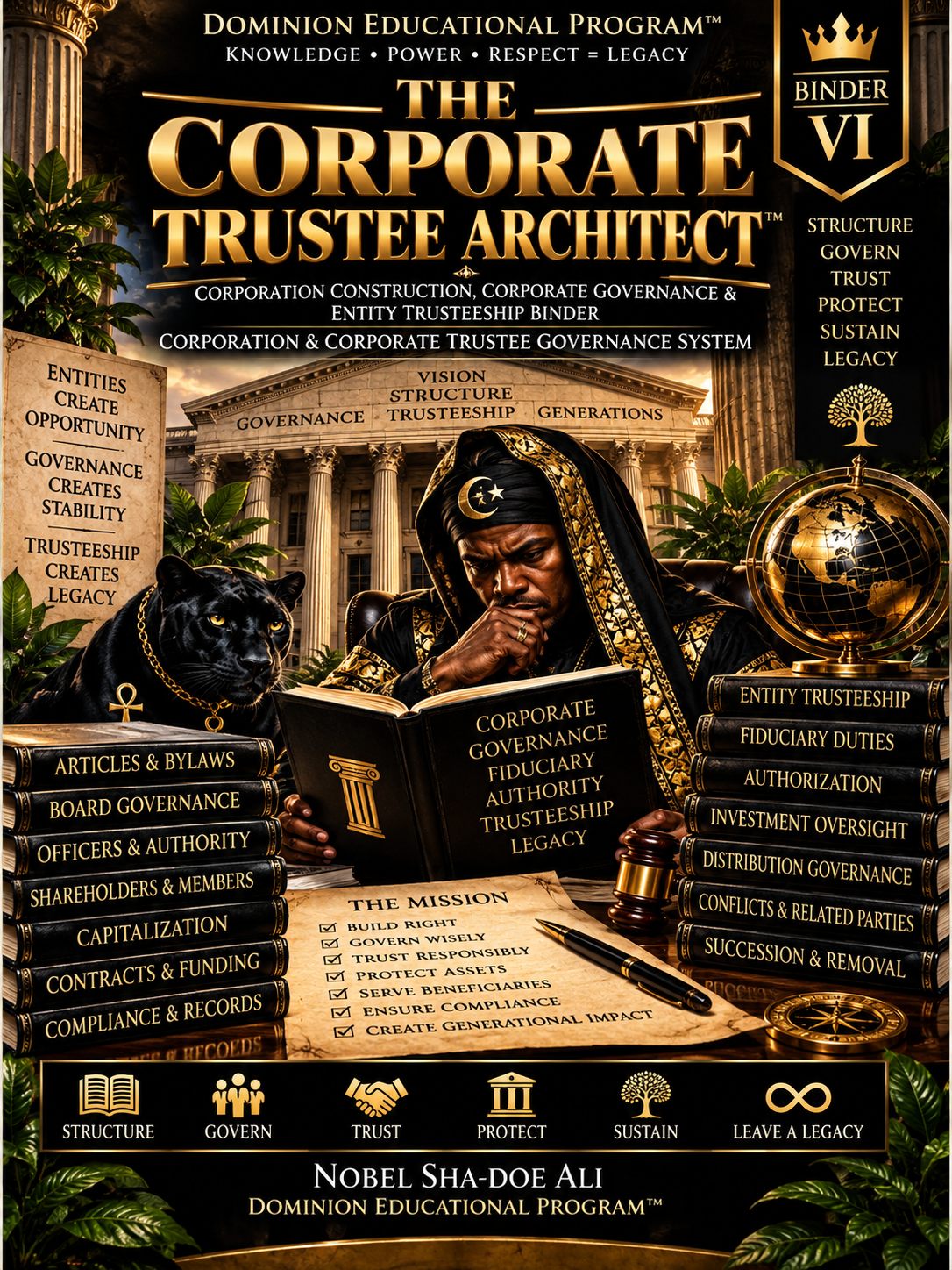
THE CORPORATE TRUSTEE ARCHITECT™ — Binder VI
THE CORPORATE TRUSTEE ARCHITECT™ — Binder VI
Corporation Construction, Governance, Capitalization & Fiduciary Administration
Dominion Estate Architecture Series™
THE CORPORATE TRUSTEE ARCHITECT™ is an advanced educational textbook and construction system for comprehending how a corporation moves from a state filing into a functioning, documented institution—and how a legally eligible entity may be structured to serve in fiduciary capacities.
This volume begins with a fundamental rule:
FORMING A CORPORATION DOES NOT AUTOMATICALLY CREATE A CORPORATE TRUSTEE.
Students first learn the corporate architecture itself: the corporation as a separate legal person, state of incorporation, foreign qualification, articles of incorporation, nonprofit organizational provisions, bylaws, incorporator action, organizational board proceedings, director authority, officer delegation, shareholder and member rights, capitalization, stock issuance, stock ledgers, voting procedures, banking controls, contracts, compensation, restricted nonprofit assets, related-party transactions, and institutional recordkeeping.
The book carefully separates the major organizational tracks that are often incorrectly blended together:
FOR-PROFIT STOCK CORPORATION → NONPROFIT/NONSTOCK CORPORATION → FEDERAL 501(c)(3) TAX-EXEMPT ORGANIZATION → CORPORATE/ENTITY TRUSTEE
Each structure has a different legal purpose, governance system, economic model, tax framework, and authority chain.
Students learn why shareholders are not directors, directors are not officers, officers are not automatically trustees, nonprofit members are not shareholders, and corporate property is not automatically trust property.
From Corporation to Corporate Fiduciary
The second dimension of the system examines what happens when an entity is considered for trusteeship.
Instead of assuming that broad language in articles or bylaws creates fiduciary authority, students are taught to investigate the actual legal gates:
CORPORATE EXISTENCE → CORPORATE POWER → FIDUCIARY ELIGIBILITY → REGULATORY AUTHORIZATION → TRUST-INSTRUMENT AUTHORITY → BOARD AUTHORIZATION → DELEGATED HUMAN AUTHORITY
The book therefore teaches students to distinguish ordinary corporate capacity from fiduciary capacity and to investigate applicable trust statutes, trust-company restrictions, licensing requirements, trust situs, governing instruments, court requirements, and regulatory limitations before an entity accepts fiduciary office.
Institutional Governance
Students are shown how sophisticated corporate administration depends upon a documented chain of authority.
The system examines:
Shareholders and Members — structural voting and ownership or governance rights.
Board of Directors — institutional management, oversight, major decisions, conflicts, and delegation.
Officers — execution of properly delegated corporate authority.
Committees — specialized oversight where legally appropriate.
Corporate Trustee — the entity serving in fiduciary capacity when legally eligible and properly appointed.
Authorized Fiduciary Officers — natural persons executing authorized functions for the entity without personally becoming the trustee merely by signing documents.
This separation allows students to comprehend who owns, who governs, who authorizes, who executes, who holds fiduciary responsibility, and what documentation proves each role.
Corporate Capital & Financial Controls
THE CORPORATE TRUSTEE ARCHITECT™ also teaches the financial infrastructure behind the legal entity.
Students study the difference between authorized shares, issued shares, outstanding shares, capital contributions, stock subscriptions, dividends, compensation, reimbursements, corporate loans, restricted charitable funds, operating reserves, and fiduciary assets.
Special attention is given to keeping these categories separate.
A corporation's operating account is not automatically a trust account.
Trust property is not automatically corporate capital.
A nonprofit surplus is not automatically distributable family profit.
A shareholder's equity does not mean the shareholder personally owns the corporation's underlying assets.
Nonprofit & Charitable Architecture
The nonprofit track separately examines nonprofit purpose clauses, dissolution provisions, restricted donations, grant accounting, endowment administration, private inurement, excess-benefit transactions, and reasonable executive compensation.
Students learn the important distinction between:
STATE NONPROFIT FORMATION ≠ FEDERAL 501(c)(3) RECOGNITION
and why charitable assets must remain governed by their applicable mission, donor restrictions, organizational documents, and federal and state requirements.
Corporate Fiduciary Administration
Once eligibility and appointment have been established, the curriculum progresses into the operational responsibilities of institutional trusteeship, including authority, delegation, banking and custody, investment administration, distributions, beneficiary communications, accounting, compensation, conflicts of interest, related-party transactions, resignation, removal, succession, and preservation of the fiduciary record.
The governing method becomes:
THE DOMINION FIDUCIARY METHOD™
ELIGIBILITY → ACCEPTANCE → AUTHORITY → DELEGATION → ADMINISTRATION → INVESTMENT → DISTRIBUTION → ACCOUNTING → REPORTING → CONFLICT REVIEW → SUCCESSION
Every stage asks a different legal question.
Every decision requires an authority trail.
Every transfer requires evidence.
Every fiduciary action must be attributable to the correct legal actor and capacity.
The Objective
This is not a collection of “magic documents,” internet theories, or forms that supposedly create authority merely because someone signs them.
It is an educational system for learning how to:
FORM → GOVERN → CAPITALIZE → AUTHORIZE → DOCUMENT → OPERATE → QUALIFY → ACCEPT → ADMINISTER → ACCOUNT → AUDIT → SUCCEED
The objective is to teach students how to build an institution whose legal existence, ownership, governance, authority, finances, fiduciary capacity, and succession can be researched, documented, verified, and explained.
DON’T BELIEVE IT. RESEARCH IT. PROVE IT.
Knowledge • Power • Respect = Legacy