
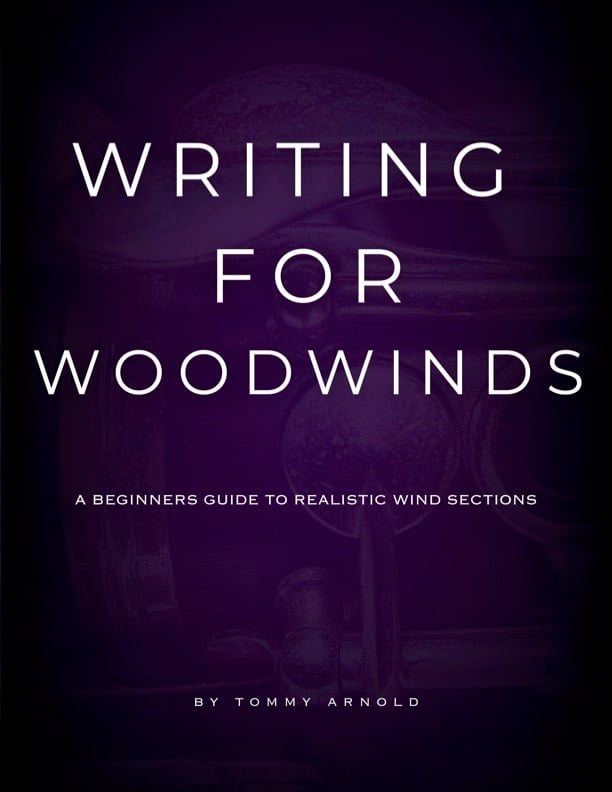
Writing for Woodwinds
Your woodwinds are invisible in the mix. Here's why.
Most aspiring film composers treat woodwinds as an afterthought — a flute doubling the melody, a clarinet buried under strings, a bassoon that nobody can hear.
The instruments that should carry your most emotional moments end up adding nothing.
The problem isn't your sample library. It's that nobody taught you how woodwinds actually work.
What's Inside This Guide
Writing for Woodwinds is a free 10-page PDF designed specifically for aspiring film composers and bedroom producers who want to write woodwind parts that are expressive, balanced, and convincing — without years of conservatory training.
Inside, you'll learn:
✦ The Woodwind Family & Their Roles — How each instrument functions in the orchestra, its unique sonic character, and what emotional purpose it serves in a film score (including piccolo, oboe, English horn, bass clarinet, and contrabassoon)
✦ Range & Sweet Spots — The exact registers where each woodwind instrument sounds its best in sample libraries, and the zones that make your mockups sound thin, strained, or synthetic
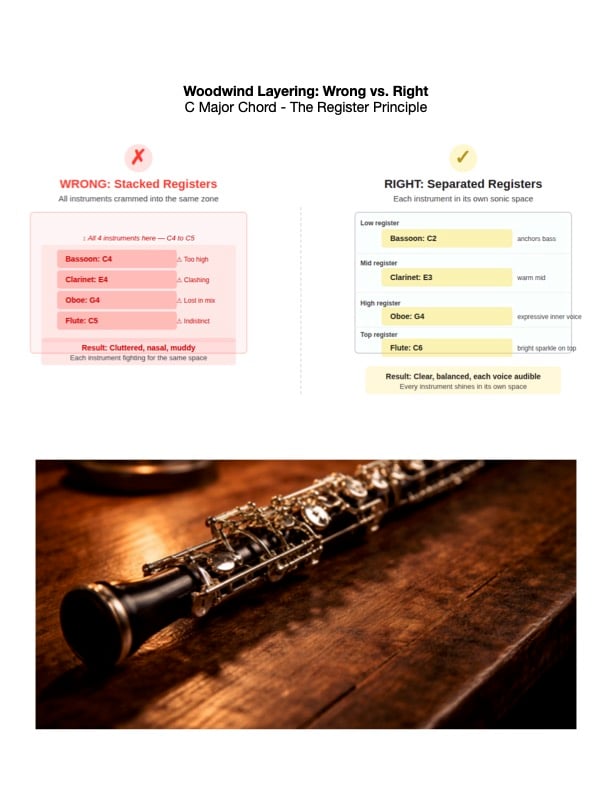
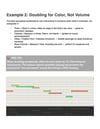
✦ Layering for Clarity — The single most important principle for stacking woodwinds without creating a muddy, indistinct mess (with a direct before/after comparison)
✦ Articulations That Create Realism — How to use legato, staccato, portato, flutter tongue, and more — and when each creates the right effect
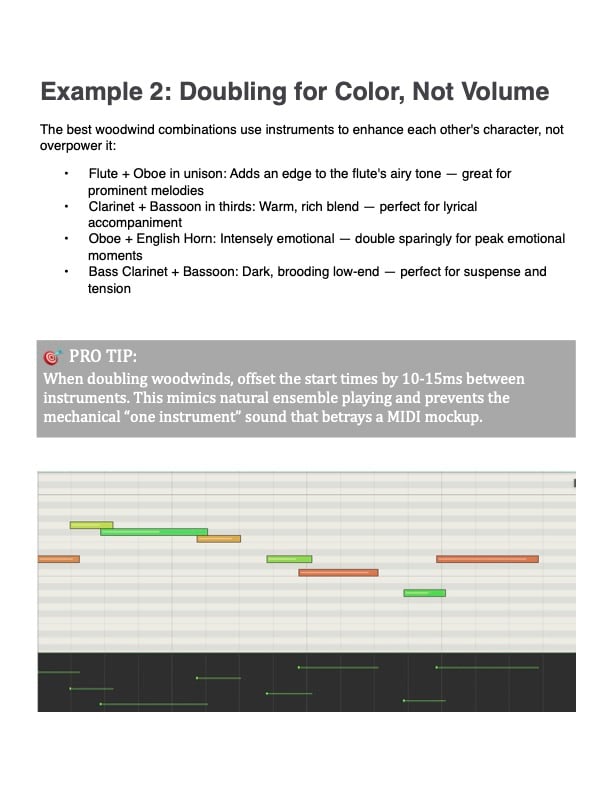
✦ Phrasing & Breath Points — How to write woodwind lines that breathe like a real player, including CC1/CC11 automation techniques that transform lifeless MIDI into expressive performance
✦ Genre Applications — Which woodwind instruments to reach for in epic fantasy, horror, emotional drama, mystery, and adventure — with specific recommendations for each
Who This Is For
This guide was written for composers who are serious about their craft but haven't had formal orchestration training. If you're working in a DAW with sample libraries and your woodwinds have always felt like an afterthought — this guide will change how you write.
Who This Is NOT For
If you're already scoring professionally or have formal orchestration training, this guide covers foundational territory you likely already know. It's intentionally designed for composers who are earlier in their journey.
Free. No catch.
Enter your email, download the PDF, and start writing better woodwinds today.
Already want to go deeper? Check out Virtual Orchestration: A Composer's Guide — the complete system for writing realistic orchestral music across all four sections.