
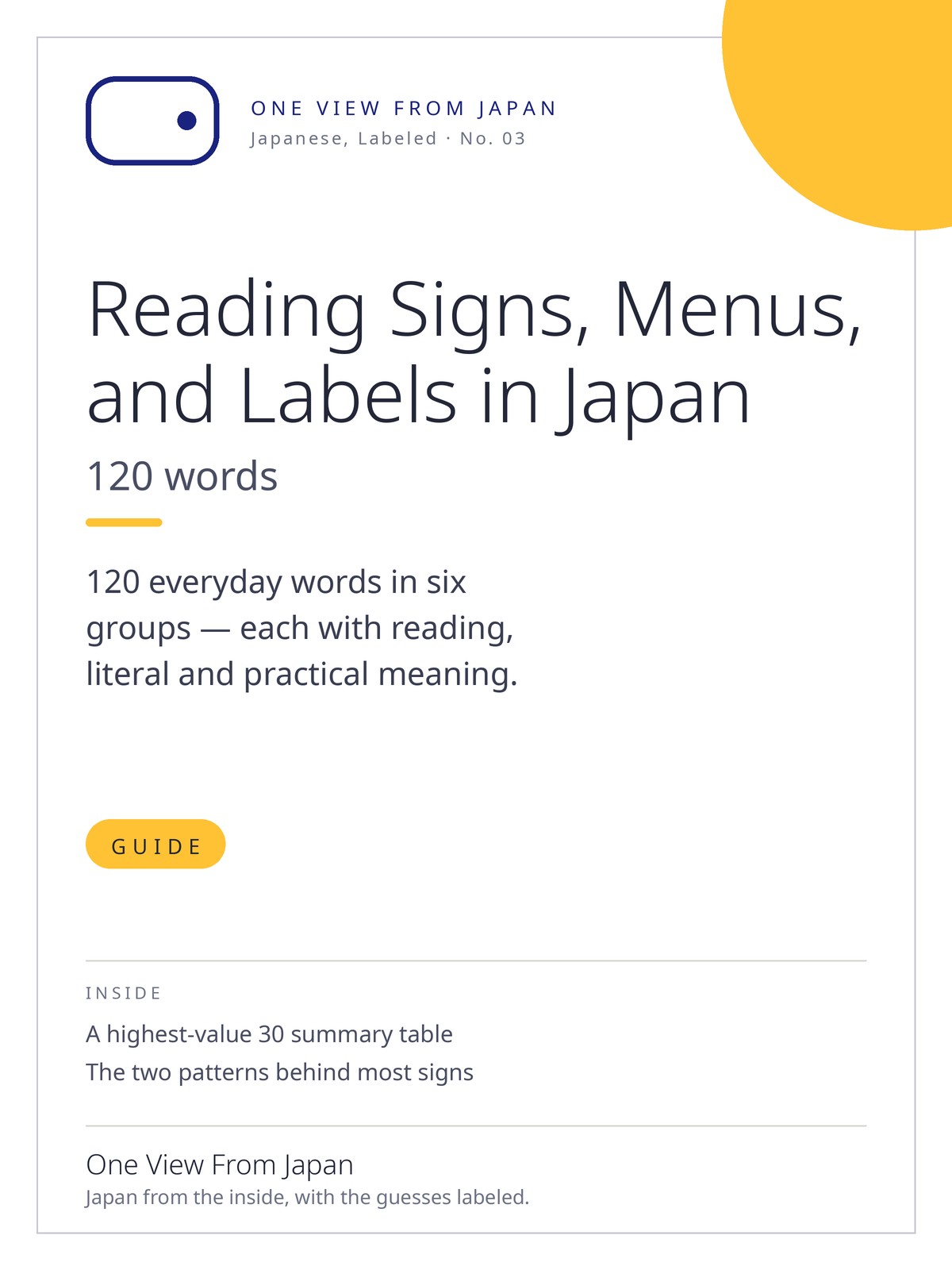
Reading Signs, Menus, and Labels in Japan: 120 Words
Japanese, Labeled · No. 03 — Reading Signs, Menus, and Labels in Japan: 120 Words
Japan runs on signs — station boards, shop doors, menus, packages, rule notices. Most visitors can read almost none.
The 120 words of daily life: Japanese, reading, literal meaning, and what each sign asks of you.
What's inside
- 2 patterns: kinshi endings are hard rules; "please refrain" wordings carry the same force
- 120 words in 6 groups — transport (24), shops and restaurants (22), menus and food labels (26), warnings (20), facilities (16), money (12)
- Food dates: best-before vs. use-by, and the allergen section to find first
- A one-page summary: the highest-value 30
Format
PDF, 10 pages. Last checked: November 2026.
Who this is for
People in Japan, or about to be, wanting the full sign set.
Not for: Drivers studying for a Japanese license.
What this guide does not cover
Road-law signs; medical warnings; reading connected Japanese text.
How the labels work
Claims are labeled Known (checked against official sources), My read (the author's interpretation), or Don't know (it varies — the guide says how to check).
By One View From Japan — a Japanese data professional based in Japan. Japan from the inside, with the guesses labeled.
Drafted with AI assistance; every claim and figure reviewed by the author.
Questions: riku-muse@muse.ai
FAQ
Q: Do I need to read hiragana or katakana first?
A: No — each entry gives its romaji reading; you recognize words as pictures.
Q: Is this a phrasebook for speaking?
A: No — a recognition vocabulary for signs, menus, and labels.