
🌻 UNDERSTANDING THE NERVOUS SYSTEM
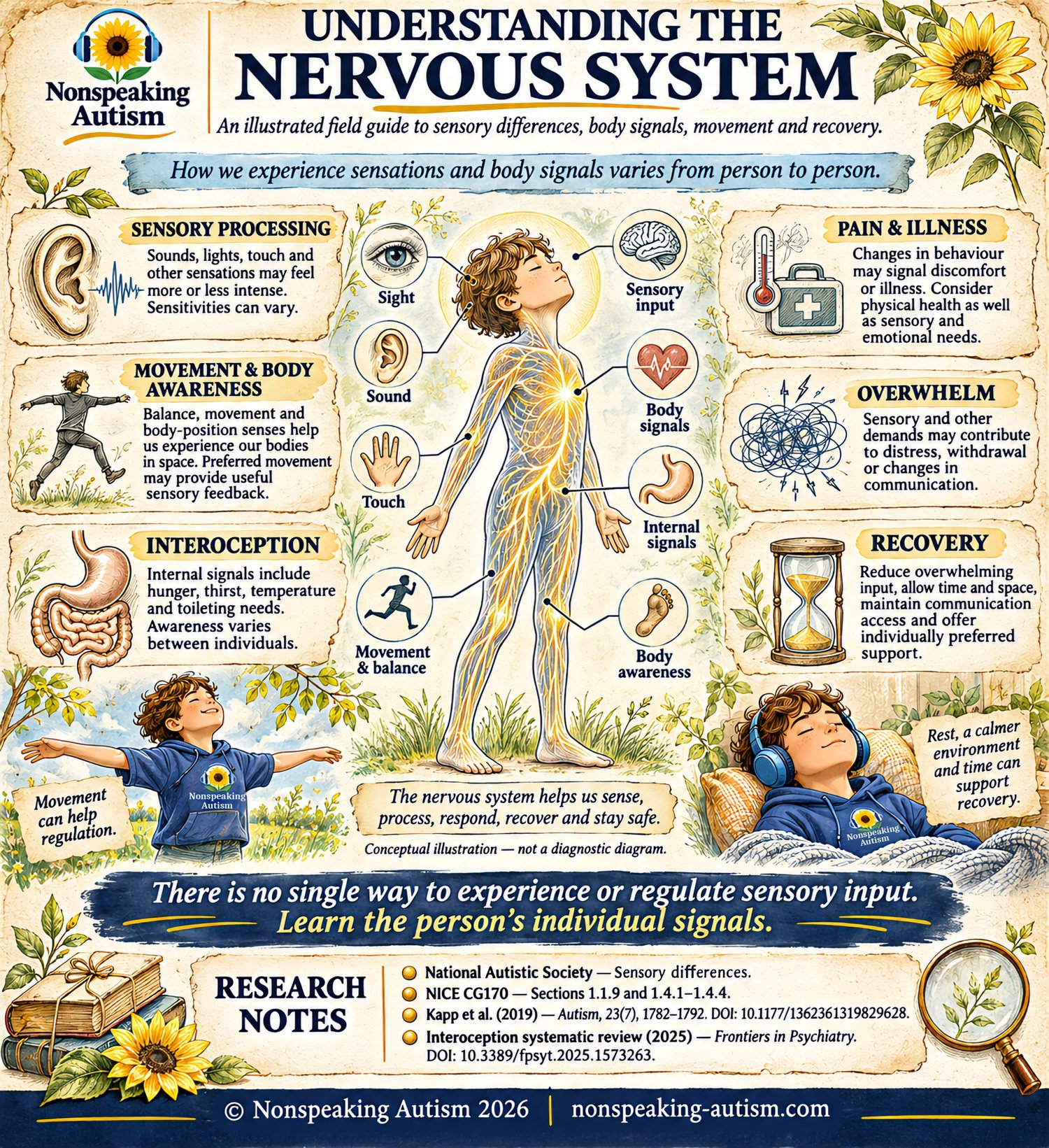
🌻 UNDERSTANDING THE NERVOUS SYSTEM
An Illustrated Field Guide to Sensory Differences, Body Signals, Movement and
Recovery
💛 FREE EDUCATIONAL RESOURCE | UK EDITION | NO WATERMARK
How we experience sensations and body signals varies from person to person.
The nervous system plays an important role in how we experience the world, recognise signals from our bodies, respond to our surroundings and recover from demanding experiences.
For autistic children, sensory experiences and regulation needs can vary considerably.
One child may find certain sounds overwhelming, while another may enjoy repetitive movement or seek particular sensations. Some children may find it difficult to recognise or communicate internal body signals, while others may be especially aware of particular sensations.
There is no single sensory experience shared by every autistic person.
Understanding the Nervous System is a free, illustrated educational resource designed to help parents, carers, educators and professionals explore sensory processing, movement, interoception, physical discomfort, overwhelm and recovery.
The guide encourages adults to recognise individual differences rather than making assumptions based on outward behaviour.
The central message:
There is no single way to experience or regulate sensory input. Learn the person's individual signals.
🧠 WHAT THIS RESOURCE EXPLORES
🌿 1. Sensory Processing
Our sensory systems help us detect and respond to information from the environment.
Sensory experiences may involve:
- Sound.
- Light and visual information.
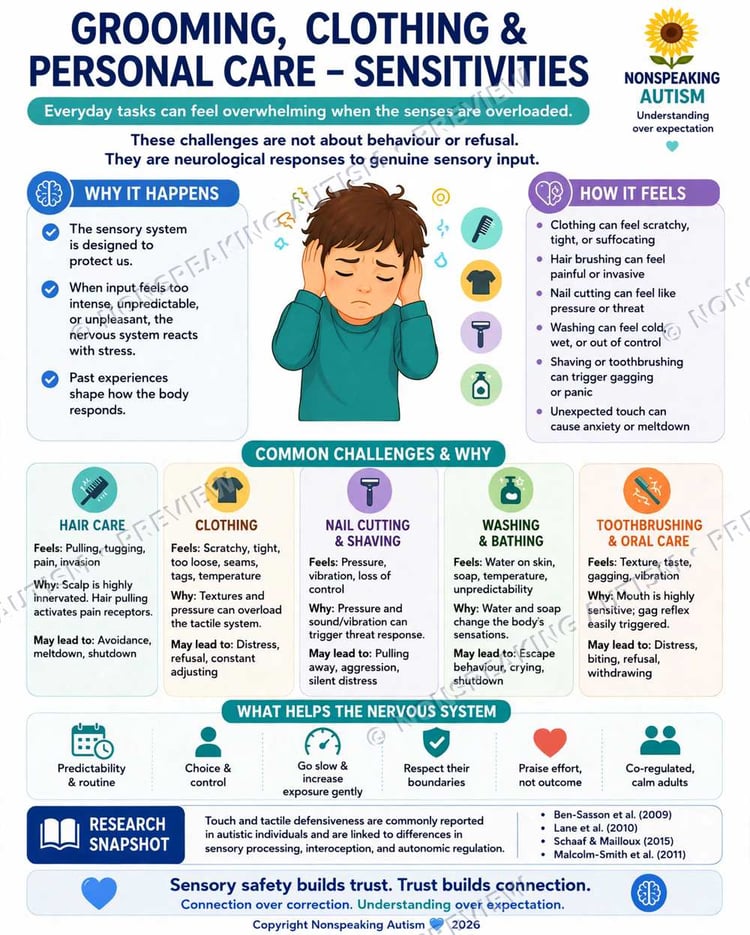
- Touch.
- Smell.
- Taste.
- Movement.
- Body position.
- Internal sensations.
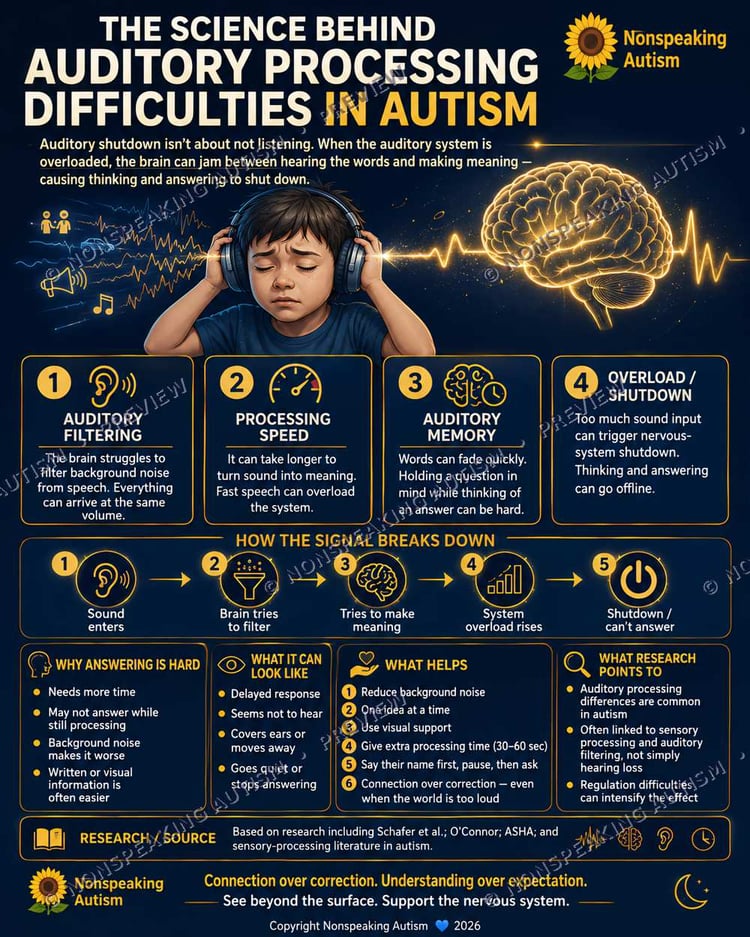
Some autistic children experience particular sensations as unusually intense, uncomfortable or difficult to filter.
Others may seek or enjoy sensory experiences that feel predictable or pleasant.
What adults can do:
Notice the child's preferences, respect sensory differences and consider environmental adjustments where helpful.
🌻 2. Movement and Body Awareness
Movement, balance and body-position senses help us experience where our bodies are in space.
Two important systems include:
Proprioception: Information from muscles, tendons and joints that contributes to body-position and movement awareness.
Vestibular processing: Sensory information associated with head movement, balance and spatial orientation.
For some children, activities such as rocking, walking, swinging or other preferred movement may provide enjoyable or useful sensory feedback.
Movement should be safe, individually appropriate and chosen with the child's preferences in mind.
The aim is not to stop harmless movement simply because it looks different.
💙 3. Interoception — Understanding Internal Body Signals
Interoception involves sensing and interpreting signals associated with the body's internal condition.
These may include sensations associated with:
- Hunger.
- Thirst.
- Temperature.
- Toileting needs.
- Breathing.
- Heartbeat.
- Physical discomfort.
Awareness and interpretation of internal sensations vary between individuals.
Some autistic children may find certain signals difficult to recognise, interpret or communicate.
However, interoceptive differences are not universal, and no single pattern applies to every autistic child.
What adults can do:
Offer accessible communication, predictable opportunities to meet physical needs and support that reflects the child's individual experience.
❤️ 4. Pain and Illness
Changes in behaviour may sometimes indicate physical discomfort or illness.
Possible concerns include:
- Earache or dental pain.
- Headaches.
- Constipation.
- Digestive discomfort.
- Injury.
- Infection.
- Other health conditions.
A nonspeaking child may communicate discomfort through AAC, gestures, facial expressions, movements or changes in their usual presentation.
Nonspeaking does not mean unable to communicate.
Pain should not be dismissed simply because a child cannot explain where it hurts.
Seek appropriate medical assessment for new, persistent or concerning symptoms.
🌧️ 5. Overwhelm and Distress
Sensory input and other demands may contribute to overwhelm.
Possible contributing factors include:
- Noise or busy environments.
- Unexpected changes.
- Communication barriers.
- Anxiety or uncertainty.
- Pain or illness.
- Fatigue.
- Accumulated demands.
Overwhelm may be associated with changes in communication, withdrawal, agitation or visible distress.
These responses can have different causes and should not automatically be attributed to sensory overload.
What adults can do:
Consider the whole situation, reduce unnecessary demands and investigate possible unmet needs.
🌼 6. Recovery and Regulation
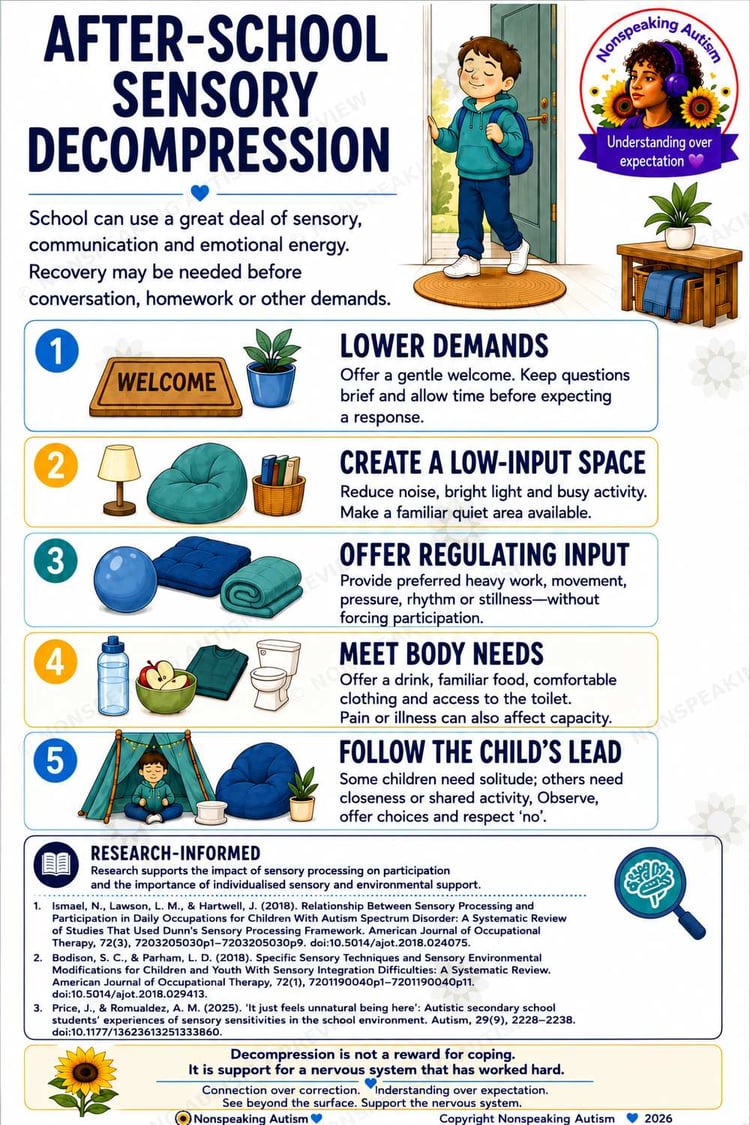
Recovery may take time after a demanding or overwhelming experience.
Some children may benefit from:
- A quieter environment.
- Reduced sensory input.
- Rest.
- Preferred movement.
- Familiar comfort items.
- Additional processing time.
- Reduced language demands.
- Access to AAC and other communication supports.
What helps one child may not help another.
Recovery should be supported according to individual preferences rather than imposed through a standard routine.
💛 WHY UNDERSTANDING THE NERVOUS SYSTEM MATTERS
A child's outward behaviour does not always tell us what they are experiencing internally.
A child who is moving constantly may be enjoying movement, expressing excitement or responding to discomfort.
A child who becomes quiet may need rest, feel overwhelmed or be concentrating.
A child who struggles with a transition may be managing sensory, physical, communication or emotional demands.
Understanding begins with curiosity rather than assumptions.
This resource encourages adults to consider sensory experiences, communication, health and environmental factors together.
🏡 PRACTICAL WAYS TO SUPPORT AT HOME AND SCHOOL
Notice individual sensory preferences. Learn which environments and experiences the child enjoys or finds uncomfortable.
Respect communication differences. Keep AAC, pictures, gestures and other communication methods available.
Offer appropriate movement opportunities. Allow safe, preferred movement rather than automatically treating it as
behaviour that needs correcting.
Consider physical health. Check for possible pain, illness, hunger, thirst or fatigue when a child's usual presentation changes.
Reduce unnecessary demands. Make adjustments to noise, lighting, transitions and expectations where helpful.
Allow recovery time. Recognise that a child may need rest or reduced demands after a difficult experience.
Work together. Share useful observations between home, school and relevant professionals while respecting the child's privacy and preferences.
🔬 RESEARCH & GUIDANCE-INFORMED
This resource draws on established concepts in sensory processing, interoception, movement and autism support.
Research recognises that autistic people may experience differences in sensory processing, although individual experiences vary considerably.
Studies of stimming also highlight that repetitive movements and activities may serve different purposes, including enjoyment, emotional expression and self-regulation.
Research on interoception continues to explore how autistic people perceive and interpret internal body signals.
Clinical guidance recommends considering sensory sensitivities, physical health, communication and environmental factors when planning individualised support.
📚 SELECTED RESEARCH AND GUIDANCE
1. National Autistic Society.
Sensory differences.
Information about sensory experiences and individual support needs.
2. National Institute for Health and Care Excellence (NICE). (2013; updated 2021).
Autism spectrum disorder in under 19s: support and management.
Clinical guideline CG170.
https://www.nice.org.uk/guidance/cg170
3. Kapp, S. K., et al. (2019).
'People should be allowed to do what they like': Autistic adults' views and experiences of stimming.
Autism, 23(7), 1782–1792.
https://doi.org/10.1177/1362361319829628
4. Interoception systematic review (2025).
Frontiers in Psychiatry.
DOI listed on the poster:
https://doi.org/10.3389/fpsyt.2025.1573263
The full author and article-title details of this reference should be checked against the original publication before it is presented as bibliographically verified.
Sources:
- Klein et al. (2025), Frontiers in Psychiatry (PDF)
- Kapp et al. (2019), full text on PubMed Central
- NICE CG170
- NAS – Ten simple sensory strategies for autistic children
📖 IMPORTANT RESEARCH LIMITATION
This poster is a simplified educational illustration, not a diagnostic diagram or a complete representation of nervous system anatomy.
It does not establish that all autistic children experience sensory input, interoception, movement or recovery in the same
way.
Research findings describe patterns across groups and cannot determine the needs of an individual child without appropriate observation and assessment.
Different support strategies have different levels of research evidence.
Individual preferences, comfort, safety and meaningful participation should guide support.
👨👩👧 WHO IS THIS FREE RESOURCE FOR?
This printable guide may be useful for:
- Parents and carers.
- Families of nonspeaking and minimally speaking autistic children.
- Autistic children and young people learning about body signals.
- Mainstream and specialist school staff.
- SENCOs and SEND teams.
- Teaching assistants.
- Occupational therapists.
- Speech and language therapists.
- Educational psychologists.
- Autism support workers.
- Healthcare professionals.
- Parent and carer support groups.
- SEND training and professional development.
🏫 HOW THIS RESOURCE CAN BE USED
At home: To help families explore sensory preferences, body signals and recovery needs.
In classrooms: To encourage understanding of sensory differences and reasonable adjustments.
In therapy rooms: As an educational visual aid for discussions about movement, interoception and regulation.
During SEND training: To explain why children may experience sensory input and internal body signals differently.
In parent and carer groups: To encourage understanding, shared learning and compassionate support.
📦 WHAT YOU RECEIVE — FREE DOWNLOAD 💛
1 × Understanding the Nervous System — Illustrated Educational Resource
Your free resource includes:
- Sensory processing and sensory differences.
- Movement and body awareness.
- Interoception and internal body signals.
- Pain and illness considerations.
- Overwhelm and distress.
- Recovery and regulation.
- A colourful conceptual nervous system illustration.
- Selected research and guidance references.
- Nonspeaking Autism illustrations and branding.
💛 YOUR FREE DOWNLOAD
✅ 100% FREE — £0.00
✅ NO WATERMARK
✅ No purchase required.
✅ UK English edition.
✅ Suitable for educational use at home, school and in professional settings.
✅ Printable digital resource.
Format: Digital image resource. A printable PDF may be offered separately if included in the Payhip download.
Digital download only — no physical product will be shipped.
⚠️ IMPORTANT EDUCATIONAL DISCLAIMER
Disclaimer
This resource is for educational and information purposes only. It is not a diagnostic tool, medical assessment, neurological scan or individual sensory assessment, and it does not replace advice from a qualified professional.
The nervous system illustration is conceptual. It is simplified and does not show every anatomical structure or physiological process.
Sensory processing, interoception and regulation differ from person to person. A change in behaviour may have a medical, sensory, emotional, environmental or communication-related cause. Seek professional advice for any new, persistent or worrying symptoms, ideally from someone who knows the individual.
All support should respect the person’s communication, dignity, preferences, safety and wellbeing.
© Nonspeaking Autism 2026 · nonspeaking-autism.com. For personal use in one home, classroom or setting only.
Please do not resell, redistribute or share the digital file.
©️ COPYRIGHT & PERMITTED USE
Copyright © 2026 Nonspeaking Autism. All rights reserved.
Although this resource is free, it remains protected by copyright.
Permitted Use
You may download, print and publicly display this resource for:
- Personal and family use.
- Schools and educational settings.
- Therapy rooms and clinical environments.
- Staff training.
- Community and support settings.
- Educational discussion and awareness.
Not Permitted
Without prior written permission, you may not:
- Resell or redistribute the digital file.
- Upload the resource to other websites or public download platforms.
- Remove copyright information.
- Edit or rebrand the artwork.
- Include the resource in another commercial product.
- Reproduce the artwork for resale.
Please direct others to the original Payhip listing to download their own free copy.
💛 THE MESSAGE BEHIND THIS RESOURCE
Every nervous system is different.
Some people experience sound more intensely.
Some find movement comforting.
Some struggle to recognise internal body signals.
Some need additional time and support to recover after demanding experiences.
None of these differences should automatically be treated as something that needs correcting.
Instead, we can listen.
We can observe.
We can respect communication in all its forms.
We can investigate possible discomfort.
And we can create environments that better support individual needs.
There is no single way to experience or regulate sensory input.
Learn the person's individual signals.
🌻 Connection over correction. Understanding over expectation.
Nonspeaking Autism © 2026
Different needs. Equal belonging.