
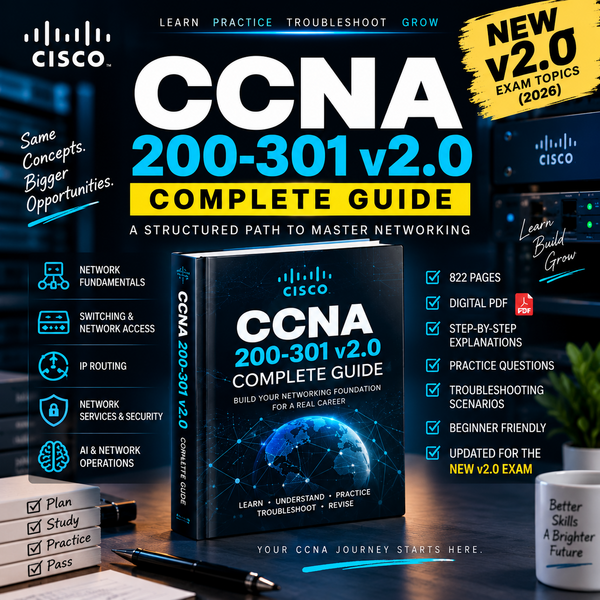
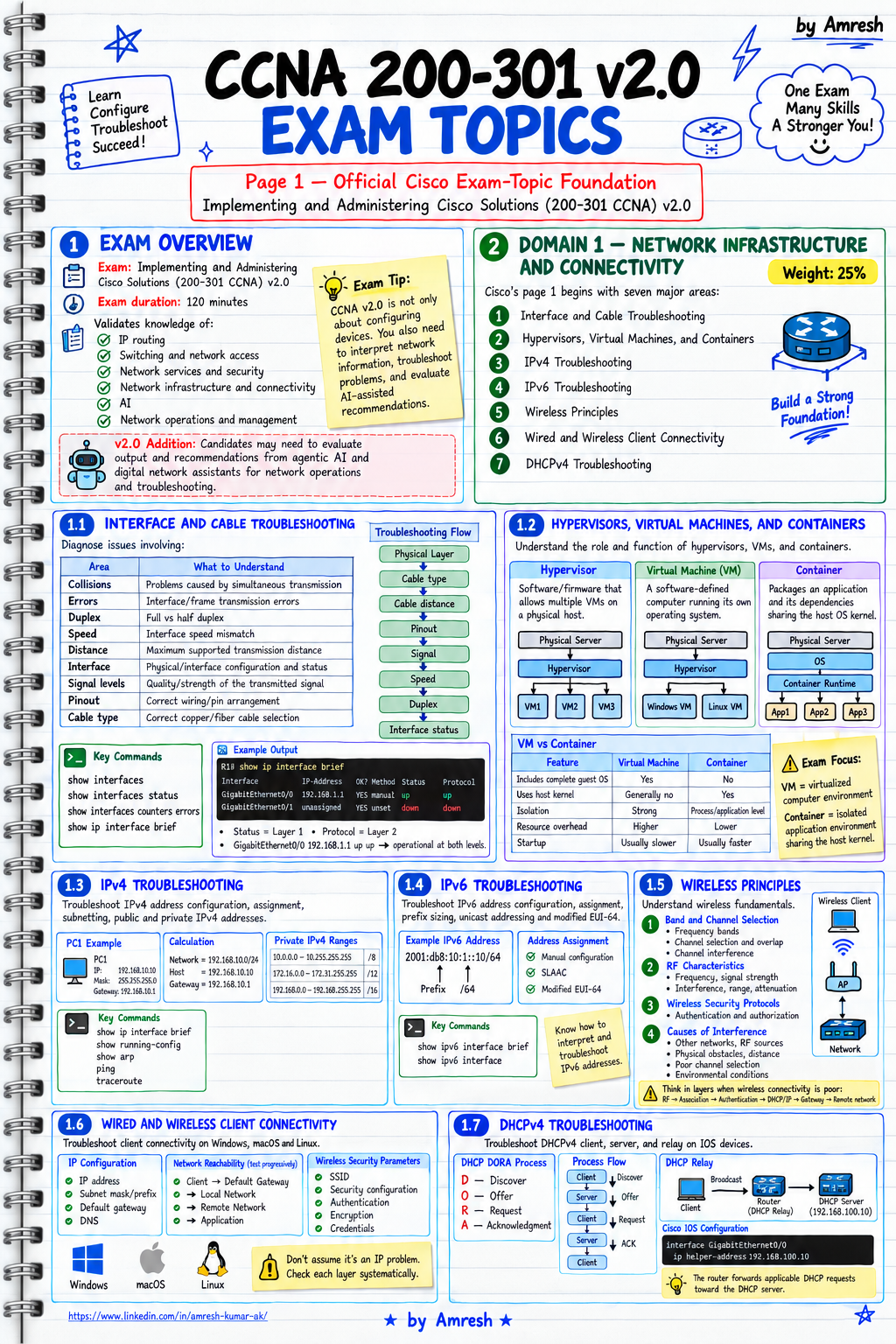
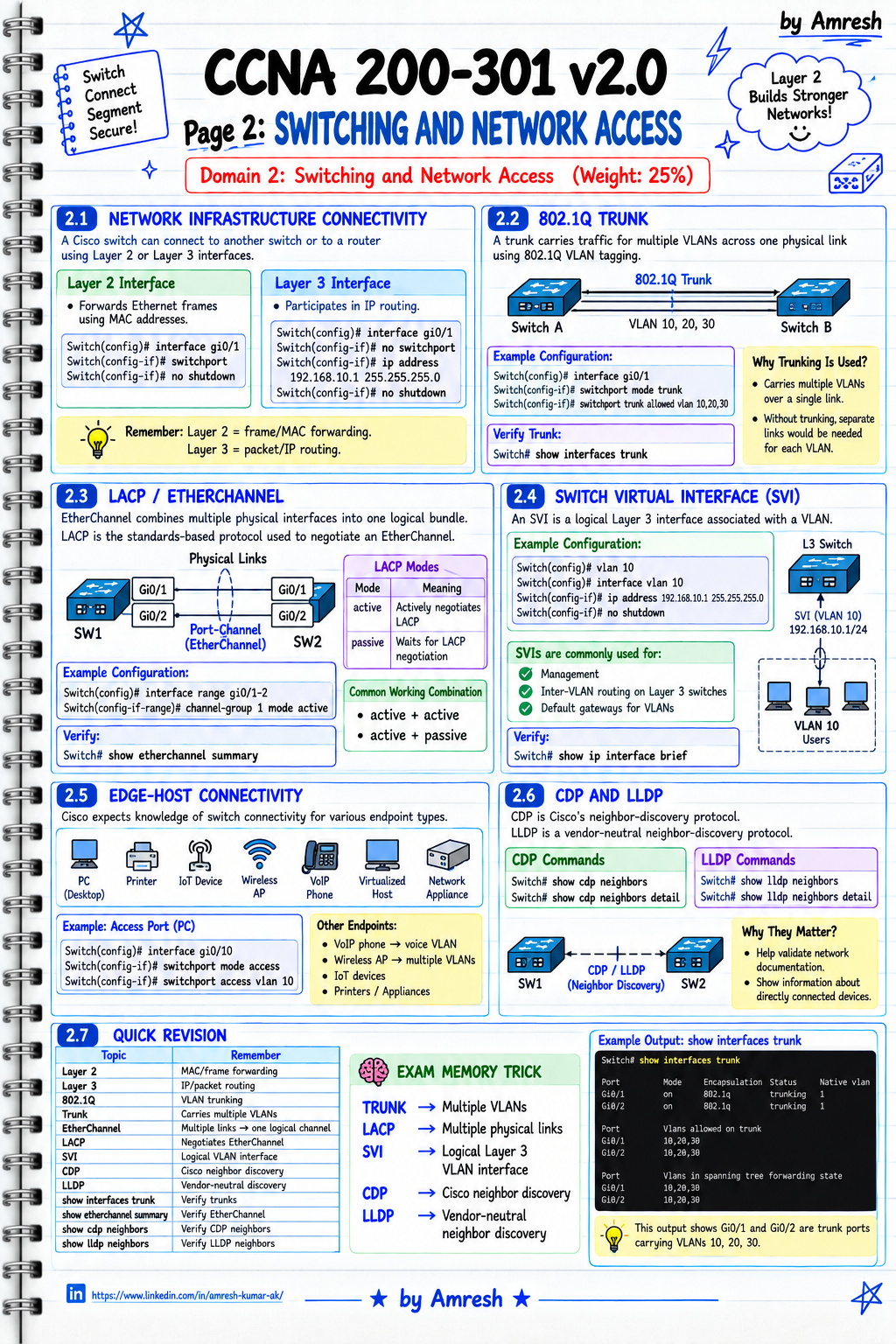
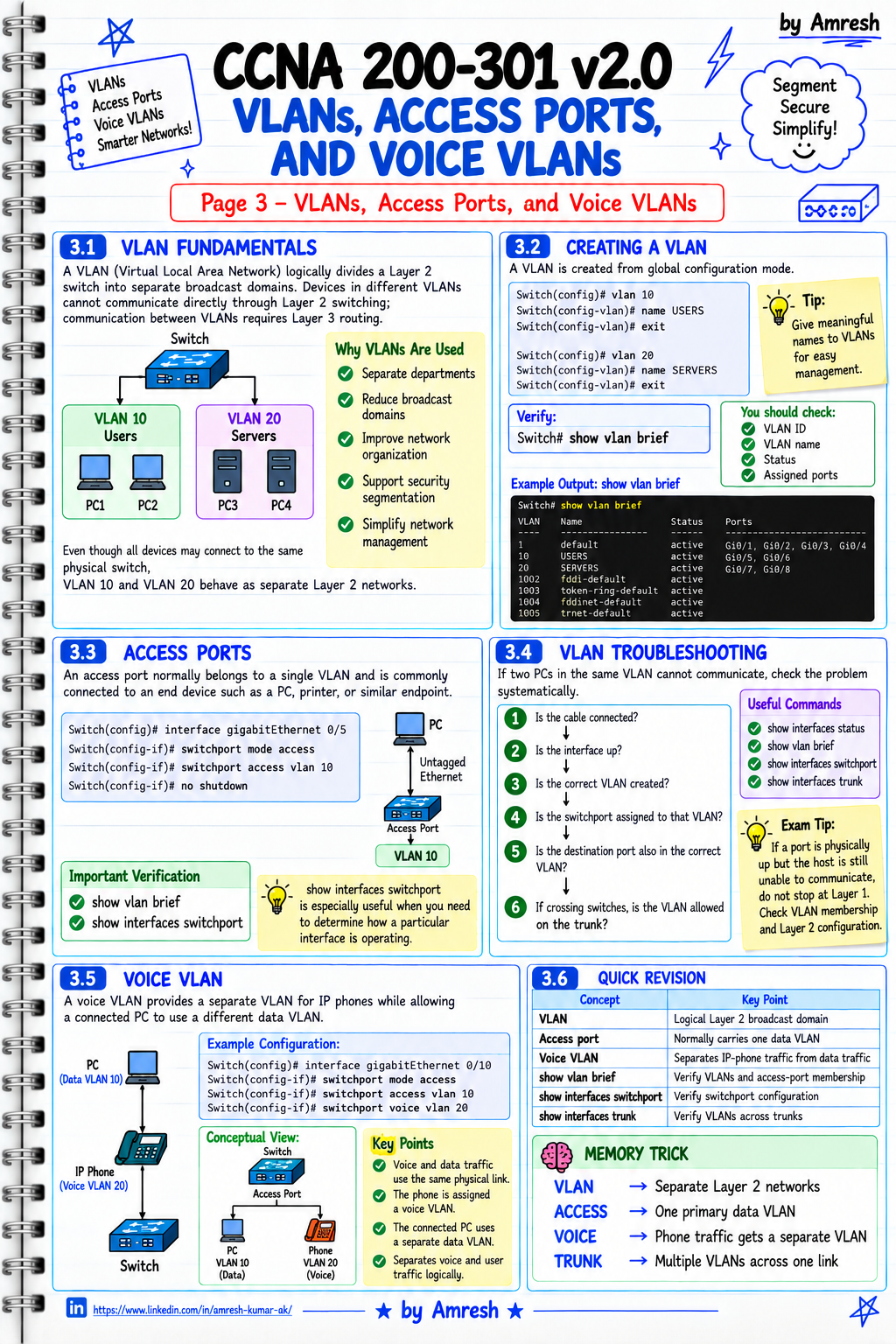
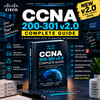
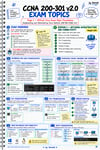
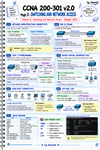
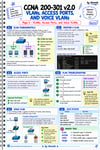
CCNA 200-301 v2.0 Complete Guide Exam pre
🌐 CCNA 200-301 v2.0 Complete Guide
🔥 LIMITED-TIME LAUNCH OFFER
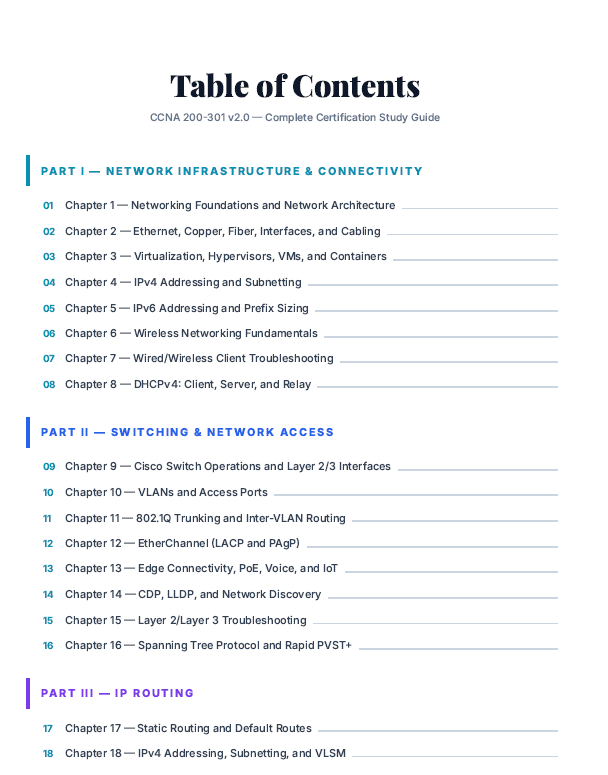
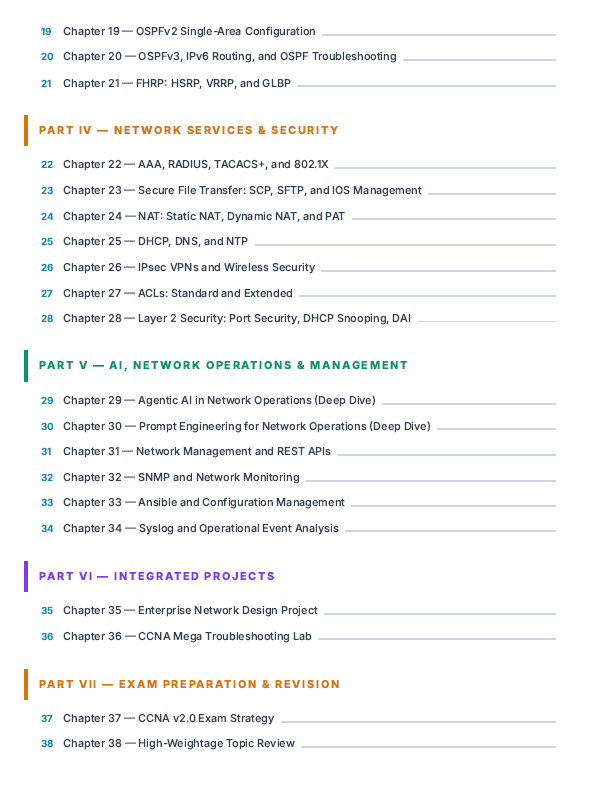
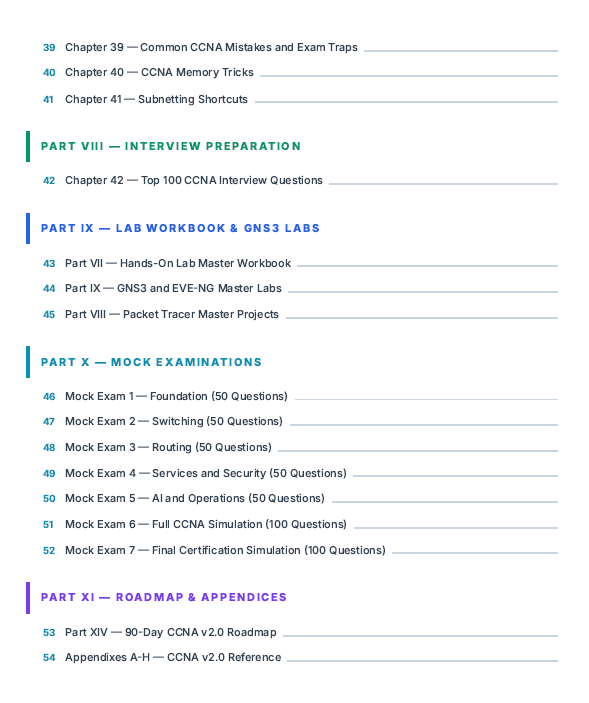
Master CCNA 200-301 v2.0 with the complete 822-page guide — built to give you one place to study, revise, and prepare.
💰 Launch Price: Just $19.99
$29.99 → $19.99
🎯 SAVE $10 — GET 33% OFF
⏳ Special launch pricing available for a limited time.
Don’t pay the regular $29.99 when you can get the complete guide for $19.99.
🔥 NEW CCNA v0.2 — 25-Page Demo Notes! 🌐
📥 Get the FREE 25-Page Demo:
https://drive.google.com/drive/folders/1j9wjhqAtEV_NPZS_6TQauvRzqWSeOWn-?usp=sharing
Stop Studying Networking in Pieces. Build the Foundation Properly.
You watch one networking video.
Then another.
You save a subnetting cheat sheet.
You find a different explanation for the OSI model.
Then you jump between articles, notes, PDFs, and practice questions — and somehow networking still feels confusing.
The problem isn't always a lack of effort. It's a lack of structure.
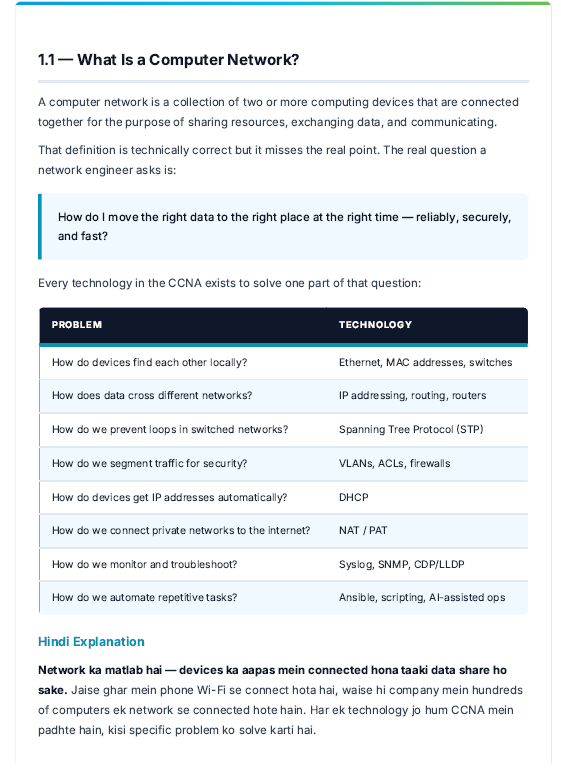
The CCNA 200-301 v2.0 Complete Guide is designed to bring important networking fundamentals into one organized learning resource so you can study concepts in the right sequence, understand how they connect, and revise them more efficiently.
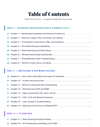
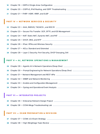
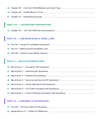
Instead of memorizing isolated definitions, you'll work through the concepts that form the foundation of modern networking — from Ethernet and network devices to IPv4 addressing, subnetting, virtualization, interfaces, troubleshooting, and practice questions.
Build the foundation once. Reuse it everywhere.
🔥 WHAT YOU'LL LEARN
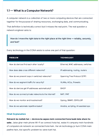
🌐 1. Networking Fundamentals
Start with the concepts everything else depends on.
You'll learn:
- Network devices and their roles
- Routers vs switches
- OSI model
- TCP/IP model
- Encapsulation and decapsulation
- MAC addresses
- IP addresses
- Broadcast domains
- Collision domains
- TCP vs UDP
- Common networking protocols
- Common protocol ports
- How data moves through a network
The goal is not simply to remember terminology.
It's to understand what happens, where it happens, and why it happens.
🔌 2. Ethernet, Interfaces & Cabling
Understand the physical and Layer-2 foundations behind network connectivity.
Topics include:
- Ethernet fundamentals
- Copper cabling
- Fiber-optic cabling
- Single-mode vs multimode fiber
- Ethernet speeds
- Speed and duplex
- Auto-negotiation
- Auto-MDIX
- Cable types and pinouts
- Interface status
- Interface counters
- CRC errors
- Late collisions
- Duplex mismatch
- Interface failures
- Common connectivity problems
You'll also see how these concepts appear during real troubleshooting situations.
Because knowing what CRC errors are is useful.
Knowing what they might tell you during troubleshooting is much more useful.
🖥️ 3. Virtualization & Networking
Modern networking doesn't exist only on physical hardware.
Build a foundation in:
- Virtual machines
- Hypervisors
- Type 1 vs Type 2 hypervisors
- Virtual NICs
- Virtual switches
- VM networking
- Containers
- East-west traffic
- VLANs in virtual environments
- Trunk connections to virtualized hosts
Understand how traditional networking concepts extend into virtualized environments.
🧮 4. IPv4 Addressing & Subnetting
The part many beginners struggle with — made structured.
Build your understanding of:
- IPv4 address structure
- Binary conversion
- Network portion
- Host portion
- Subnet masks
- CIDR notation
- Public vs private IP addresses
- APIPA
- Default gateways
- Network addresses
- Broadcast addresses
- Usable host ranges
- Subnetting
- Block-size method
- Fast subnetting techniques
- Worked examples
Instead of memorizing random subnetting tables, learn a repeatable process.
Example workflow:
IP Address → Subnet Mask → Network Address → Broadcast Address → Usable Host Range
Once the process becomes familiar, subnetting becomes a calculation problem rather than a guessing game.
🎁 BONUS: FREE CCNA Cheat Sheets Visual & Animated Notes
Get additional cheat sheets, visual notes, and animated learning resources to help you understand key networking concepts faster and revise more effectively.
📚 Based on the previous CCNA v1 certification:
300+ video lectures and two Cisco books were used as part of the learning ecosystem.
🧠 LEARN THE "WHY", NOT JUST THE "WHAT"
A common problem with networking study material is that it gives you a definition and expects you to memorize it.
This guide takes a more practical approach.
You'll encounter:
- Step-by-step explanations
- Practical networking scenarios
- Configuration examples
- Troubleshooting workflows
- Comparison tables
- Revision notes
- Worked examples
- Practice questions
- Exam-focused concepts
For example, instead of simply defining routing, the guide helps you understand what happens when a device communicates with another device on a different subnet.
You'll connect concepts such as:
ARP → Ethernet → Switching → Default Gateway → Routing → Layer-2 Header Changes
That's the kind of understanding that makes later networking topics easier to learn.
🛠️ TROUBLESHOOTING MINDSET
Knowing networking concepts is only part of becoming good at networking.
You also need to learn how to think when something doesn't work.
The guide introduces scenarios involving problems such as:
- Interface failures
- Incorrect speed/duplex settings
- Duplex mismatches
- CRC errors
- Late collisions
- Incorrect IP configuration
- Incorrect subnet masks
- Gateway problems
- Connectivity failures
Instead of immediately asking:
"What command should I run?"
Learn to ask:
"Where is the problem occurring, and what evidence can prove it?"
That shift is important for anyone moving toward network support, networking, system administration, or cybersecurity.
📝 PRACTICE QUESTIONS
Reading networking concepts is not enough.
You need to test whether you can actually use them.
The guide includes chapter-level practice questions covering topics such as:
- Networking fundamentals
- Routers and switches
- Ethernet
- TCP and UDP
- Common protocols
- HTTPS
- Cabling
- Speed and duplex
- Interface troubleshooting
- Virtualization
- IPv4 addressing
- Subnetting
Questions are accompanied by answers and explanations so you can identify what you misunderstood and why.
A simple study cycle:
Learn → Test → Find the Gap → Review → Test Again
🎯 WHO IS THIS GUIDE FOR?
This guide is designed for:
- CCNA students
- Networking beginners
- IT students
- BCA students
- MCA students
- Computer science students
- Aspiring network engineers
- Network support beginners
- IT professionals strengthening networking fundamentals
- Cybersecurity students who need stronger networking foundations
- Students preparing for CCNA 200-301
- Anyone who wants structured networking revision
If networking currently feels like a collection of disconnected terms, this guide is designed to help you see the connections.
🚫 WHO SHOULD NOT BUY THIS?
Be realistic about what you're buying.
This guide may not be suitable if:
- You are already an advanced network engineer
- You want an official Cisco publication
- You expect a PDF alone to guarantee a CCNA pass
- You want instructor-led training
- You need live mentorship
- You are looking for a complete virtual lab environment
- You are specifically looking for advanced enterprise networking training
This is a digital study and revision resource.
It is not an official Cisco certification course, live training program, or exam guarantee.
📦 WHAT YOU GET
📕 CCNA 200-301 v2.0 Complete Guide
A structured digital PDF covering core networking concepts, explanations, examples, troubleshooting scenarios, revision material, and practice questions.
🧠 Structured Learning
Follow a logical progression instead of jumping randomly between unrelated topics.
🧮 Subnetting Practice
Work through IPv4 addressing and subnetting using repeatable methods and examples.
🔧 Troubleshooting Scenarios
Understand common interface, connectivity, and network-performance problems.
📝 Practice Questions
Test your understanding chapter by chapter.
⚡ Revision-Friendly Notes
Review important concepts without rebuilding your notes from multiple sources.
🔥 WHY THIS GUIDE?
Because collecting more resources does not automatically mean learning more.
You can have:
20 YouTube videos + 10 PDFs + 5 websites + dozens of saved posts
…and still struggle to explain what happens when a packet crosses a router.
More information isn't always the solution.
Better structure is.
This guide is built around a simple progression:
🌐 Fundamentals
↓
🔌 Ethernet & Interfaces
↓
🖥️ Virtualization
↓
🧮 IPv4 Addressing
↓
📐 Subnetting
↓
🔧 Troubleshooting
↓
📝 Practice
The objective is simple:
Understand the concept.
Apply the concept.
Test the concept.
Fix the gaps.
Revise the concept.
🚀 FROM CONFUSION TO STRUCTURE
If you are starting CCNA preparation, one of the easiest mistakes to make is trying to learn everything at once.
Don't.
Build the foundation first.
When you understand:
MAC addresses → Ethernet → IP addresses → subnetting → routing → troubleshooting
many later networking concepts become easier to connect.
This guide gives you a structured starting point.
⚠️ IMPORTANT: WHAT THIS GUIDE DOES NOT PROMISE
Let's keep expectations realistic.
This guide does not promise:
- A guaranteed CCNA pass
- Guaranteed certification
- Guaranteed employment
- Official Cisco certification material
- Instructor support
- Live classes
- A replacement for hands-on labs
Your results depend on how you study, practice, and apply the material.
Use the guide alongside practical labs, configuration practice, and other appropriate CCNA preparation resources.
❓ FREQUENTLY ASKED QUESTIONS
Is this an official Cisco book?
No.
Unless explicitly stated otherwise, this is an independent study resource and not an official Cisco publication.
Is this suitable for beginners?
Yes.
The guide begins with networking fundamentals before progressing into Ethernet, interfaces, virtualization, IPv4 addressing, and subnetting.
Does it cover subnetting?
Yes.
IPv4 addressing and subnetting are covered using explanations, methods, formulas, and worked examples.
Does it include practice questions?
Yes.
The guide includes chapter-level practice questions with answers and explanations.
Is this enough to guarantee that I pass CCNA?
No.
No legitimate study guide can guarantee an exam result.
Use this resource as part of a broader preparation strategy that includes hands-on practice and revision.
What format do I receive?
Digital PDF.
Can I access it immediately?
If the Gumroad product is configured for instant delivery, the PDF will be available after purchase.
🛡️ BEFORE YOU BUY
Please read the description and review the available product information before purchasing.
This is a digital learning resource. Its usefulness depends on your current knowledge, study habits, and learning objectives.
Make sure the topics and format match what you're looking for before purchasing.
🎯 YOUR NEXT STEP
You don't need another folder full of random networking resources.
You need a clear path through the fundamentals.
Start with the basics.
Understand how the pieces connect.
Practice what you learn.
Then build toward more advanced networking and cybersecurity topics.
🌐 Build Your CCNA Foundation.
Learn. Understand. Practice. Revise.
Get the CCNA 200-301 v2.0 Complete Guide and start building your networking foundation today.