
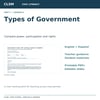
Civic Literacy U1 L4 | Types of Government Around the World
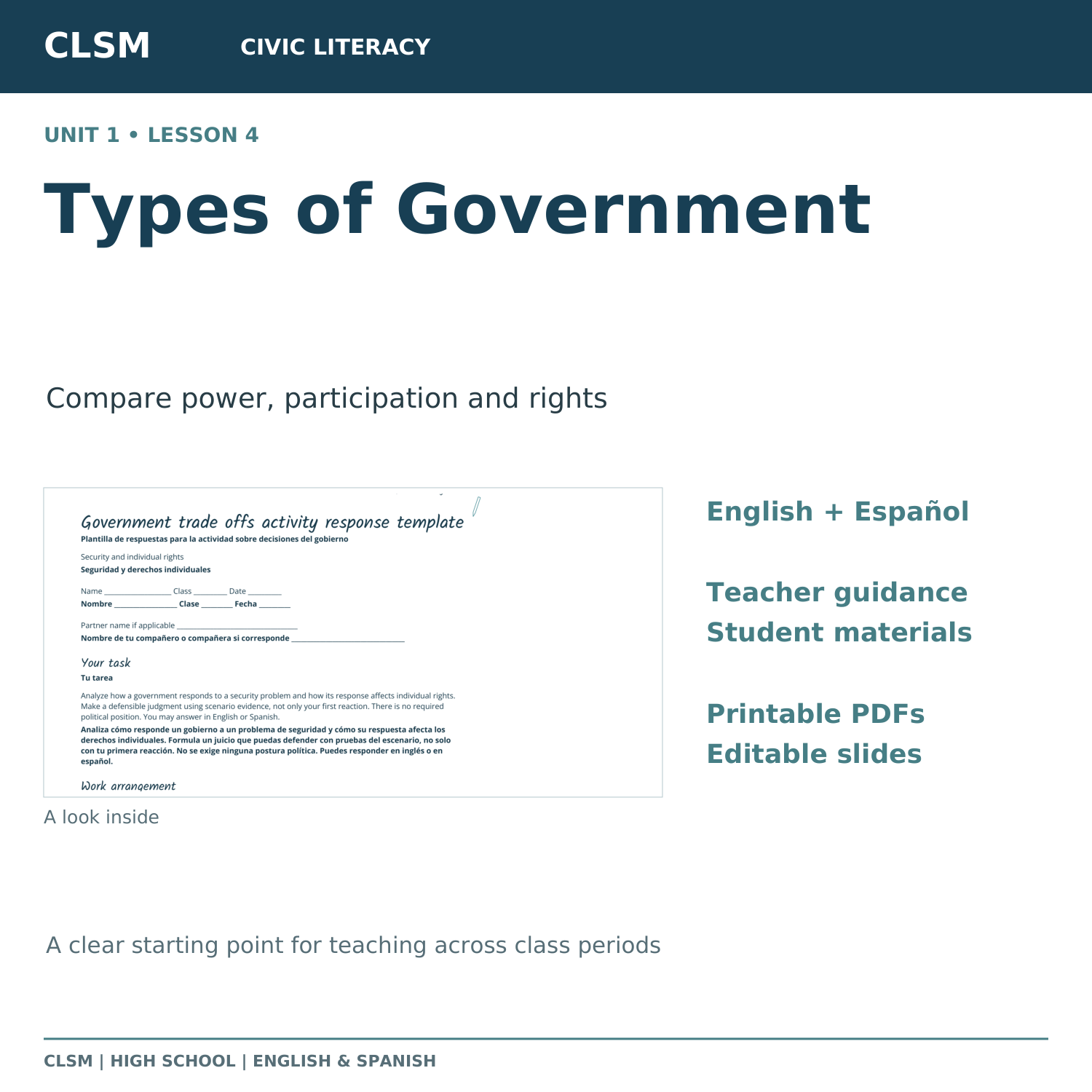
Types of Government Around the World | Civic Literacy Unit 1, Lesson 4
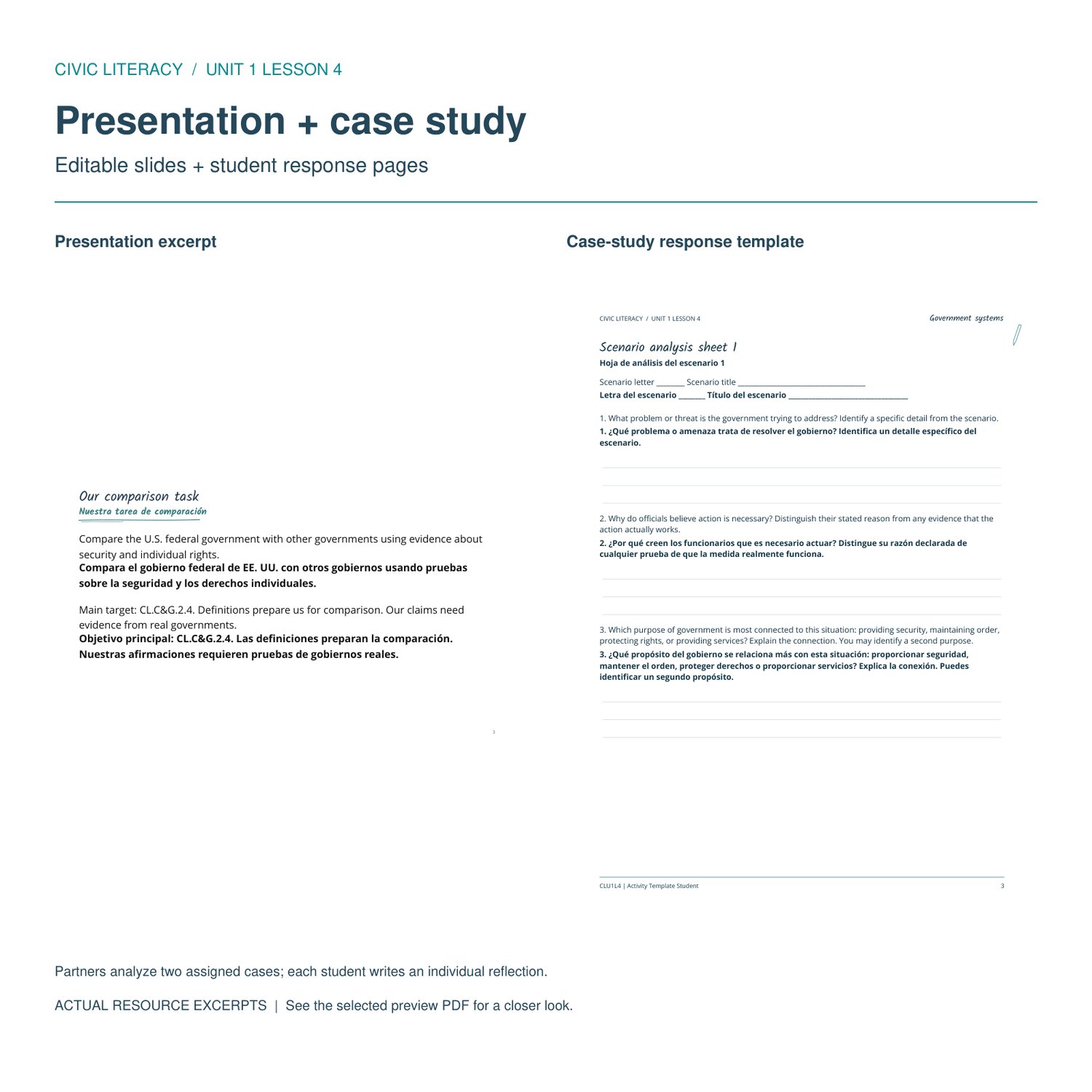
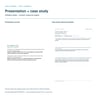
Partners analyze Government Trade-Off cases to decide how a government should balance security and individual rights. They support a judgment with evidence, consider a counterargument, and propose an alternative. Each student then writes an individual reflection. The cases are hypothetical and allow different defensible conclusions.
The lesson compares government systems and distinguishes authority from legitimacy. Three expanded scenarios give you choices: pairs analyze two assigned cases, while the individual differentiation option uses one. A response template, analytic rubrics, and teacher reasoning guide support the discussion and written work.
What’s included
• A 35-slide editable PowerPoint and matching PDF.
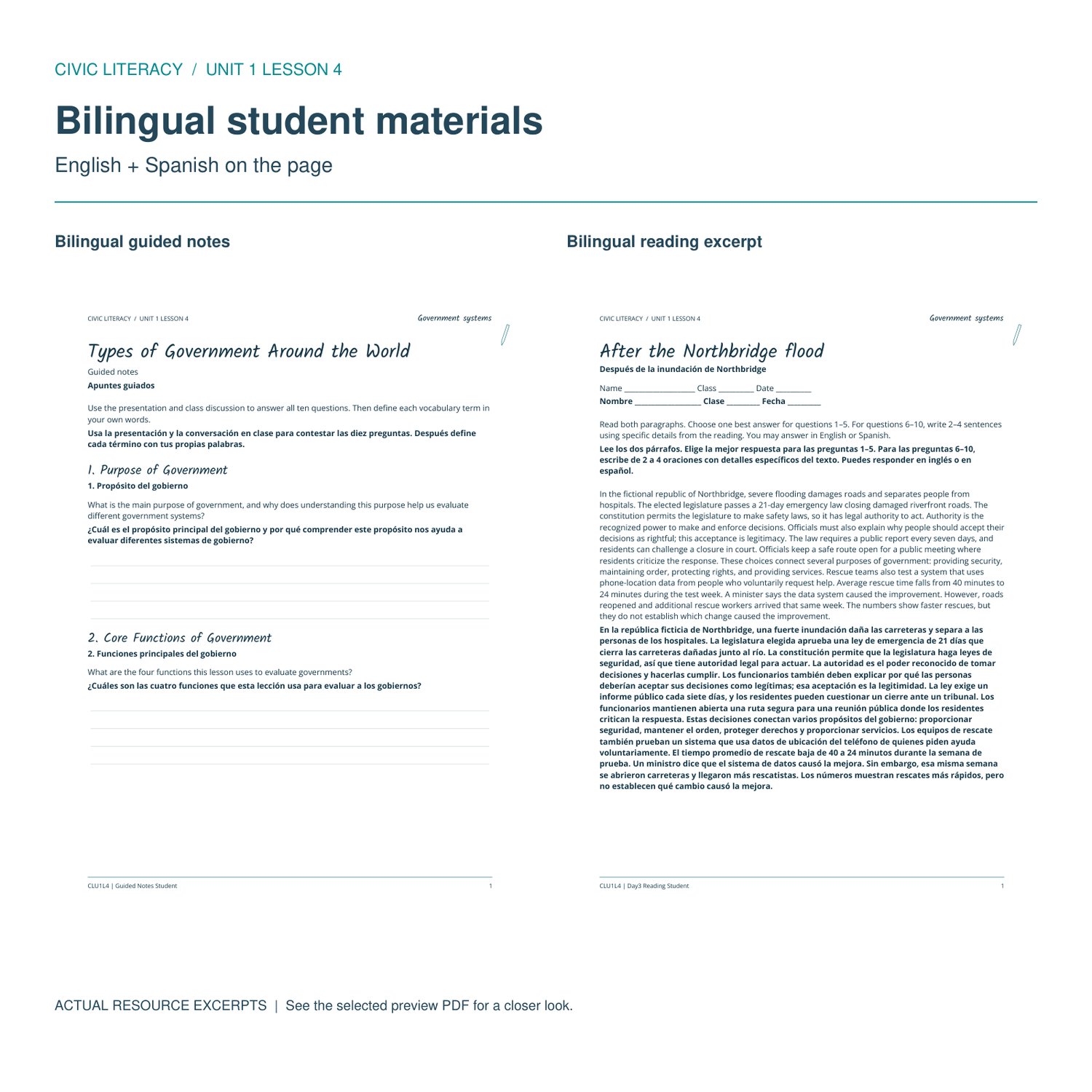
• Guided notes with ten questions and ten vocabulary terms, plus an explained teacher key.
• A 15-question multiple-choice quiz with complete bilingual questions, choices, answers, and explanations in the teacher edition.
• Three Government Trade-Off scenarios, two case-analysis sheets, an individual reflection, rubrics, and teacher guidance.
• A bilingual two-paragraph reading with five multiple-choice and five short-answer questions and an explained teacher edition.
• Two recall sets with five content prompts and an opinion prompt each, expanded teacher explanations, and an optional bilingual review guide.
• Detailed English Day 1 lecture and Day 2 teaching bridge, lesson guide, sources, and credits.
Planning and language
Use the notes and presentation to introduce the concepts, then the quiz and case analysis to develop students’ reasoning. The reading and recall sets provide review and application. Adjust pacing to your class; the next lesson and unit assessment are not included.
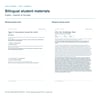
Student resources pair English with bold Spanish. Quiz and reading teacher editions are bilingual; detailed lectures and expanded recall explanations are English-only. Spanish is an instructional translation, not an official legal translation or certified reading-level result. Keep teacher keys and slide speaker notes separate from student files.
Standards and files
The teacher guide explains the government-comparison connection to North Carolina CL.C&G.2.4. No district assessment match, official endorsement, or accessibility certification is claimed. The hypothetical cases are teaching scenarios, not legal rulings about named countries.
The ZIP contains 37 static, nonfillable PDFs: 19 core files and eighteen color-accent alternatives, plus one editable PPTX. Choose one print design for each document; the alternatives repeat the same work and are not extra assignments.
Students can work on paper or read digitally and respond separately; the PDFs are not editable worksheets. PowerPoint text is editable, while illustrations remain images. No native Google Slides file or automatic grading is included. Check formatting after editing or opening in another presentation program, and retain the source, artwork, and font notices.
Resumen en español
En parejas, el alumnado analiza casos hipotéticos sobre seguridad y derechos, justifica una decisión, considera un contraargumento y propone una alternativa. Cada estudiante completa una reflexión. Incluye tres casos, plantillas, rúbricas, apuntes, cuestionario, repasos, lectura y claves. Los materiales estudiantiles son bilingües; las clases detalladas están en inglés. Los PDF no son interactivos y la presentación es editable. No incluye la siguiente lección ni la evaluación de la unidad.
CLASSROOM USE
One purchase covers one teacher’s classes, including sharing with enrolled students through a private classroom platform such as Google Classroom. Public posting, resale, and sharing the package with other teachers are not permitted.
DOWNLOAD HELP AND REFUNDS
Contact CLSM Learning Studio if you have a download problem or want to request a refund. Requests are reviewed case by case. This does not limit any rights required by law.