
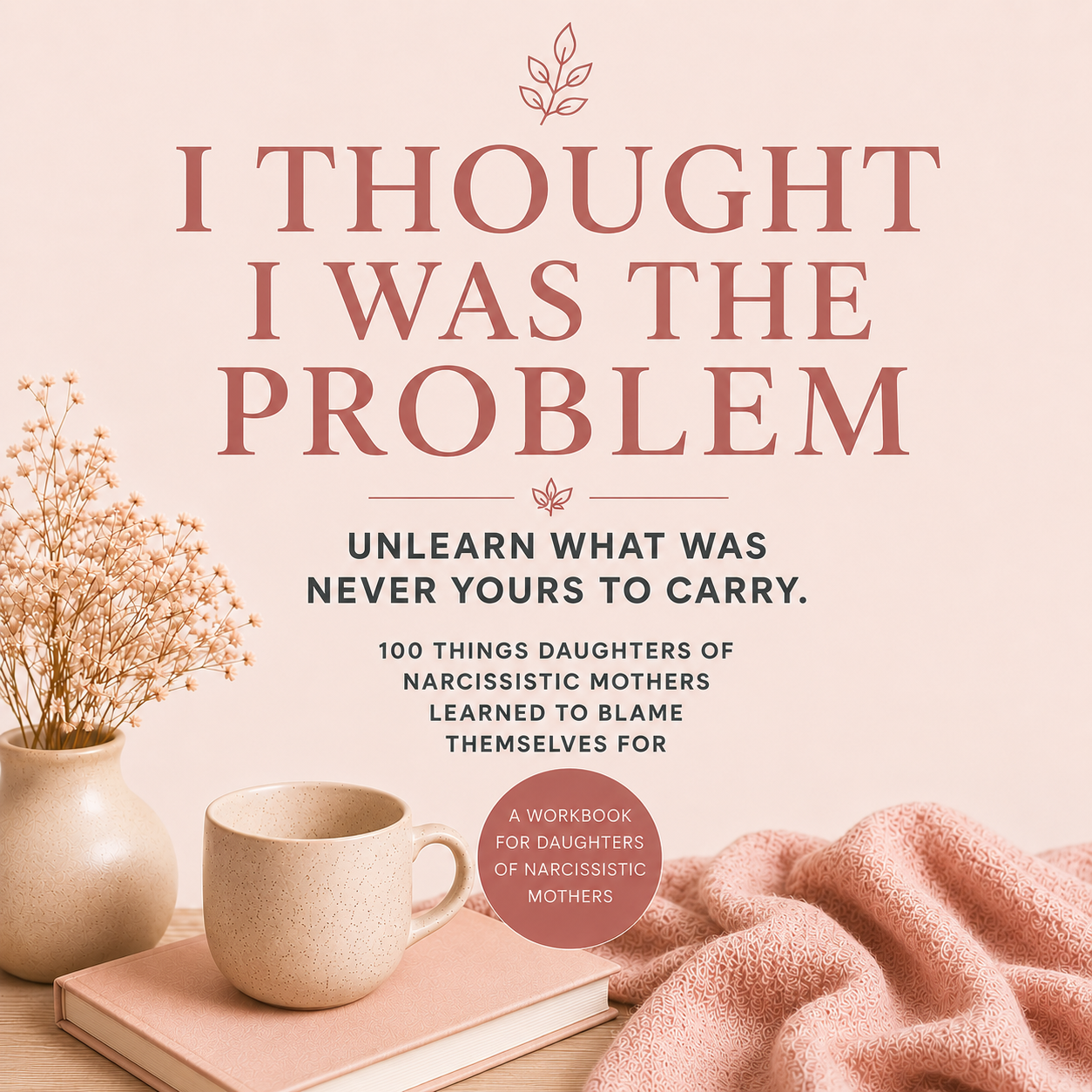
I Thought I Was the Problem: 100 Things Daughters of Narcissistic Mothers Learned to Blame Themselves For
I THOUGHT I WAS THE PROBLEM
Unlearn What Was Never Yours to Carry
You spent years trying to figure out what was wrong with you.
Why were you so sensitive?
Why did her criticism hurt so much?
Why could you never seem to make her happy?
Why did saying no make you feel guilty?
Why did her silence make you panic?
Why did you constantly question yourself after making a decision?
Why did you feel responsible for her moods, her disappointment, her loneliness—even her happiness?
And somewhere along the way, you may have reached the conclusion so many daughters of narcissistic mothers carry into adulthood:
Maybe I’m the problem.
But what if some of the things you spent years blaming yourself for were actually things you learned in order to survive the relationship you had with your mother?
You Were a Little Girl Before You Were an Adult Woman
You didn't grow up thinking:
“My mother is emotionally immature.”
“She's projecting onto me.”
“She's guilt-tripping me.”
“She's giving me the silent treatment because I set a boundary.”
You were a child.
So when your mother criticized you, you didn't question her.
You questioned yourself.
When she withdrew her affection, you wondered what you had done.
When she called you selfish, difficult, dramatic, ungrateful, or too sensitive...
you believed her.
When she was unhappy, you tried harder.
You became quieter.
More helpful.
More agreeable.
Less needy.
Less difficult.
Less you.
Because when you're little, keeping your mother's love can feel more important than protecting yourself from her.
And those childhood conclusions don't necessarily disappear just because you grow up.
You May Still Be Carrying Them Today
Maybe you apologize when you've done nothing wrong.
Maybe someone's disappointment immediately makes you question your decision.
Maybe you explain your boundaries over and over because simply saying no feels cruel.
Maybe criticism stays with you for days while compliments barely register.
Maybe you constantly wonder:
Am I being selfish?
Am I overreacting?
Was it really that bad?
Should I just let it go?
Maybe she didn't mean it that way.
Maybe it really was me.
That is exactly why I created I Thought I Was the Problem.
100 Things Daughters of Narcissistic Mothers Learned to Blame Themselves For
This isn't just a list of narcissistic mother behaviors.
It's designed to help you make the connection between what happened then and what you may still believe about yourself now.
For each pattern, you'll explore:
✓ What happened
✓ What you may have believed about yourself
✓ What you learned in order to adapt
✓ How that belief can follow you into adulthood
✓ A new rule to begin practicing
✓ A reflection to help you separate who you are from what you were taught to believe
So instead of only thinking:
“My mother did this.”
You can begin asking:
“What did this teach me about ME?”
Because that's often where the deepest impact lives.
This Workbook Was Created for You If:
• You constantly second-guess yourself.
• You feel guilty when you choose yourself.
• You struggle to say no without explaining why.
• You feel responsible when your mother is disappointed.
• You learned to monitor her moods before expressing your own needs.
• You still hear her criticism when you look in the mirror.
• You worry that having boundaries makes you selfish.
• You became the “good daughter” who kept the peace.
• You minimize your childhood because “other people had it worse.”
• You understand intellectually that your mother's behavior affected you—but part of you still wonders whether you were actually the problem.
The Question Isn't Only “What Did She Do?”
It's also:
What did I learn because of it?
Did I learn that love has to be earned?
That saying no makes me selfish?
That someone's disappointment means I've done something wrong?
That my feelings are too much?
That my needs inconvenience people?
That I have to explain myself to be allowed to make my own decisions?
That keeping everyone happy is my responsibility?
That criticism must be true?
That being loved requires becoming whoever someone else needs me to be?
Those beliefs can become so familiar that they stop feeling like beliefs.
They start feeling like who you are.
And that is what this workbook is designed to help you begin separating.
Maybe You Weren't the Problem.
Maybe people-pleasing helped you stay connected.
Maybe perfectionism helped you avoid criticism.
Maybe hyperawareness helped you predict her moods.
Maybe overexplaining helped you protect yourself from being misunderstood.
Maybe staying small helped you avoid becoming a target.
Maybe guilt helped keep you in the role of the “good daughter.”
Those patterns may have made sense in the environment where you learned them.
But understanding why they're there doesn't mean you have to keep living by them.
This Isn't About Blaming Your Mother for Everything.
And it isn't about pretending you're never responsible for your behavior.
It's about finally becoming curious about the beliefs you've spent years treating as facts about yourself.
“I'm selfish.”
“I'm too sensitive.”
“I'm difficult.”
“I'm never enough.”
“I can't trust myself.”
“I have to keep everyone happy.”
“Something is wrong with me.”
And beginning to ask:
Is this actually mine?
Or is this something I learned?
Digital PDF workbook. Save it to your phone, read it at your own pace, mark the patterns that feel familiar, journal through the reflections, and return to the new rules whenever an old belief gets loud again.
You spent years learning how to become the daughter she needed you to be.
Now you get to discover who you are underneath everything you learned to blame yourself for.