
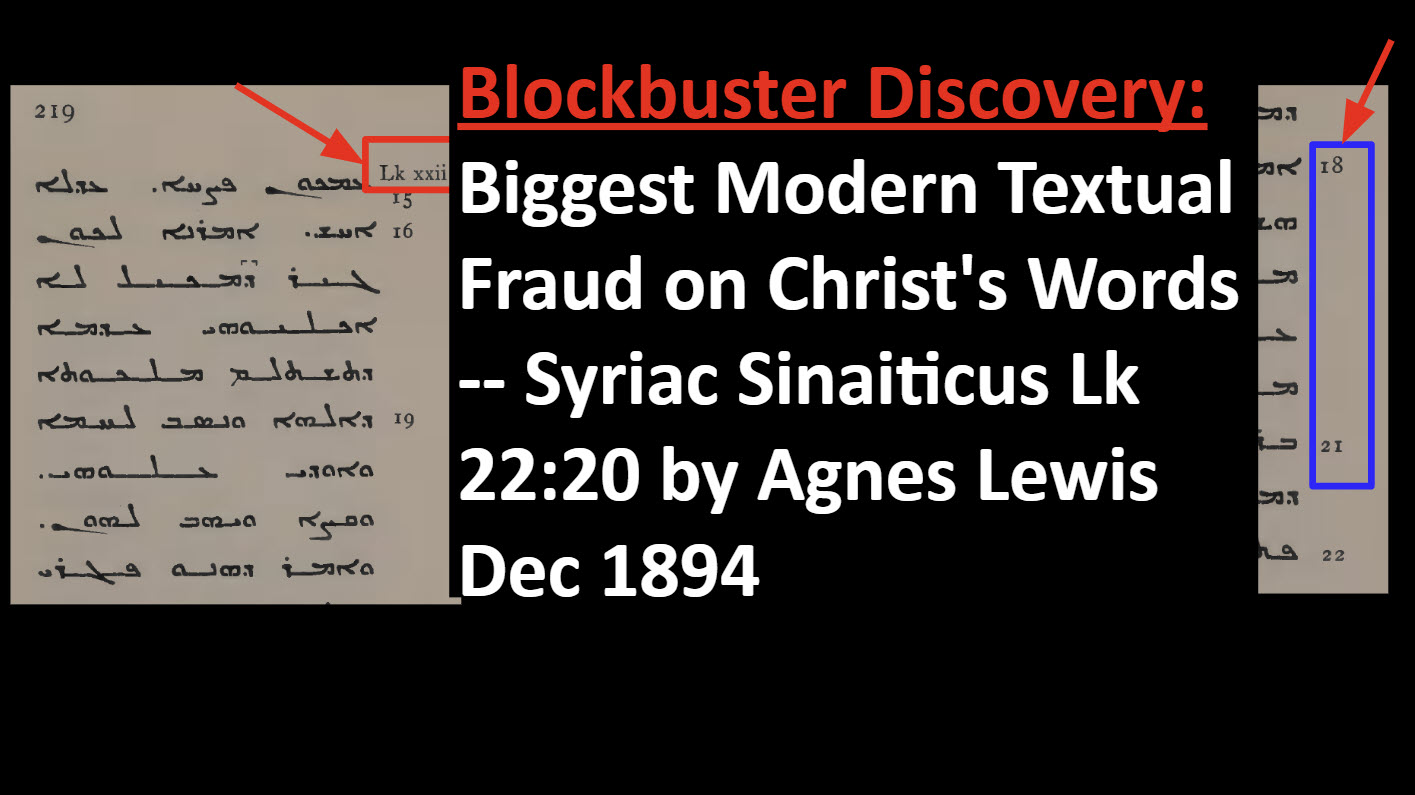
9 PDFS to prove Interpolation of "new" to Luke 22 v 20 of Syr Sin by Agnes Lewis in 1894 & 1896
Did Jesus ever say the words "New Covenant" or "New Testament" at the Last Supper? Or was it added by later scribes and obscured by a 19th-century translation cover-up?
In our video released August 23, 2026, we crack open one of the most explosive and long-hidden secrets in Christian textual criticism. When wealthy manuscript hunter Agnes Smith Lewis discovered the Second Century Syriac Sinaiticus palimpsest at Mount Sinai in 1892, she brought back a text older than any Greek codex. But she also brought back a storm of controversy.
First, her manuscript filled in the missing 14th generation of Matthew’s genealogy, reading: "Joseph begat Jesus"—triggering a national "heresy" panic in Victorian Britain that accused her of denying the virgin birth. Then, in Luke 22:20, her manuscript revealed a "one-cup" Last Supper liturgy that lacked the word "new" (ܚܕܬܐ / khadtha) as a modifier to "covenant" -- similar to how Mark and Matthew now universally reads for all new Bibles published since 1946 now read - "blood of the covenant" but not of a "new" covenant.
Terrified of being branded a heretic twice over, Agnes Lewis added the word "new" to the English word "testament" (more accurately "covenant") to both her 1894 and 1896 English translations, masking the raw under-text from the English public.
But the raw academic truth has a way of breaking free. By looking directly at George Kiraz’s 1996 Comparative Edition of the Syriac Gospels -- agrees with the October 1894 The Four Gospels in Syriac by Bensley and his team, we show you the raw Syriac characters:
ܗܢܐ ܕܕܡܝ ܕܕܝܬܩܐ
(Hana d-demy d-diyatheqe): "This is of my blood of the covenant".
The word "new" in Kiraz' work is marked with a clear physical X omission placeholder! That X means "new" is not modifying the word for "covenant" (testament). See also Bensley's 1894 The Four Gospels in Syriac.
Even more shocking, we examine how the United Bible Societies (UBS5) critical apparatus continues to rely on these "smoothed-over" (false) English translations, UBS5 omitting key witnesses like the Syriac Sinaiticus and Syriac Cureton from the list of earliest texts lacking this "new" altogether.
The Star of the Show: Verifiable Biblical Studies with AI!
This video serves as a "proof positive" case study of how Gemini Notebook has revolutionized biblical studies. You no longer need a PhD in Semitic languages to verify these manuscripts. Using Gemini Notebook, you can easily read, translate, and verify ancient Syriac and Greek texts yourself—bypassing 130 years of translation smoothing and theological shielding.
Want to run these tests yourself? Check out the documents we provide for download-- our exclusive study packet containing the raw transcriptions of the following works: [1] the October 1894 The Four Gospels in Syriac by the top Cambridge Syriac language experts under Bensley (see page 219); [2] Agnes Lewis’s 1894 and 1896 translations of the Syriac Sinaiticus; [3] the relevant comparative pages from George Kiraz’s 1996 / 2004 Comparative Edition of the Syriac Gospels pages 443-444 (authorized in copyright as "fair use"); and [4] USB5th Edition 2014 pages 287-88 relating t Luke 20:19-20 -- permitted by the "fair use" authority.
🔗 Get the PDF Study Packet ($40) above to replicate the the steps to reach the conclusions above.