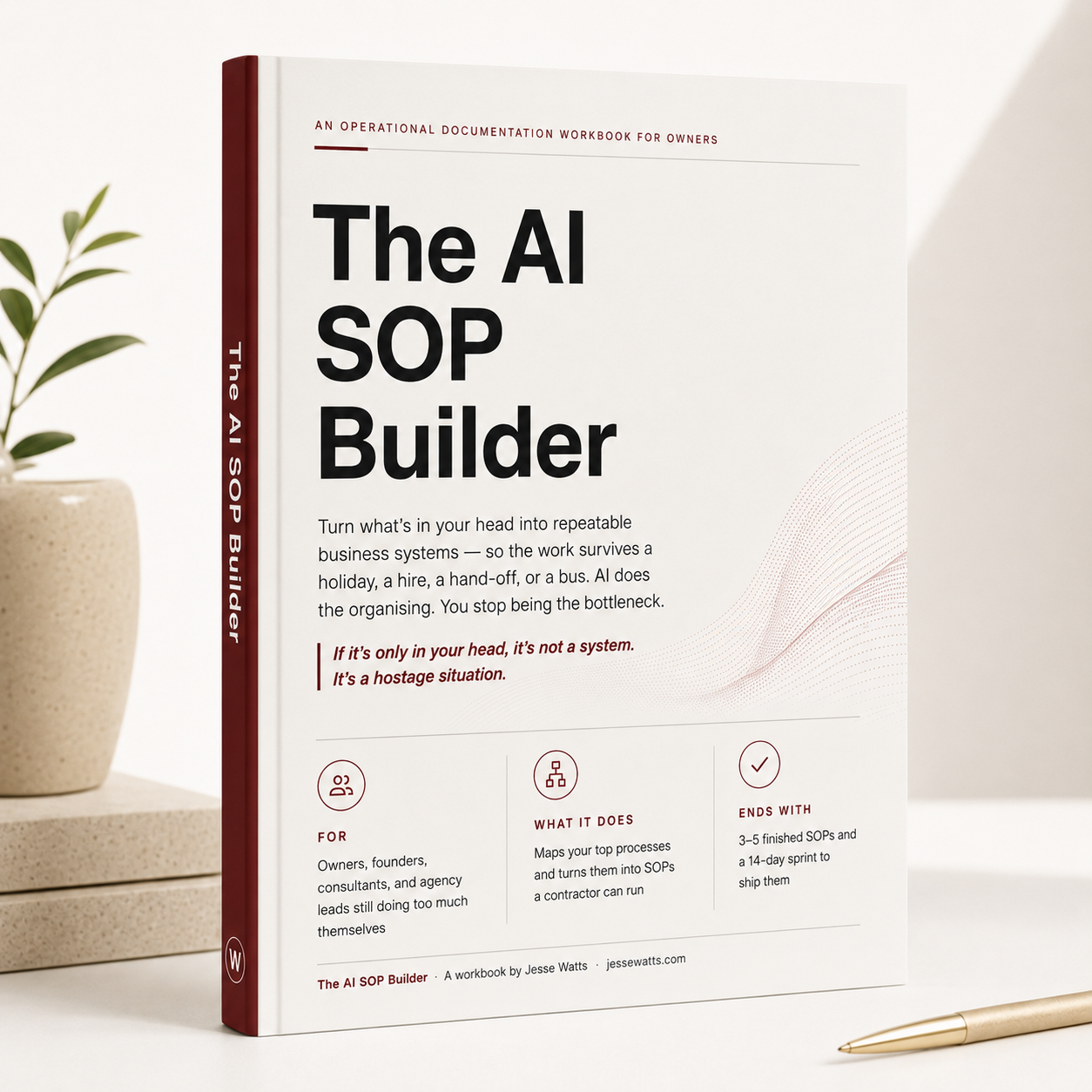
Turn recurring tasks into clear, repeatable SOPs your team, contractor, VA, or future hire can actually follow.
A business that lives in your head does not scale.
It cannot be delegated cleanly.
It punishes you for taking time off.
It makes every new hire harder to train.
And it keeps dragging you back into work someone else should eventually be able to do.
The AI SOP Builder helps you document the recurring work that keeps your business running — without turning it into a bloated corporate manual nobody reads.
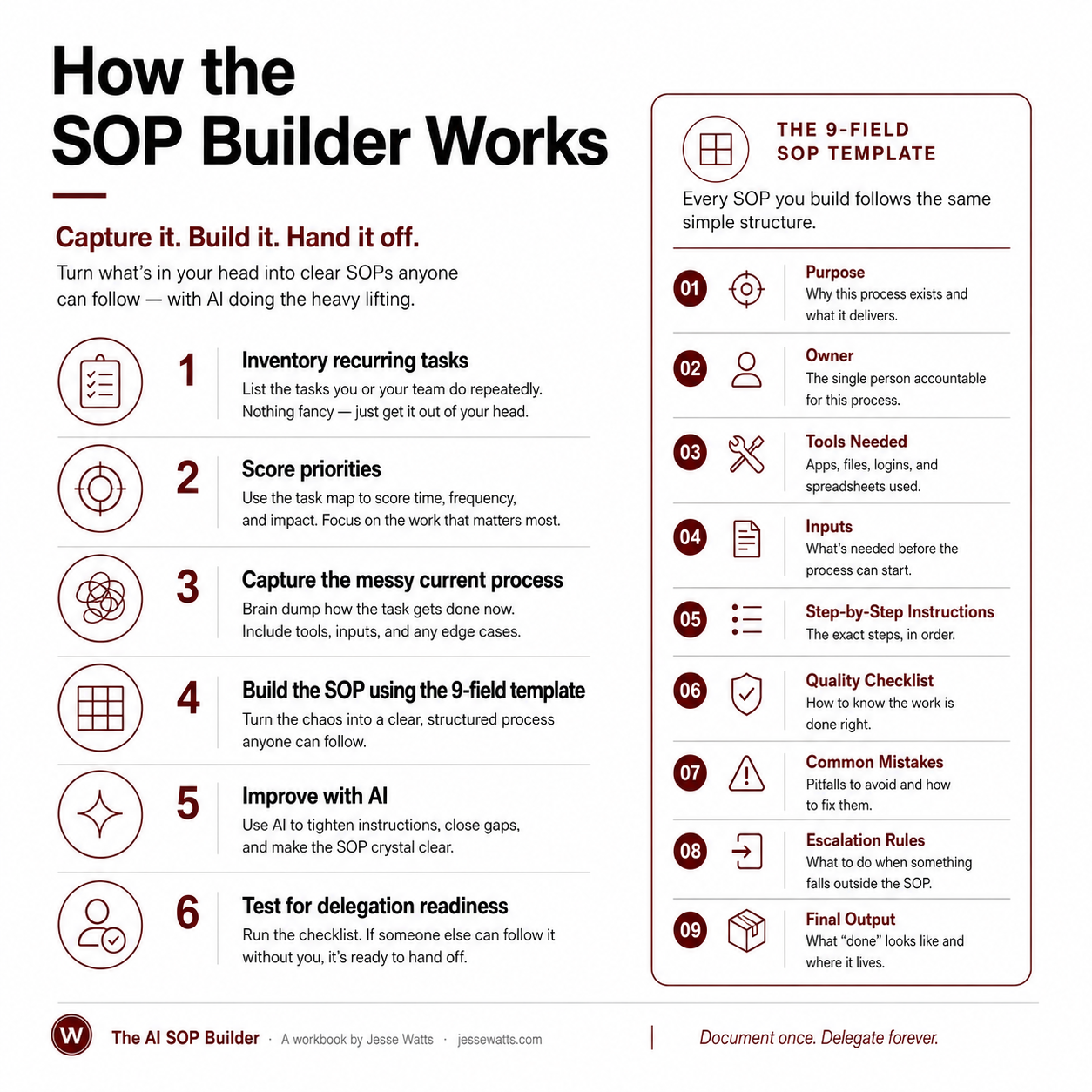
You’ll inventory the work, prioritize the most valuable processes, capture the messy current version, use AI to organize and improve the draft, test it for delegation readiness, and follow a 14-day sprint to get 3–5 SOPs documented and handed off.
Get the AI SOP Builder
Instant download · Digital PDF workbook · Build 3–5 SOPs in 14 days
Who It’s For
This workbook is built for:
Business owners who are still the only person who knows how too many recurring tasks get done.
Ecommerce founders who need to document product uploads, campaigns, support replies, reporting, promotions, admin, and fulfilment processes.
Agency owners and consultants who want to stop reinventing the same client work, reporting process, onboarding flow, or delivery system every time.
Small teams preparing to hire, delegate, or outsource but lacking the documentation to make handoff realistic.
Operators who want AI to help organize knowledge without pretending AI should decide how the business works.
The workbook is explicitly designed for owners, founders, consultants, and agency leads still doing too much themselves, and it ends with 3–5 finished SOPs plus a 14-day sprint to ship them.
Format & Delivery
Format: Digital PDF workbook
Length: 27 pages
Delivery: Instant download after purchase
Access: Delivered by email
Best used with: A notebook, your calendar, your current tools, and one recurring task you know you need to stop owning alone
What’s Inside
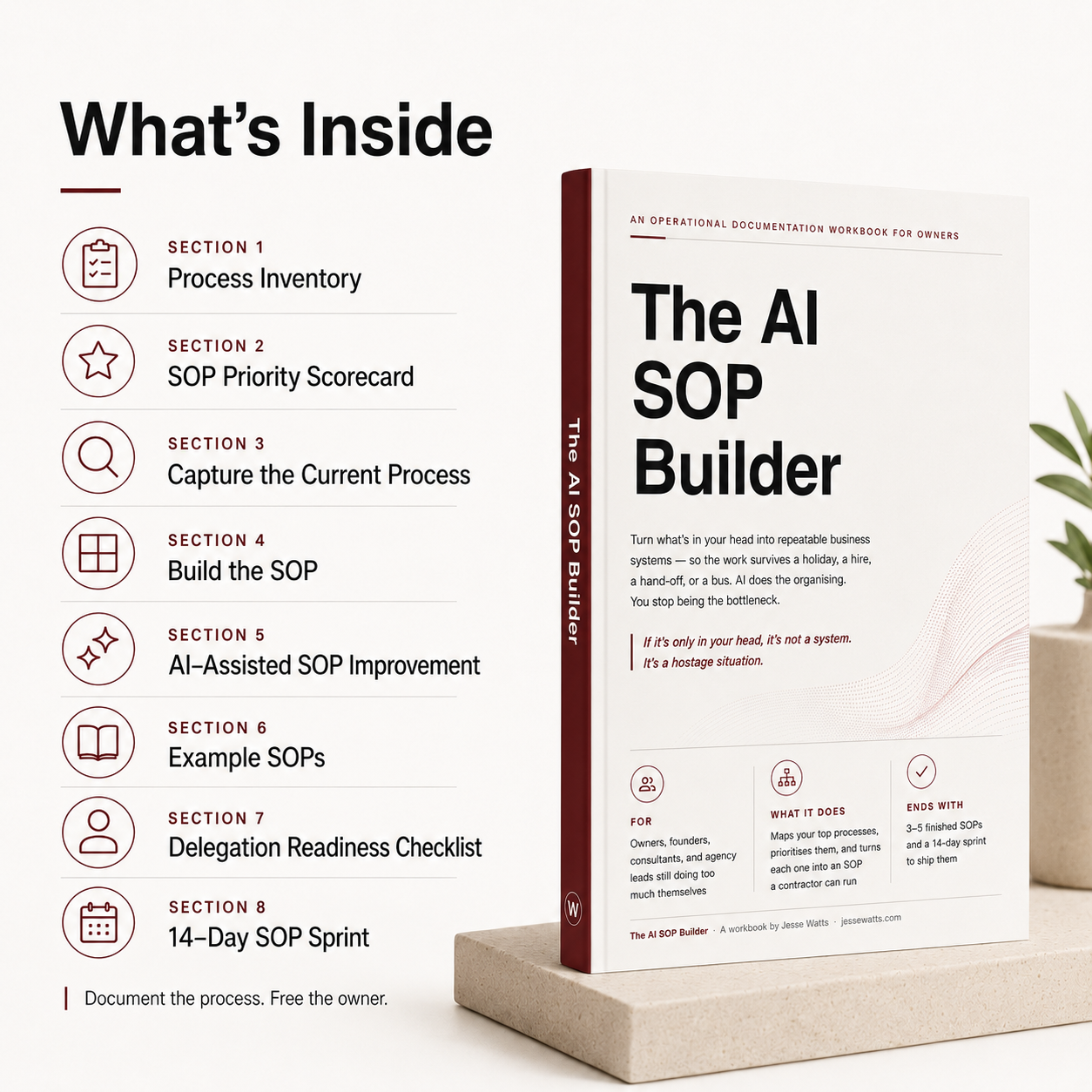
1. Process Inventory
A worksheet for listing recurring tasks across eight business categories: marketing, sales, customer service, operations, admin, fulfilment, reporting, and content creation. The goal is to identify the tasks only the owner currently knows how to run.
2. SOP Priority Scorecard
A six-criteria scoring system that ranks tasks by frequency, risk of mistakes, time required, delegation potential, revenue impact, and owner dependency. The workbook recommends documenting the top three to five tasks first.
3. Capture the Current Process
A seven-question worksheet for capturing the messy version of the process before trying to write the clean SOP. It covers triggers, current owner, tools used, step order, decisions made, common mistakes, and what “done correctly” looks like.
4. Build the SOP
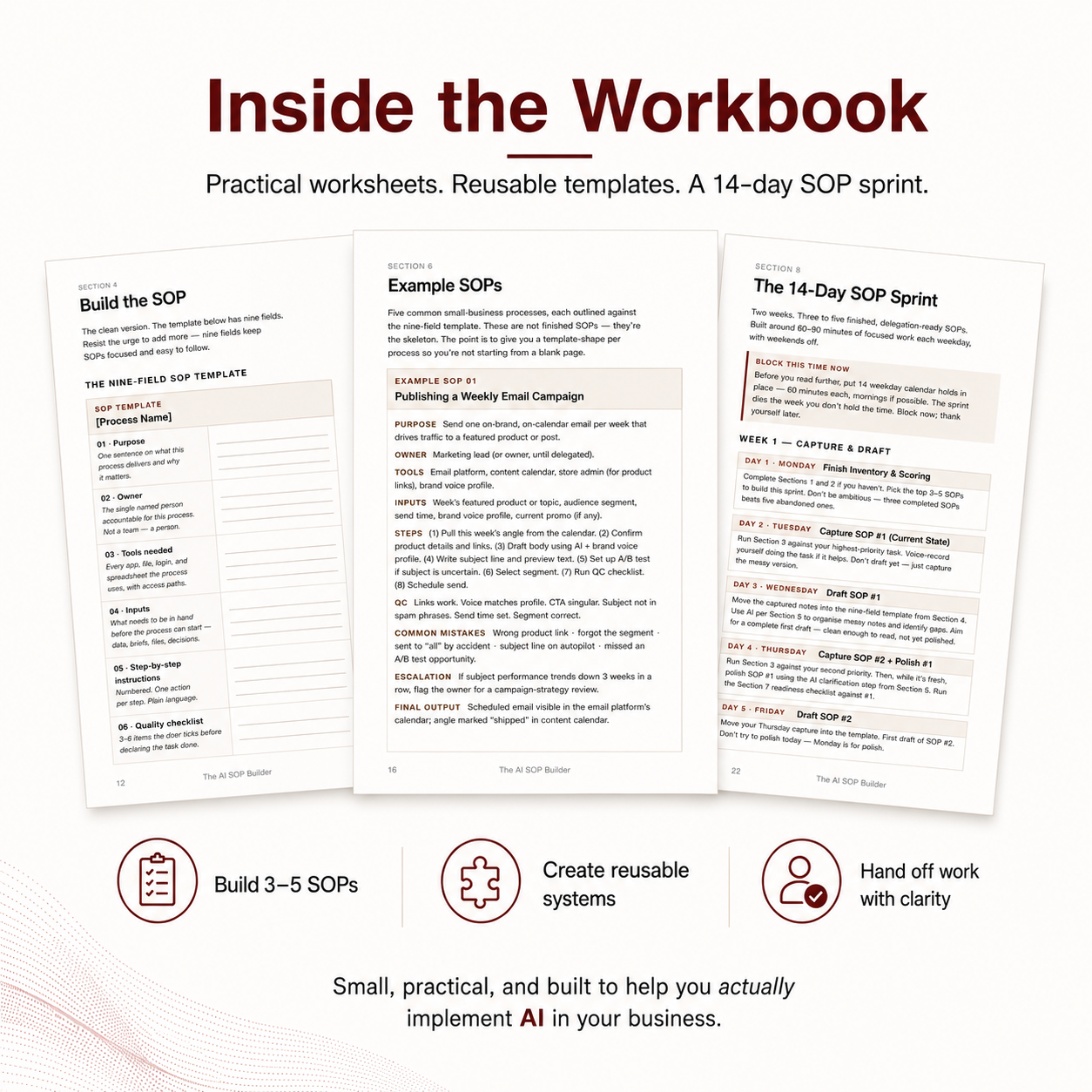
A simple nine-field SOP template: purpose, owner, tools needed, inputs, step-by-step instructions, quality checklist, common mistakes, escalation rules, and final output. The workbook deliberately keeps the template lean so SOPs stay usable.
5. AI-Assisted SOP Improvement
Five practical ways AI can help improve SOPs: organizing messy notes, clarifying vague steps, identifying missing details, converting rough instructions into checklists, and creating training documentation. The workbook is clear that AI helps structure and clarify — it does not replace owner judgment.
6. Example SOPs
Five example SOP outlines for common small-business processes: publishing a weekly email campaign, uploading a new product, creating a weekly marketing report, responding to common customer tickets, and preparing a promotion.
7. Delegation Readiness Checklist
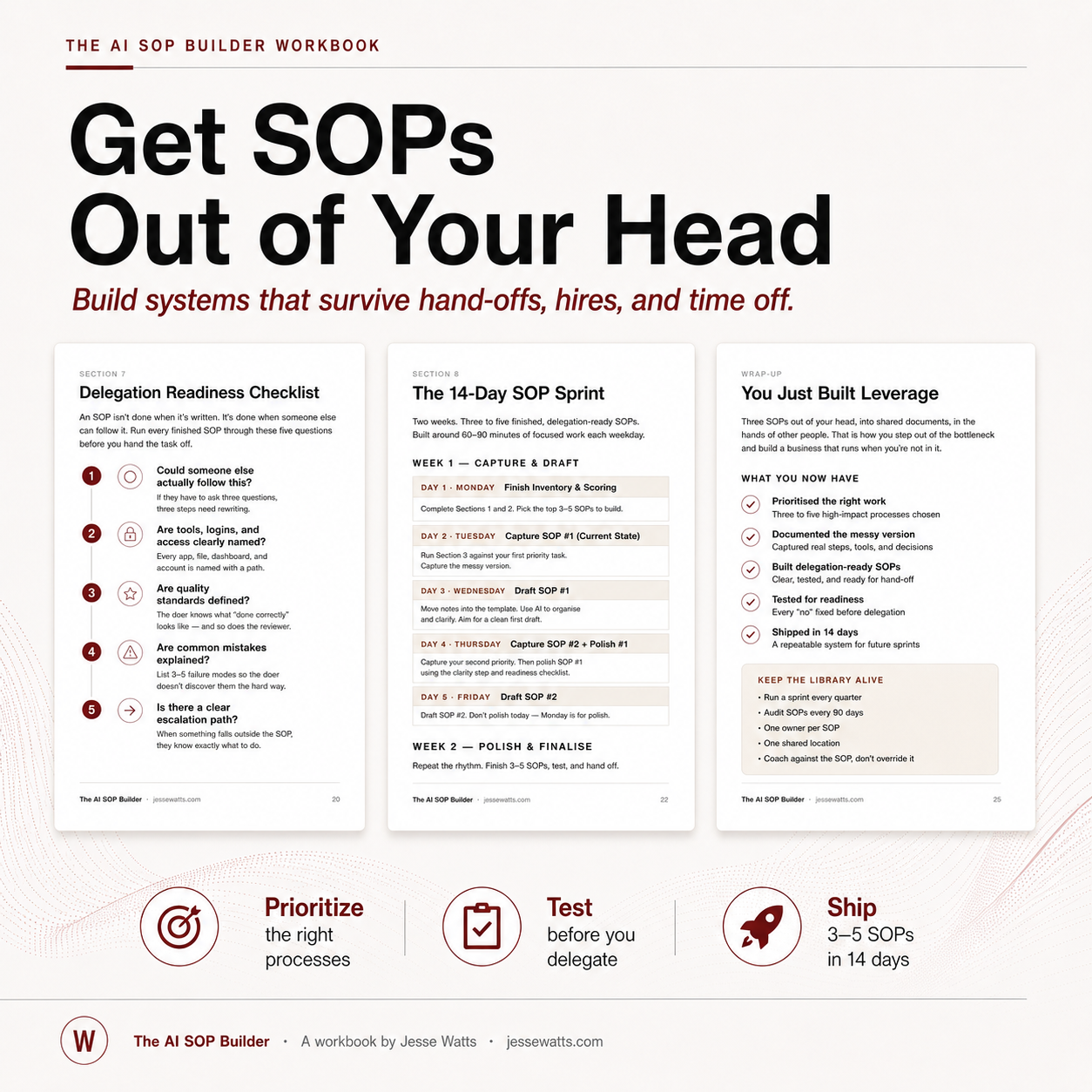
A five-question checklist for testing whether an SOP is actually ready to hand off. It checks whether someone else can follow it, whether tools and logins are clearly named, whether quality standards are defined, whether common mistakes are explained, and whether escalation rules are clear.
8. The 14-Day SOP Sprint
A two-week implementation plan designed to produce three to five finished, delegation-ready SOPs. The sprint includes inventory, scoring, capturing, drafting, polishing, testing, and handing off the first SOPs.
If It Only Lives in Your Head, It Is Not a System
A process you “just know how to do” is not really a process yet.
It is a dependency.
That dependency may not feel urgent when the business is small. But it becomes expensive fast: every handoff takes longer, every new contractor needs more explanation, every mistake comes back to you, and every vacation becomes conditional.
The AI SOP Builder helps you turn owner knowledge into business infrastructure.
Not by creating a 60-page operations manual.
Not by documenting every task in the business.
Not by pretending AI can run your company.
Instead, you identify the 3–5 processes most worth documenting, capture how they work now, turn them into clear SOPs, and test whether someone else can follow them.
That is the point: not documentation for its own sake, but freedom from being the only person who knows how the work gets done.
What You’ll Walk Away With
A clear inventory of recurring work
See what happens every week across marketing, sales, support, admin, reporting, content, and operations.
A ranked list of SOP priorities
Know which processes are worth documenting first instead of trying to document everything.
A captured current-state process
Get the messy version out of your head before trying to make it clean.
A simple nine-field SOP template
Create SOPs that are short, usable, and built for real small businesses.
AI-assisted improvement steps
Use AI to organize, clarify, tighten, and turn rough process notes into better documentation.
Five example SOPs
Borrow proven structures for common business processes instead of starting from scratch.
A delegation readiness checklist
Test whether the SOP can actually be followed by someone else.
A 14-day sprint
Ship 3–5 SOPs in two weeks without trying to rebuild your entire business at once.
This Is Not Corporate Documentation Theatre
This workbook is not about creating giant SOP binders nobody reads.
It is not about documenting every tiny action your business takes.
It is not about turning a small business into a bureaucracy.
The goal is practical: write down the recurring work that matters most, in a format someone else can follow, so the business becomes easier to run.
SOPs are not paperwork.
Done properly, they are leverage.
Build the Systems Your Business Should Already Have
Stop carrying every process in your head.
Pick the recurring tasks that matter most. Capture the messy version. Turn them into usable SOPs. Test them. Hand them off.
That is how the business starts becoming an asset instead of a job you have to personally hold together.
Get the AI SOP Builder
Instant download · Digital PDF workbook · Build 3–5 SOPs in 14 days