
Creative portfolios often fail because they try to preserve everything. Every experiment, client revision, student project, and recent commission receives a place. The result may be complete, but it is rarely convincing. A portfolio is not an archive of activity. It is an argument for the work you want next.
Begin by writing one sentence: I want to be hired for… If a project does not strengthen that sentence, it should not lead the portfolio. It may belong deeper in the site, in a process journal, or nowhere at all. Editing is not erasing your history; it is giving your direction a visible shape.
THE THREE-PROJECT TEST
Choose only three projects and place them in order. The first should establish your strongest point of view. The second should reveal range without breaking the story. The third should leave a memorable emotional or technical impression. If those three projects create a coherent portrait, the rest of the portfolio becomes supporting evidence.
Case studies should show decisions, not merely outputs. Describe the constraint that mattered, the false direction you rejected, the system you built, and the effect of the final work. Process is compelling when it demonstrates judgment. A wall of sketches without interpretation is still an archive.
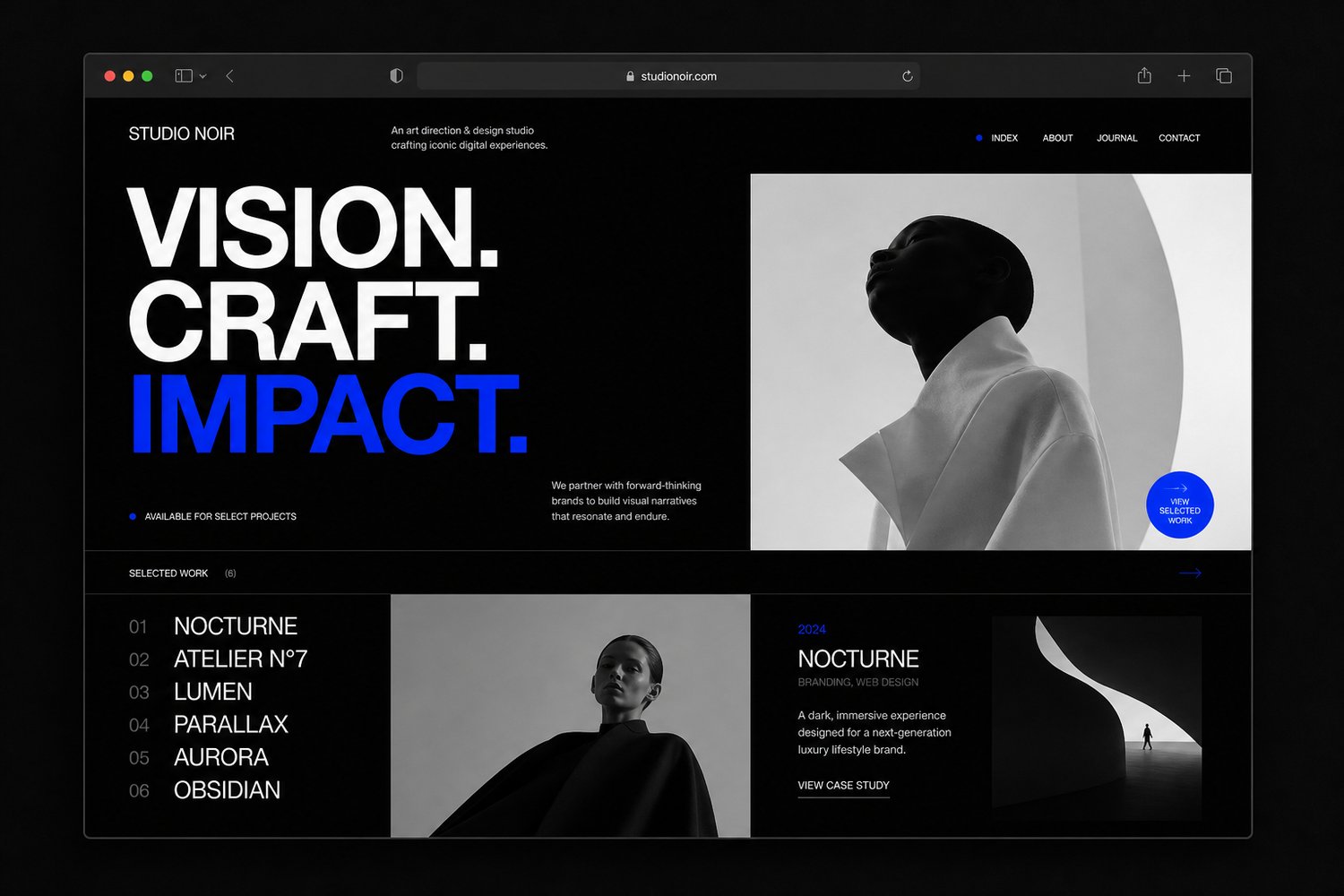
Studio Noir uses dramatic contrast and restrained typography to make visual work feel authored. The dark environment is not a shortcut to sophistication; it is a frame designed for photography, identity systems, motion stills, and art direction with strong color.
Pay attention to endings. Many case studies fade out after the final mockup. Close with what changed, what you learned, or how the system continued beyond the launch. An ending turns documentation into narrative.
The best portfolio leaves a little unsaid. It gives a future collaborator enough evidence to imagine what you could make together.
Explore Studio Noir:
https://downsstore.com/b/tPq0O