
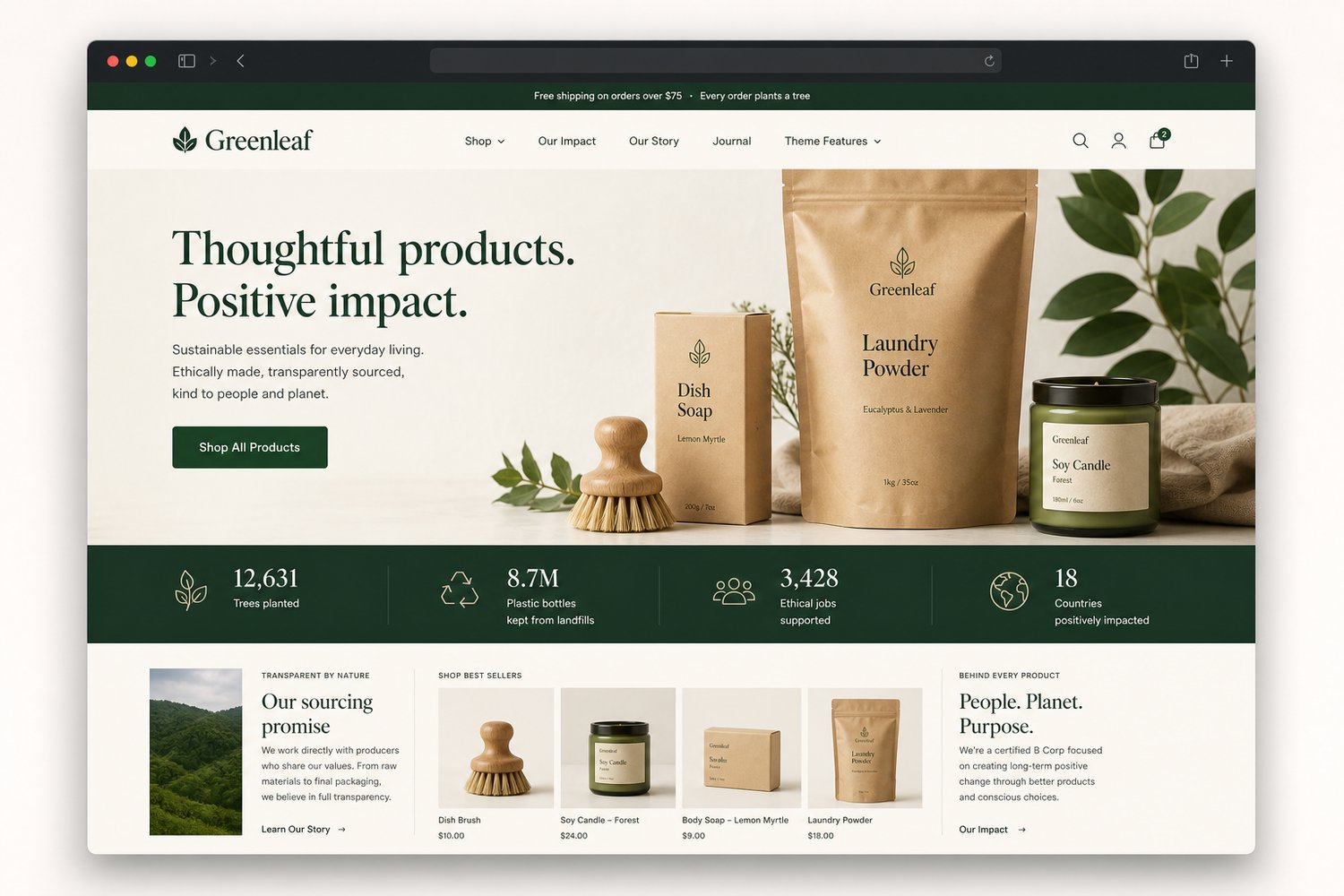
A green palette can signal nature in a fraction of a second. It cannot prove a responsible supply chain, explain a material choice, or show what happens at the end of a product’s life. For sustainable brands, visual language creates the invitation; evidence earns belief.
Begin with the claim a customer is most likely to question. If the product is lower-impact, lower than what—and measured how? If packaging is recyclable, in which systems? If production is local, how close and why does it matter? Specific answers are more beautiful than broad virtue because they respect the reader’s intelligence.
THE CREDIBILITY LAYER
Place proof near the claim it supports. A materials statement belongs beside the product, not buried in a distant responsibility page. Certifications should include plain-language context. Progress reports should acknowledge the work that remains. Transparency becomes persuasive when it is useful rather than ceremonial.
Photography can also document rather than decorate. Show the material source, the workshop, the repair process, the refill system, or the people responsible for a stage of production. Images with informational value deepen the brand story and reduce dependence on visual clichés.
Greenleaf provides an earthy but disciplined framework for this communication. Its layout can hold product stories, impact data, maker profiles, and practical calls to action without losing warmth. The visual system signals care while leaving room for substantiation.
Try a language audit. Highlight every word that implies goodness—clean, conscious, ethical, natural, responsible. For each one, add a fact or remove the adjective. The page will become shorter, stronger, and more trustworthy.
Sustainability communication should feel less like a halo and more like an open notebook: clear decisions, visible tradeoffs, measurable progress, and an invitation for customers to participate.
Explore Greenleaf:
https://downsstore.com/b/jktq8