

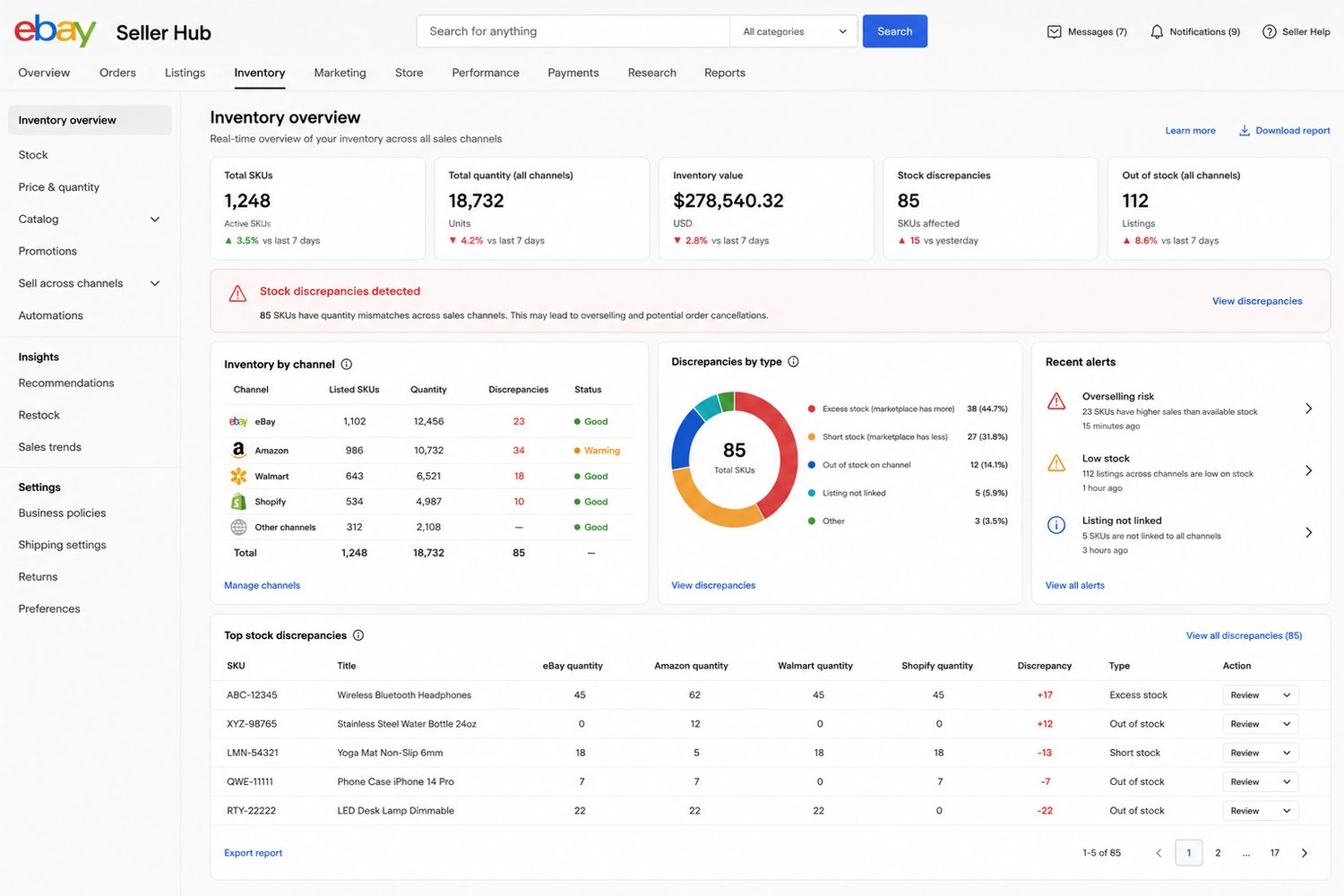
Discover why inventory sync issues increase as ecommerce stores grow. Learn how app conflicts, delayed updates, multi-channel selling, and manual overrides create overselling and stock errors.
The Hidden Sync Problems Behind Overselling and Stockouts
Many ecommerce store owners assume inventory errors happen because someone made a mistake.
Sometimes that's true.
But as stores grow, inventory problems often become system problems rather than human problems.
What worked when managing 20 orders per week can quickly fail when managing hundreds.
As order volume increases, inventory data must move between:
- ecommerce platforms
- marketplaces
- fulfillment software
- warehouse systems
- inventory applications
- shipping platforms
The more systems involved, the more opportunities exist for synchronization delays.
And that's where inventory errors begin multiplying.
Growth Exposes Inventory Weaknesses
Many stores operate successfully at smaller volumes despite having weak inventory controls.
The weaknesses simply remain hidden.
When growth occurs:
- orders arrive faster
- inventory changes more frequently
- products sell across multiple channels
- system updates happen continuously
Small delays that were previously harmless suddenly become costly.
A five-minute inventory delay may not matter when selling a few products daily.
But during peak sales periods, those same delays can create overselling events, stockouts, and customer complaints.
Growth doesn't create inventory problems.
Growth reveals them.
Multi-Channel Selling Creates New Inventory Risks
Selling across multiple channels increases revenue opportunities.
It also increases complexity.
A product may be listed simultaneously on:
- Shopify
- eBay
- Amazon
- Etsy
- Walmart Marketplace
- social commerce channels
Each sale must update inventory accurately across every connected platform.
If synchronization is delayed, multiple buyers may purchase the same item before inventory adjusts.
This leads directly to:
- overselling
- order cancellations
- refund requests
- delayed fulfillment
- buyer dissatisfaction
The more channels involved, the greater the need for inventory visibility.
App Conflicts Often Create Invisible Inventory Problems
Modern ecommerce stores rely heavily on third-party applications.
Many merchants install apps to manage:
- inventory
- bundles
- subscriptions
- warehouses
- shipping
- forecasting
- marketplaces
Each application may modify inventory differently.
Problems arise when multiple systems attempt to update the same inventory records simultaneously.
For example:
- one app reserves inventory
- another updates stock counts
- a third pushes marketplace quantities
When systems compete for control, inventory accuracy can deteriorate rapidly.
Store owners often don't notice until customers start reporting problems.
Delayed Inventory Updates Cause Overselling
Inventory synchronization is rarely instantaneous.
Every platform processes updates differently.
Delays can occur because of:
- API limitations
- application processing queues
- server congestion
- marketplace update schedules
- software integration issues
These delays create temporary gaps between actual inventory and displayed inventory.
During high-demand periods, those gaps become dangerous.
Customers continue purchasing products that are no longer available.
The result is often:
- canceled orders
- refund requests
- negative reviews
- damaged buyer trust
Related Reading:
Why Customer Complaints Usually Start Before Customers Complain
Manual Overrides Create Hidden Inventory Conflicts
Many growing stores still rely on manual corrections.
Staff frequently adjust inventory because:
- stock counts seem incorrect
- products appear unavailable
- marketplaces show outdated quantities
- fulfillment discrepancies emerge
While manual overrides may solve immediate problems, they often create new synchronization conflicts.
When employees make adjustments without understanding how connected systems interact, inventory
records become increasingly unreliable.
The issue is not the correction itself.
The issue is that manual fixes often hide underlying system failures.
Stockouts Are Often Data Problems
Many merchants view stockouts as purchasing failures.
In reality, stockouts frequently originate from inventory visibility problems.
Stores may have inventory physically available while systems display inaccurate counts.
This can happen because:
- products are reserved incorrectly
- inventory locations are misconfigured
- updates fail between systems
- synchronization delays occur
The business doesn't lack inventory.
The business lacks accurate inventory information.
And inaccurate information creates operational friction throughout the organization.
Why Inventory Errors Increase Customer Support Volume
Inventory issues rarely stay inside operations.
Customers quickly experience the consequences.
Inventory inaccuracies often lead to:
- delayed shipments
- unexpected cancellations
- fulfillment substitutions
- refund requests
- repeated order inquiries
Support teams then spend time managing preventable problems.
As inventory accuracy declines, customer service workload rises.
What appears to be a support issue is often an inventory systems issue.
Related Reading:
Why Operational Delays Create More Support Tickets
The Goal Is Inventory Visibility, Not Just Inventory Counts
Many businesses focus on counting inventory.
Fewer focus on visibility.
Modern inventory management requires confidence that every connected system reflects reality.
Healthy operations prioritize:
- real-time inventory visibility
- consistent system integrations
- controlled application environments
- inventory audit procedures
- standardized adjustment processes
The objective is not perfection.
The objective is predictability.
Because predictable inventory creates predictable fulfillment.
And predictable fulfillment creates buyer confidence.
Final Thoughts
Inventory errors become more common as stores scale because growth increases operational complexity.
The biggest risks often come from:
- inventory sync issues
- multi-channel selling
- delayed updates
- app conflicts
- manual overrides
- visibility gaps
Most overselling and stockout problems do not originate in the warehouse.
They originate in the systems responsible for tracking inventory.
The stores that scale successfully are not necessarily the ones with the most inventory.
They are the ones with the most reliable inventory visibility.
Download the Free eBay Seller Compliance Risk Audit
Inventory problems rarely begin in the warehouse.
They usually begin inside disconnected systems.
Learn how structured operational controls help growing ecommerce businesses reduce inventory errors, improve visibility, and scale with greater confidence.
👉 eBay Seller Compliance Risk Audit
 About the Author
I work with Shopify and eBay sellers to identify and stabilize operational systems before fulfillment pressure turns into customer complaints, refunds, and margin loss.
My focus is helping stores handling 10–30 orders per day build resilient workflows that scale without creating hidden operational stress.
👉 Download the free fulfillment audit: eBay Seller Compliance Risk Audit
📢 Share This
Found this useful? Share it with other operators: