
Why Delayed Fulfillment Creates Refund and Complaint Chains
Many online stores focus on marketing performance.
They track ad spend, conversion rates, and customer acquisition costs.
But a large number of operational problems begin after the sale is made.
Orders sit in processing queues.
Inventory confirmations take longer than expected.
Shipping labels are generated late.
These delays create order processing bottlenecks, one of the most common operational problems in eCommerce.
Platforms like Shopify stores and marketplaces such as eBay both rely heavily on consistent fulfillment workflows.
When order processing slows down, it triggers a chain reaction that often leads to refunds, complaints, and declining customer satisfaction.
For stores processing 10–30 orders daily, bottlenecks often appear in subtle ways—queues, delays, or manual checks.
At this volume, even small slowdowns begin to stack.
What Is an Order Processing Bottleneck?
An order processing bottleneck occurs when a step in the fulfillment workflow slows down the movement of orders.
Instead of flowing smoothly from purchase to shipment, orders accumulate at a specific stage.
Examples include:
- manual order review taking too long
- inventory verification delays
- label creation queues
- warehouse picking backlogs
When these bottlenecks appear, the order fulfillment timeline becomes inconsistent.
Customers experience this as shipping delays, even if the warehouse eventually catches up.
Why Delayed Order Fulfillment Creates Refund Chains
Shipping delays rarely remain isolated incidents.
Instead, they create a chain of operational consequences.
The typical pattern looks like this:
- Orders remain in the processing queue longer than expected
- Customers begin asking for order updates
- Support teams respond manually to inquiries
- Frustrated customers request refunds or cancellations
- Negative feedback or disputes increase
Over time, even a small delay in processing can generate multiple operational problems.
Common Causes of eCommerce Order Processing Bottlenecks
Understanding the root causes helps store owners prevent these problems.
1. Manual Order Review Delays
Many stores manually review orders for:
- fraud risk
- address verification
- inventory confirmation
While manual checks can reduce risk, they can also slow down fulfillment if the review process lacks clear time limits.
Orders may remain unprocessed while teams prioritize other tasks.
Bottlenecks often lead to fulfillment delays, which contribute to refund patterns (see → Refund Pattern Analysis for eCommerce Stores).
2. Warehouse Processing Errors
Even well-organized warehouses experience occasional workflow issues.
Examples include:
- incorrect item picking
- misplaced inventory
- packaging delays
If warehouse teams must correct errors frequently, the order queue grows larger.
This creates a backlog that affects every order in the system.
In some cases, delays also cause inventory mismatches (explained here → Inventory Synchronization Failures in Online Stores).
3. Automation Misconfiguration
Automation tools are designed to speed up fulfillment, but incorrect configurations can create the opposite effect.
Examples include:
- apps delaying order routing
- incorrect supplier integration settings
- failed automation triggers
When automation fails silently, orders may remain in pending status without immediate detection.
4. Operational Queue Buildup
During promotions or high-demand periods, order volume increases rapidly.
If operational capacity does not scale with order volume, queues begin to form.
Common signs of queue buildup include:
- delayed label generation
- longer warehouse picking times
- support teams responding slower to inquiries
Without intervention, these queues extend fulfillment timelines across the entire store.
These issues are often rooted in lack of structured systems (see → Why Shopify Sellers Need a Fulfillment Risk Audit).
Download the Free Shopify Fulfillment Risk Audit
If orders are getting delayed or stuck in processing, this checklist helps you pinpoint exactly where your workflow is slowing down.
👉 Download it here: Shopify Fulfillment Risk Audit
Early Warning Signs of Order Processing Problems
Order processing bottlenecks rarely appear suddenly.
They often begin with small warning signals such as:
- increasing processing times between order and shipment
- more customer messages asking about order status
- warehouse teams working overtime to catch up
- rising cancellation requests
Recognizing these signals early allows store owners to correct operational issues before they escalate.
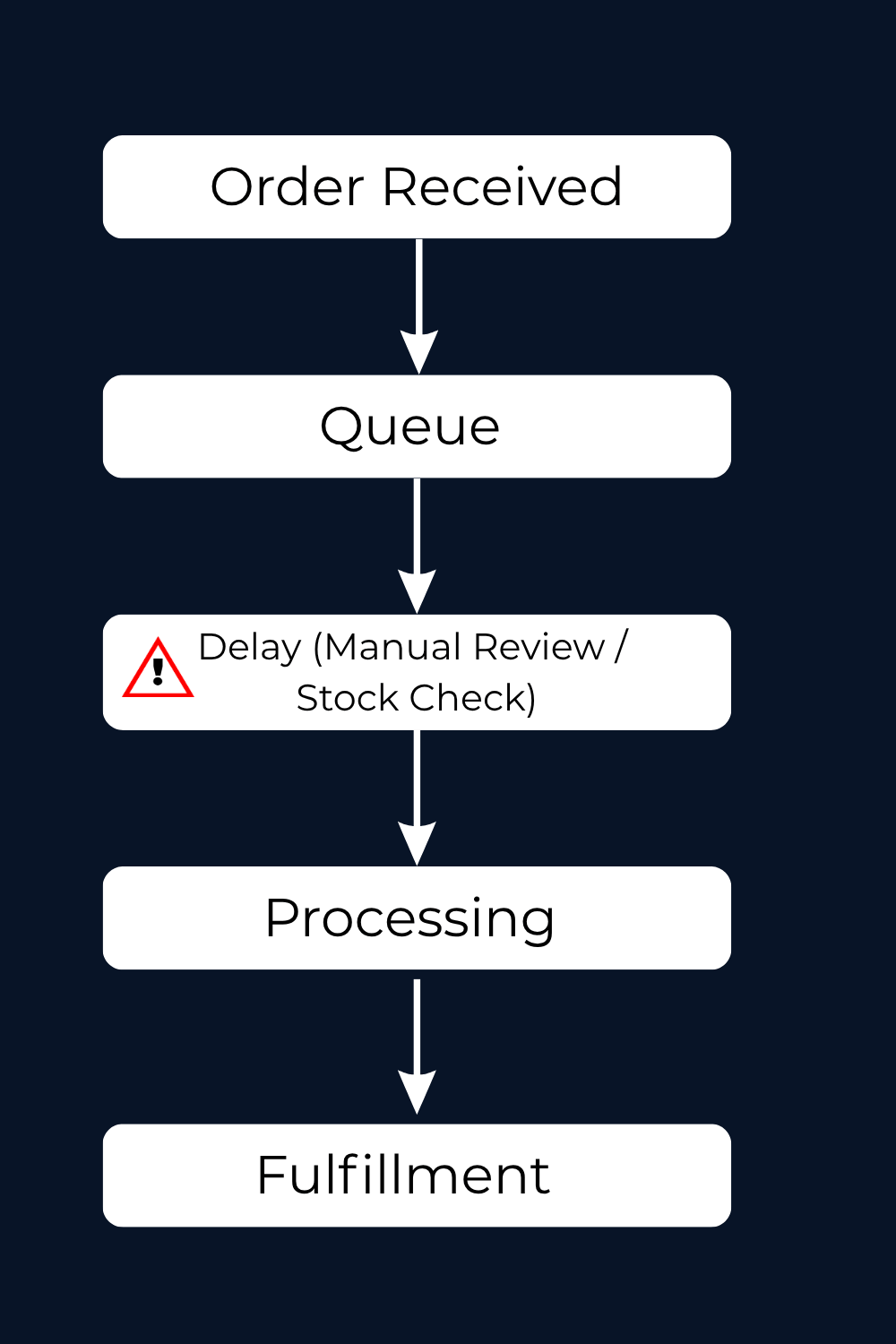
Bottlenecks don’t stop orders- they slow them down between steps.
How to Prevent Order Processing Bottlenecks
Improving order processing efficiency requires operational discipline and system visibility.
Effective strategies include:
Standardizing Order Processing Workflows
Creating clear step-by-step workflows ensures every order follows the same path from purchase to shipment.
This reduces confusion and delays.
Monitoring Processing Time Metrics
Tracking the time between order placement and shipment helps identify bottlenecks early.
Even small increases in processing time can indicate operational issues.
Reviewing Automation Rules
Automation systems should be reviewed regularly to ensure integrations and triggers function correctly.
Small configuration errors can create large delays.
Preparing for High-Volume Periods
Promotions, seasonal demand, and viral marketing can increase order volume quickly.
Planning operational capacity in advance prevents queues from forming.
Why Order Processing Efficiency Matters for eCommerce Growth
Fast order processing does more than improve shipping speed.
It protects multiple aspects of store performance:
- customer satisfaction
- refund rates
- operational workload
- platform performance metrics
Stores with reliable fulfillment workflows are able to scale more sustainably because their operations support growth instead of slowing it down.
Strengthening Your eCommerce Fulfillment Workflow
Order processing bottlenecks are rarely caused by a single mistake.
They typically result from multiple small operational gaps working together.
Regular fulfillment audits help identify problems such as:
- workflow inefficiencies
- automation failures
- inventory coordination issues
- queue buildup during demand spikes
Addressing these operational risks early protects both customer experience and profitability.
Download the Free Shopify Fulfillment Risk Audit
If orders are getting delayed or stuck in processing, this checklist helps you pinpoint exactly where your workflow is slowing down.
👉 Download it here: Free Shopify Fulfillment Risk Audit
 About the Author
I work with eCommerce sellers to identify and fix fulfillment system gaps—especially for stores handling 10–30 orders per day where operations start to break under pressure.
My focus is on building structured systems that not only prevent issues, but also recover quickly when disruptions happen.
If your store is experiencing operational issues:
👉 Download the free fulfillment audit: Free Shopify Fulfillment Risk Audit
📢 Share This
Found this useful? Share it with other store owners:
Comments ()