
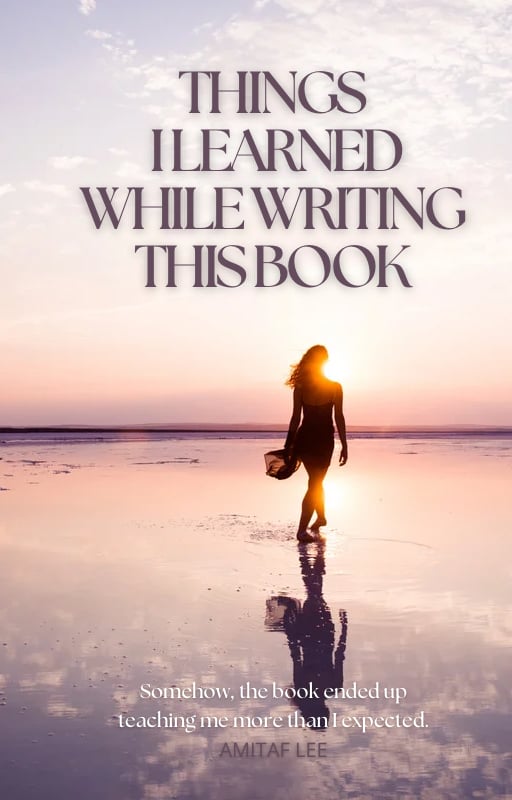
Things I Learned While Writing This Book
I thought I was writing this book to share what I had learned about love.
Somehow, the book ended up teaching me more than I expected.
Writing EQUILIBRIUM made me realize that sometimes, the lessons we think we have already learned still have another layer waiting to be understood.
1. Love and losing yourself are not the same thing.
You can love deeply without giving up your identity.
You can make space for someone without shrinking yourself to fit into their life.
Love should add something to who you are—not erase who you were.
2. Understanding someone doesn’t mean excusing everything.
We all have our struggles.
We all have reasons behind our behavior.
But understanding someone’s reasons doesn’t mean we have to accept what continuously hurts us.
Compassion and boundaries can exist together.
3. Consistency speaks louder than promises.
Words can be beautiful.
Promises can sound convincing.
But eventually, actions tell us what words cannot.
I learned to pay attention not only to what someone says, but to what they consistently do.
4. Detachment isn’t always indifference.
This was one of the biggest lessons.
You can care about someone and still stop chasing them.
You can wish someone well and still choose distance.
You can love someone and understand that they are not meant to stay in your life forever.
Detachment can be an act of love toward yourself.
5. Peace is a form of success.
We often measure success by what we achieve, what we have, or who chooses us.
But there is another kind of success:
Being able to sleep peacefully.
Being comfortable with your decisions.
Not constantly questioning your worth.
Not having to convince someone to treat you well.
That kind of peace is priceless.
6. Some endings are not failures.
I used to think that if something ended, something had gone wrong.
Now I see things differently.
Some relationships teach us.
Some experiences redirect us.
Some endings create space for something healthier.
Not everything that ends was a mistake.
Sometimes it simply completed its purpose.
7. Becoming whole is a lifelong process.
We don’t wake up one morning completely healed.
We grow.
We learn.
We fall back into old patterns.
We catch ourselves.
We begin again.
And that is okay.
Becoming whole isn’t about becoming perfect.
It’s about becoming more honest with yourself.
More aware of your needs.
More protective of your peace.
And more willing to choose what is healthy for you.
Perhaps that is the greatest lesson this book gave me:
You can love with your whole heart without abandoning yourself.
And maybe that is what equilibrium really means.
Finding the balance between giving and receiving.
Between holding on and letting go.
Between loving another person and remembering to love yourself, too.
— AmitafLee
Comments ()