

At 8:12 on a busy Monday morning, a patient calls to ask whether her test result has arrived. The receptionist can see that a document was uploaded, but she cannot interpret it and does not know who is expected to call the patient. She says, carefully, “I will ask someone to get back to you.”
At 10:40, the patient calls again. A different person answers. There is no note that shows who received the first request, what the patient was told or when a callback was expected. The second receptionist apologises and begins the search again.
Nothing in that scene requires a complicated quality programme. It does, however, expose a common weakness in small clinics: important communication depends on individual memory.
Most front-desk staff are doing several things at once. They answer calls, welcome patients, adjust appointments, pass on messages, take payments and respond to people who are worried, late or frustrated. Expecting them to remember every promise is not a sign of trust. It is a fragile workflow.
A practical communication system makes the next step visible. It helps the receptionist know what can be answered, what must be passed on, who owns the follow-up and what the patient should reasonably expect.
Why capable teams still give inconsistent answers
Inconsistency does not always mean the team needs more training. Sometimes each person has learned a slightly different version of the job.
One receptionist may have been told to send all result questions to a nurse. Another may send them directly to the doctor. A third may simply note the patient’s number on paper because the clinical team is busy. Each choice may have made sense at some point, but the clinic has never agreed on one current process.
The same pattern appears in appointment delays. One team member gives a specific estimate. Another avoids giving any estimate. Someone else says, “It should not be long,” even when there is no reliable information. Patients then compare the messages they received and conclude that the clinic is disorganised.
The people are not necessarily inconsistent by nature. The working agreement is missing.
Look for variation before blaming performance
A manager can learn a great deal by listening to how three staff members answer the same ordinary question:
“When will someone call me back?”
If the answers differ, ask what information each person had, where they recorded the request and what they believed should happen next. This usually reveals a process gap faster than a general reminder to “communicate better.”
The four agreements every front desk needs
A small clinic does not need a script for every sentence. It does need a few visible agreements that guide common situations.
1. What reception can answer directly
Administrative questions should have clear, current answers. These may include opening hours, appointment preparation, rescheduling rules, accepted payment methods and where a patient should send a document.
The wording does not have to be identical. The information must be consistent.
For example:
“Your appointment is at 2:30. Please arrive ten minutes early so we can update your details.”
That is more useful than “Come a bit earlier,” because it gives the patient a clear action without sounding formal or mechanical.
2. What must be handed over
Reception staff need clear boundaries around clinical questions, complaints, medication requests and anything that requires professional judgement.
A boundary works best when it includes a next step:
“I cannot interpret the result, but I can send your message to the clinical team and record the best number for the callback.”
The sentence does not dismiss the patient. It explains the limit and keeps the conversation moving.
3. Who owns the next step
“I passed it on” is not the same as a completed handover.
A useful callback or handover record should show the patient’s name, the reason for contact, urgency according to the clinic’s approved process, the person or role receiving the request, the expected response window and the current status.
The most important field is often the owner. When no one is named, everyone may assume someone else is handling it.
4. What the patient should expect
Uncertainty becomes easier to tolerate when the next step is clear.
Compare these two replies:
“Someone will call you.”
“I have sent the request to the nursing team. Our usual callback window is by the end of the working day. If you have not heard from us by then, please call again and mention that a callback request was logged this morning.”
The second reply should only be used if it reflects the clinic’s real process. Its value comes from the practical expectation, not from extra words.
Three tools that make the system usable
Policies often fail at the front desk because they are stored in a long document away from the actual work. A usable system brings the right information close to the moment of need.
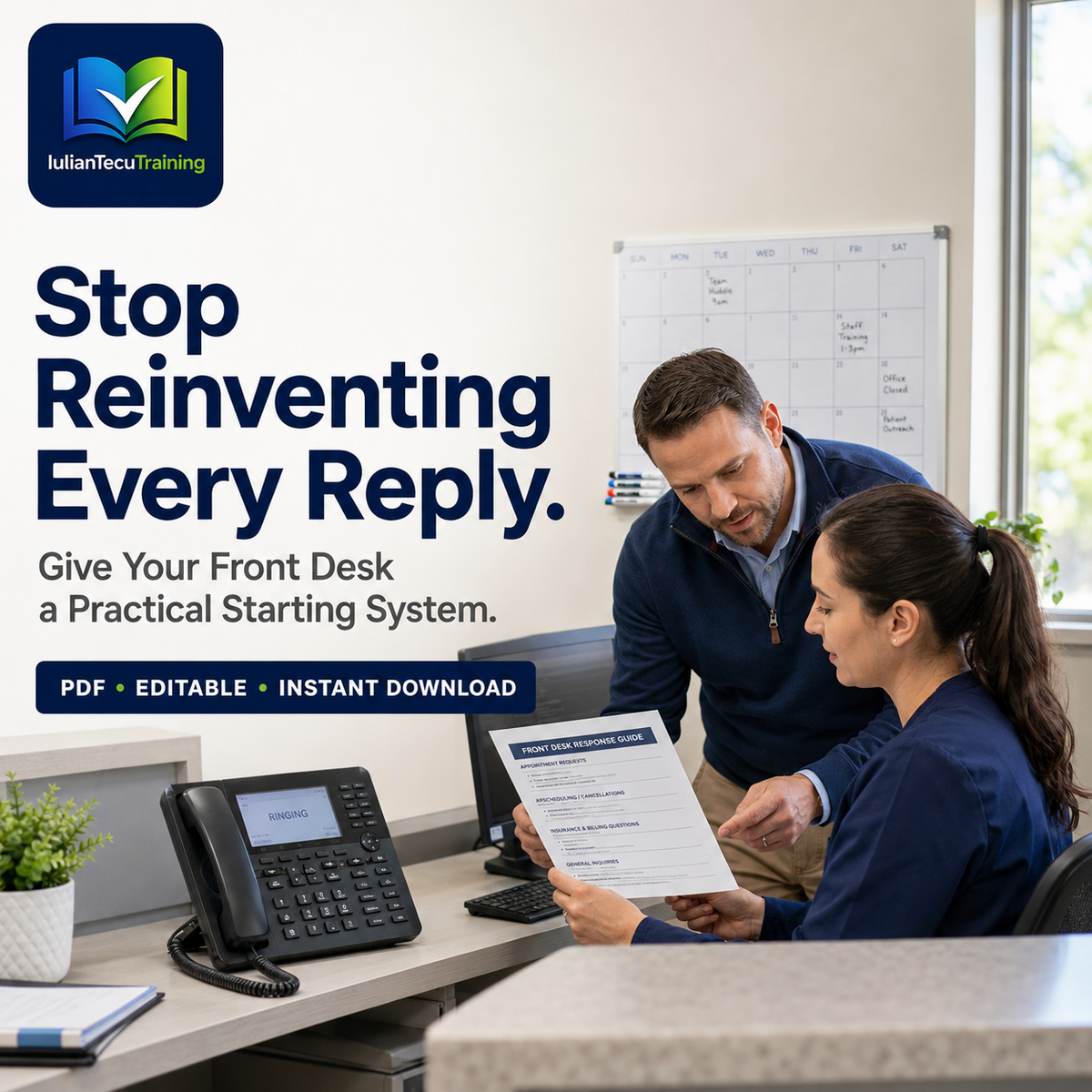
A one-page response guide
This guide should cover the clinic’s most frequent administrative questions, approved boundaries and escalation routes. It is not a rigid script. It is a reference that helps staff give accurate information and find the next step quickly.
Keep it short enough to scan during a call. Review it whenever a policy, schedule or responsibility changes.
A callback and handover log
The format may be digital or printed, depending on privacy requirements and the clinic’s systems. The important point is that unfinished requests are visible, owned and closed.
A manager should be able to look at the log and answer three questions: What is still open? Who owns it? When does it need attention?
A daily communication checklist
A checklist can be brief. At opening, confirm changes in schedules and staffing. During the day, review unresolved callbacks and delays. Before closing, identify anything that must carry over and name the person responsible.
This is less dramatic than a major training session, but it is often more useful. It turns communication from a vague expectation into a repeatable routine.
How to introduce the system without making staff sound robotic
People often resist scripts because they imagine unnatural lines delivered word for word. That concern is reasonable. A clinic should not erase individual warmth or force every staff member to speak in the same rhythm.
The system should standardise the information, boundaries and next steps—not every word.
Begin with one situation that creates repeated work. Callbacks are a good example. Ask the team to describe what currently happens from the first patient request to the completed response. Write down the differences without judging them. Then agree on:
- where the request is recorded;
- who receives it;
- who remains responsible for checking completion;
- what response window can honestly be communicated;
- what happens if the request remains open.
Test that small process for one week. Ask staff what slowed them down and what information was missing. Adjust the tool before adding another situation.
This approach respects the reality of a small clinic. The team learns through use, not through a large set of instructions delivered all at once.
A seven-day starting plan
On day one, collect three recurring questions from reception staff. Do not rely only on management assumptions.
On day two, compare the current replies and identify where information or ownership differs.
On day three, draft one short response guide for the most common situation.
On day four, create or revise the callback and handover record.
On day five, practise two imperfect but realistic examples as a team. Let staff use their own words while keeping the correct boundary and next step.
On day six, use the tools during normal work and note where they cause friction.
On day seven, review what remained open, what became clearer and what needs one more adjustment.
The goal is not to declare the system finished. The goal is to make one recurring communication problem easier to manage.
When a starter bundle is useful
Some clinics know where the gaps are but keep postponing the work because every checklist, guide and worksheet must be created from a blank page. A starter bundle is useful when the team needs editable tools that can be adapted rather than a fixed system imposed from outside.
The Small Clinic Communication Starter Bundle is designed for that stage. It gives managers and front-desk teams a practical place to begin, while leaving room for local policies, responsibilities and language.
For clinics that want to go beyond the first tools and build a wider team approach, Medical Communication for Small Clinics: Practical Scripts, Team Protocols and a 30-Day Implementation Plan offers deeper learning around everyday conversations and implementation. The book is available here: https://www.amazon.com/dp/B0HDJ1L6CQ
Do not try to fix every conversation at once. Choose one situation the team handles repeatedly. Make the next step visible. Give it an owner. Then listen to what changes during the week.
Blog CTA
Ready to stop creating every front-desk tool from scratch? Explore the editable Small Clinic Communication Starter Bundle and choose one resource to test with your team this week: https://iuliantecutraining.etsy.com/listing/4532116136/small-clinic-communication-bundle-30-day
11. Newsletter copy
Subject line options
- Who owns the callback?
- Your front desk should not have to invent every reply
- One simple system for clearer clinic communication
Preview text
Start with one recurring problem, one visible next step and one named owner.
Email body
At 8:12, a patient asks for a callback. At 10:40, she calls again—and the second receptionist cannot see what was promised or who owns the request.
This is rarely a motivation problem. It is what happens when a clinic’s communication system lives in individual memory.
A useful starting point is to agree on four things:
- what reception can answer;
- what must be handed over;
- who owns the next step;
- what the patient should expect.
The Small Clinic Communication Starter Bundle brings practical, editable tools together so your team can begin that work without creating every guide and checklist from zero.
Choose one recurring situation. Adapt one tool. Test it for a week.
See what is included in the Starter Bundle: https://iuliantecutraining.etsy.com/listing/4532116136/small-clinic-communication-bundle-30-day
P.S. If your clinic is ready for a more complete implementation approach, the Amazon book develops these ideas through practical scripts, team protocols and a 30-day plan: https://www.amazon.com/dp/B0HDJ1L6CQ