
You finally have five minutes.
The physician sits down.
Your materials are ready.
You know exactly what you want to cover.
So you begin.
Thirty seconds later, you're explaining your second key point.
Two minutes later, you're showing evidence.
Four minutes later, you're trying to summarize.
The visit was professional.
The information was accurate.
The timing was good.
There is only one problem.
You still don't know whether any of it mattered to the person sitting opposite you.
Product knowledge can create an unexpected problem
Medical representatives need strong product knowledge.
Without it, useful professional conversations are impossible.
But there's a paradox.
The more information you know, the more information you have available to say.
And when access is limited, that creates pressure.
I need to cover this.
I should mention that.
I haven't shown this study.
I still need to discuss this benefit.
Soon, the representative is managing content rather than having a conversation.
The physician becomes the audience.
That's rarely the most useful use of access.
A question changes who owns the conversation
Suppose instead you begin with something connected to your previous interaction:
“Last time you mentioned that X was the main difficulty. Is that still what you're seeing?”
Then stop.
The physician answers.
Perhaps:
“Yes, particularly in…”
Now you have direction.
Or:
“Actually, that's less of an issue now. The bigger problem is…”
Even better.
You've learned that the presentation you prepared may not be the presentation you need.
That's not failed preparation
This distinction is important.
Representatives sometimes feel that if they prepared material and didn't use it, the preparation was wasted.
It wasn't.
Preparation gives you options.
Professional judgment tells you which option belongs in the conversation.
The purpose of preparation isn't to guarantee that every prepared message gets delivered.
It's to make you ready for what happens.
What makes a useful discovery question?
It isn't necessarily sophisticated.
In fact, some of the most useful questions are quite ordinary.
A good discovery question usually has one characteristic:
You genuinely care which answer you receive.
Consider:
“What are your main challenges?”
It's broad.
It may work.
But it can also sound like a question taken directly from a sales-training workbook.
Now compare:
“Last time you mentioned that adherence was particularly difficult in this group. Are you still seeing that?”
The second question has memory.
It demonstrates continuity.
And it gives the physician something specific to respond to.
Use what you already know
Discovery does not mean entering every visit as if you know nothing.
You've probably visited before.
You may know the physician's area of interest.
You may have discussed a particular patient profile.
There may be a question left unresolved.
Use that context.
Instead of:
“What do you look for in a treatment?”
you might ask:
“You mentioned tolerability was especially important for these patients. What tends to be the biggest issue in practice?”
Again, there is no universally perfect wording.
The principle matters more than the sentence.
Start where the previous conversation ended.
Don't ask questions you don't need answered
Sales frameworks sometimes create question inflation.
Representatives learn five categories of discovery.
Then they try to ask one question from each category.
The conversation begins to sound like a questionnaire.
You don't need five questions because the framework contains five boxes.
Sometimes one answer is enough to reveal where the conversation should go.
A useful question earns a useful answer.
Then listen to it.
The second question may matter more than the first
The physician says:
“It's difficult because many of these patients…”
You have two options.
Return to your prepared sequence.
Or follow what was just said.
“What tends to make that most difficult?”
Now you're no longer running a questioning technique.
You're having a conversation.
Follow-up questions are powerful precisely because they aren't entirely pre-written.
They show that the previous answer mattered.
Discovery is not interrogation
There is a point where curiosity becomes exhausting.
Physicians have limited time.
Five excellent questions may still be four too many.
Pay attention to the rhythm of the conversation.
Question.
Listen.
Respond.
Perhaps share something relevant.
Ask again only if it genuinely helps.
A good medical visit should not sound like:
Question → answer → question → answer → question → answer → presentation.
Real conversations are less symmetrical.
The answer should change the presentation
This is probably the most important test.
Imagine two physicians give completely different answers to your discovery question.
If you proceed to exactly the same presentation with both, something is wrong.
Discovery should create selection.
One answer may make a particular evidence point relevant.
Another may make it unnecessary.
One physician may need clarification.
Another already understands the issue.
One may be interested in a particular patient group.
Another may rarely encounter it.
Relevance requires subtraction.
You don't demonstrate expertise by showing everything you know.
Sometimes you demonstrate it by choosing the one thing that belongs in the conversation.
What if you only have thirty seconds?
Discovery doesn't disappear simply because time is short.
But it changes.
A thirty-second visit probably doesn't support a sequence of exploratory questions.
One focused question may be enough.
Or perhaps the better decision is to reference a previous issue and arrange another conversation.
For example:
“Last time you asked about X. I don't want to give you a rushed answer now. Would it be useful if we picked that up properly next time?”
The visit remains connected.
You haven't turned thirty seconds into a miniature presentation.
Three minutes gives you room to learn
Three minutes can support a simple conversational sequence:
Reconnect.
Ask.
Listen.
Respond to what matters.
Progress.
The temptation is to think:
“I have three minutes. How many messages can I fit?”
Try:
“I have three minutes. What would be useful to understand?”
That change in question changes the visit.
Five minutes allows depth, not volume
When a physician gives you five minutes, the extra time doesn't have to become extra content.
It can become better understanding.
A pause.
A follow-up question.
A clarification.
A more relevant evidence discussion.
The value of additional time is not simply that you can say more.
It's that both people can participate more.
Listen for language you can use
Suppose the physician says:
“My concern is mainly…”
Those words matter.
Don't immediately translate them into your internal sales terminology.
Stay with the language used.
When you later connect information to the concern, you can return to it:
“You mentioned your main concern was…”
That makes the conversation coherent.
The physician hears their own issue reflected back rather than receiving a generic transition into a product message.
Don't manufacture a problem
Discovery is not an exercise in forcing the physician to admit that something is wrong.
Sometimes the answer is:
“No, that's not really an issue for me.”
Good.
You learned something.
Don't spend the next two minutes trying to prove that it should be a problem.
There may be another relevant topic.
Or perhaps today there isn't.
Professional conversations can survive an answer you weren't hoping for.
Questions also reveal when not to present
This may be one of the least discussed benefits of discovery.
Sometimes the answer tells you:
This isn't relevant today.
That's useful.
Respecting that information can build more credibility than forcing the prepared presentation into the remaining time.
You can say:
“Understood. Then I won't take your time with that today.”
That sentence can communicate considerable confidence.
From discovery to value
When something relevant does emerge, the presentation becomes easier.
You no longer need a dramatic transition.
The physician has given you the bridge.
“You mentioned X. That's actually why I thought this information might be useful…”
Now value has context.
The product information hasn't changed.
Its relevance has.
That's the difference between presenting information and connecting information to a conversation.
Discovery should eventually lead somewhere
Listening isn't the entire visit.
At some point, a professional conversation should progress.
That may mean answering the question that emerged.
Providing appropriate approved information.
Clarifying a point.
Agreeing to return to something later.
Or identifying the next useful conversation.
The next step doesn't need to be dramatic.
It needs to make sense given what was discussed.
A simple pre-visit discovery exercise
Before entering, write down three things:
What do I already know?
What happened previously?
What don't I know yet?
What one thing would make today's conversation clearer?
What might change depending on the answer?
Which part of your planned discussion would you use—or remove?
The third question is crucial.
If nothing in your plan can change, you're probably preparing a presentation rather than a conversation.
The 30-second, 3-minute and 5-minute visit are connected
A good medical representative doesn't need three unrelated speeches.
They need an adaptable conversational structure.
With 30 seconds, perhaps you establish relevance or continue a previous thread.
With 3 minutes, there is room to discover and respond.
With 5 minutes, there is more space to explore, connect value and establish a sensible next step.
The amount of time changes.
The principle does not:
Listen before deciding what deserves to be said.
The visit isn't successful because you finished the presentation
After a visit, don't ask only:
“Did I cover my messages?”
Try:
“What did I learn?”
“What mattered to the physician?”
“What changed because of the conversation?”
“What should happen next?”
Those questions tell you much more about the quality of the interaction.
A representative can cover every prepared message and learn nothing.
Another can use one question, one relevant piece of information and one next step—and leave with a much stronger conversation behind them.
Ask before you present
Product knowledge gives you something valuable to say.
Discovery helps you decide when it is valuable to say it.
That's why the best question isn't necessarily clever.
It's the question whose answer you're prepared to listen to.
And whose answer you're willing to let change the rest of the visit.
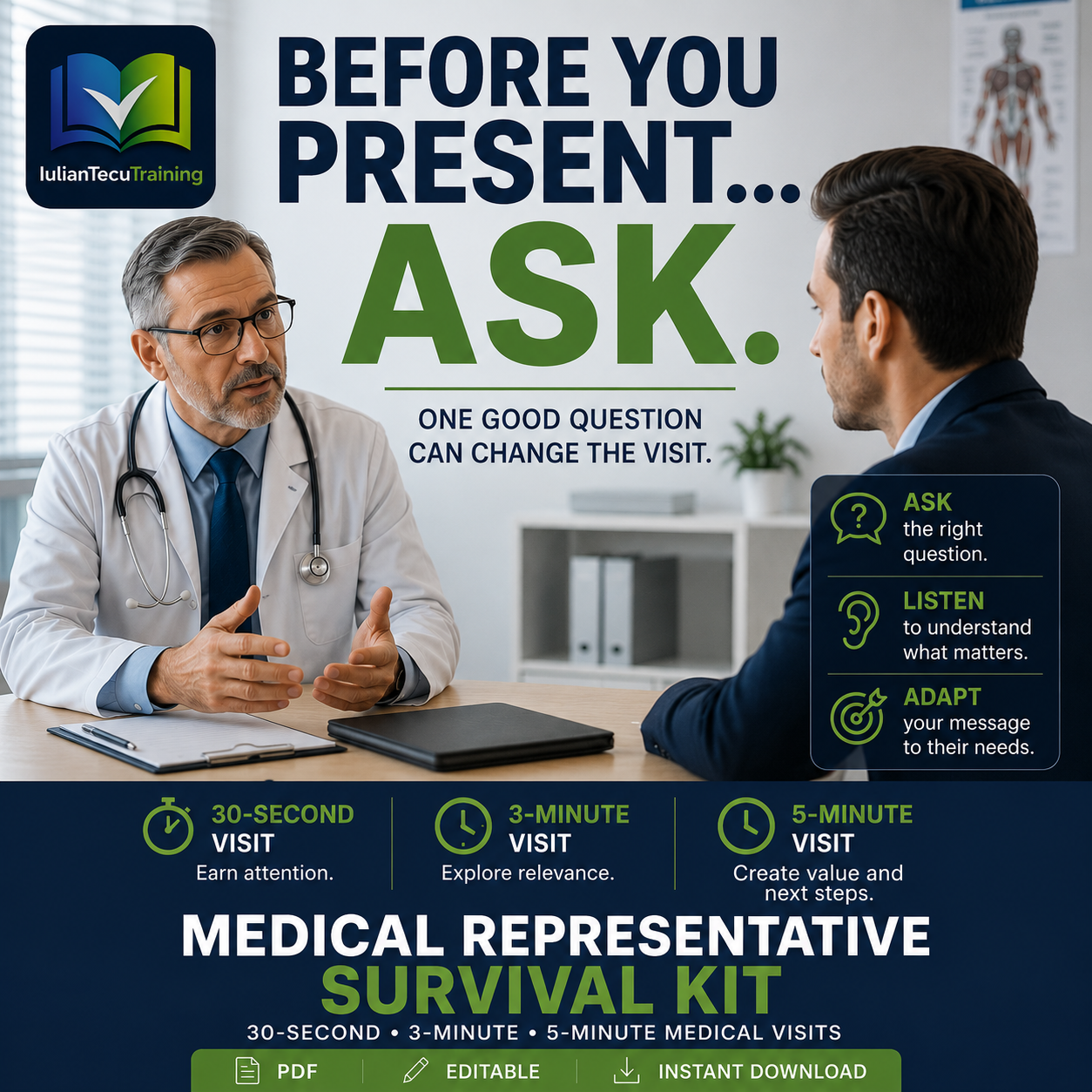
The Medical Representative Survival Kit brings together practical structures for 30-second, 3-minute and 5-minute Medical Representative Visits precisely because conversations vary.
The objective isn't to memorize three pitches.
It's to remain relevant when the amount of time, the physician's priorities and the direction of the conversation change.
Explore the complete Medical Representative Survival Kit → https://payhip.com/b/5g1le