

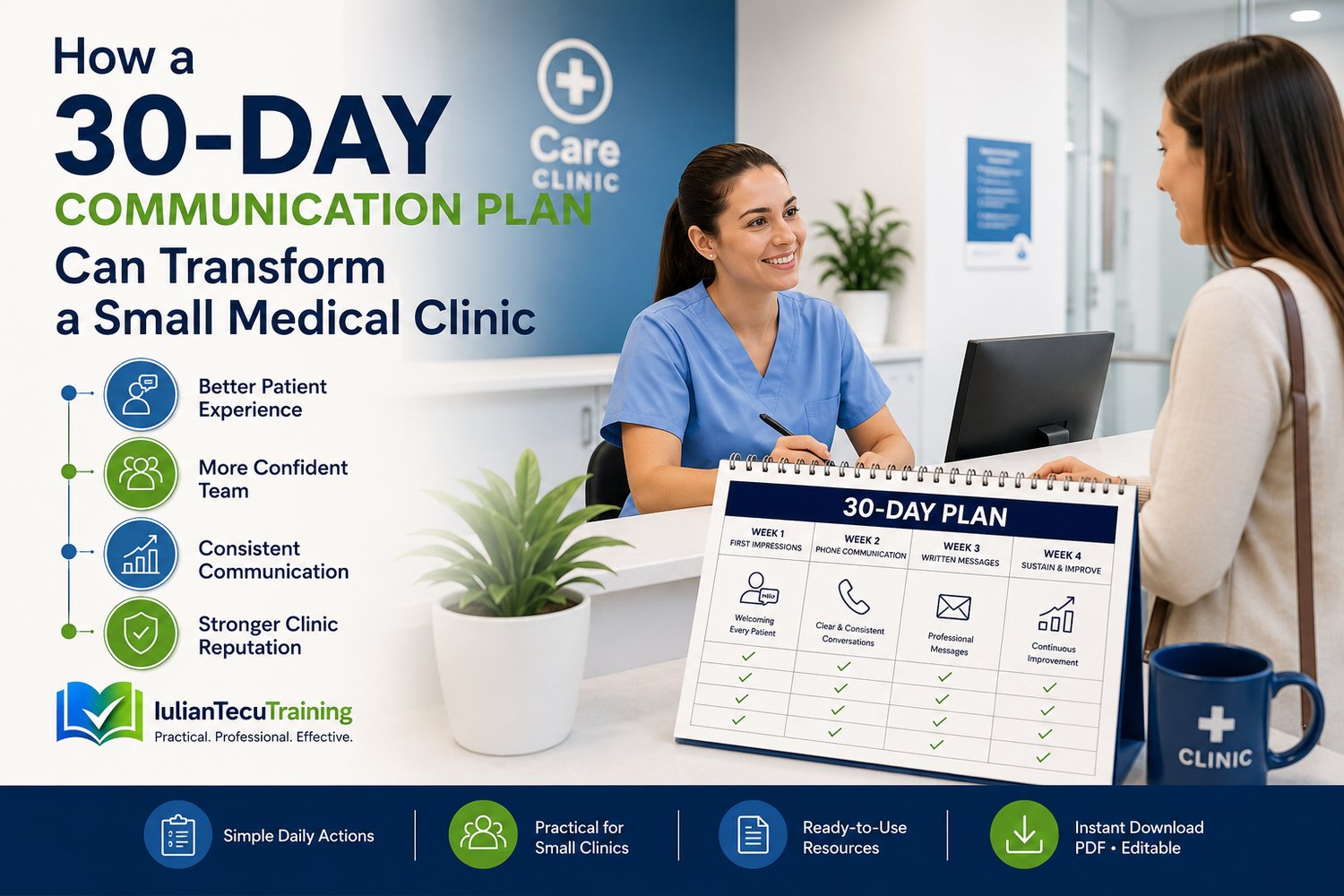
Every clinic wants patients to feel welcomed, informed and confident from the very first interaction.
Yet improving communication is often much harder than it seems.
Managers organize occasional training sessions, discuss patient complaints during team meetings and encourage staff to "communicate better." Unfortunately, after a few weeks, daily routines return, old habits reappear and the initial enthusiasm fades.
The reason is simple.
Communication is not changed by one meeting or one training session.
It changes through consistent practice.
That is exactly why a structured 30-Day Communication Plan can make such a significant difference.
Instead of trying to improve everything at once, your team focuses on one practical communication skill every day. Small, manageable improvements gradually become habits, and those habits eventually become part of your clinic's culture.
Why Communication Improvement Often Fails
Most communication initiatives fail for one reason:
They try to change too much too quickly.
Reception teams already work in fast-paced environments.
Phones are ringing.
Patients are arriving.
Appointments need to be scheduled.
Questions require immediate answers.
Adding a lengthy communication program on top of an already busy schedule usually creates resistance rather than improvement.
People become overwhelmed before they become confident.
Instead of building new habits, they simply return to familiar routines.
Information Alone Doesn't Change Behaviour
Many clinics invest in communication training.
The team attends a workshop.
Everyone agrees with the ideas.
People leave motivated.
Then reality begins.
Busy mornings.
Unexpected delays.
Difficult patients.
Staff shortages.
Without daily reinforcement, most new techniques disappear within a few weeks.
This isn't because people don't care.
It's because habits are stronger than intentions.
Why Daily Improvements Work Better
Behavioural science consistently shows that small, repeated actions create stronger long-term habits than large, occasional efforts.
Improving one communication skill every day feels achievable.
Improving twenty different skills at once feels overwhelming.
A 30-day communication plan removes this pressure.
Each day focuses on a single practical objective that staff can immediately apply during normal patient interactions.
Examples include:
- greeting patients consistently;
- using more empathetic language;
- confirming understanding before ending a conversation;
- reducing negative wording;
- improving telephone greetings;
- managing waiting-time conversations more professionally.
None of these changes are dramatic individually.
Together, they transform the patient experience.
Building Confidence One Day at a Time
Confidence does not appear overnight.
Receptionists become more confident because they repeat successful conversations.
Daily practice creates familiarity.
Familiarity creates confidence.
Confidence improves communication.
Better communication improves patient satisfaction.
The process becomes self-reinforcing.
What a 30-Day Communication Plan Includes
A structured communication plan is much more than a calendar.
It provides a roadmap for continuous improvement.
Each day introduces a realistic communication objective that can be completed without disrupting the clinic's workflow.
Typical daily activities may include:
Improving First Impressions
Practice welcoming every patient using a consistent greeting.
Small differences in tone and body language can significantly influence first impressions.
Active Listening
Instead of preparing the next answer immediately, staff practice listening without interruption.
Patients who feel heard are often calmer and more cooperative.
Positive Language
Replacing phrases such as:
"You'll have to wait."
with
"We'll do everything we can to help you as quickly as possible."
creates a noticeably different patient experience.
Telephone Communication
The first phone call often determines whether someone chooses your clinic.
Daily exercises improve:
- greeting callers
- gathering information
- scheduling appointments
- ending conversations professionally
Handling Difficult Conversations
Not every patient interaction will be easy.
Practising empathetic responses helps reception teams remain calm under pressure.
Instead of reacting emotionally, staff learn structured communication techniques that reduce tension and maintain professionalism.
Why Consistency Matters More Than Perfection
Patients rarely expect perfection.
They expect consistency.
A clinic where every receptionist communicates in a similar, professional manner creates confidence.
Patients know what to expect.
The experience feels organised.
Trust develops naturally.
Consistency also benefits the team.
New employees learn faster because clear standards already exist.
Managers spend less time correcting communication mistakes.
Experienced staff feel more confident because everyone follows the same approach.
Benefits for Small Clinics
Implementing a structured communication improvement plan produces benefits far beyond the reception desk.
Better Patient Experience
Patients feel welcomed, informed and respected.
Positive communication reduces anxiety and improves satisfaction.
Faster Onboarding
New receptionists learn faster because expectations are clearly defined.
Instead of learning only through observation, they follow an organised improvement process.
Reduced Team Stress
Communication uncertainty creates stress.
Having practical guidance removes much of this uncertainty.
Staff know how to begin conversations.
They know how to respond during challenging situations.
They know what professional communication sounds like.
Stronger Clinic Reputation
Every conversation influences how patients describe your clinic to others.
Excellent communication generates:
- positive reviews;
- recommendations;
- patient loyalty;
- long-term trust.
Creating a Culture of Continuous Improvement
Perhaps the greatest benefit of a 30-day communication plan is that it changes the culture of the clinic.
Instead of viewing communication as something that is discussed once a year during training, it becomes part of everyday work.
Every day offers one small opportunity to improve.
Managers begin noticing progress.
Receptionists become more engaged.
Patients experience the difference.
Over time, these daily improvements become part of the clinic's identity.
Practical Tips for Success
If you decide to introduce a communication improvement plan, keep it simple.
Focus on one objective per day.
Avoid overwhelming the team.
Celebrate progress.
Recognise improvements rather than only correcting mistakes.
Positive reinforcement encourages long-term change.
Encourage discussion.
Ask staff what worked well.
Discuss difficult conversations openly.
Learning becomes easier when experiences are shared.
Keep resources available.
Quick-reference guides, scripts and communication checklists help staff apply new skills immediately.
Be patient.
Real behavioural change takes time.
Consistency always produces better results than intensity.
Final Thoughts
Improving communication does not require expensive consulting projects or complex training programs.
It requires consistency.
One conversation.
One improvement.
One day at a time.
A structured 30-Day Small Clinic Communication Plan helps reception teams build confidence gradually, develop stronger communication habits and create a more professional patient experience without disrupting daily operations.
The most successful clinics understand that excellent communication is not a single event.
It is a habit practiced every day.
Frequently Asked Questions
Is a 30-day communication plan suitable for small clinics?
Yes. It is specifically designed for busy clinics that need practical improvements without lengthy training sessions.
Can new receptionists use it?
Absolutely.
It provides a structured onboarding framework that helps new staff build confidence through daily practice.
How much time is required each day?
Most daily activities take only a few minutes and are integrated into normal patient interactions.
Can experienced teams benefit as well?
Yes.
Experienced teams often improve consistency, refine communication habits and strengthen collaboration through structured daily practice.
Improving patient communication doesn't happen overnight—but it can start today.
The 30-Day Small Clinic Communication Plan gives your reception team one practical communication goal each day, helping them build confidence, consistency and stronger patient relationships without disrupting their workflow.
✔ 30 daily communication activities
✔ Printable and easy to implement
✔ Perfect for onboarding and continuous staff development
✔ Instant digital download
Start building better patient communication—one day at a time.