

The meeting ends at 4:35 on a Monday afternoon. The clinic manager has spent 40 minutes explaining a new communication priority: patients should receive clearer updates when appointments run late. The team agrees. Someone offers a good example. Another employee writes down a phrase they want to try. The conversation feels useful.
At 11:10 the next morning, a clinician is 25 minutes behind. A patient approaches reception and asks how much longer the wait will be. The receptionist says, “It should not be too long.” Twelve minutes later, the patient asks a colleague and receives a different answer. No proactive update happens.
It is tempting to conclude that the staff did not listen. Yet the meeting may have produced genuine agreement. What it did not produce was an implementable behaviour.
“Keep patients informed” is a sound principle. It is not specific enough to guide a busy employee who is answering a call, checking in another patient and waiting for information from the clinical room. Until the clinic defines when the action starts, what the employee does, what must be avoided and how the process will be reviewed, the new standard has nowhere to live.
Agreement Is Not the Same as Implementation
Training often feels complete because people understood the message. Understanding matters, but daily work introduces a different test. Can the employee recognise the moment when the standard applies? Is the expected action realistic during a busy period? Does the person have the information and authority needed to carry it out?
A clinic can answer “yes” during a calm meeting and still discover practical barriers on Tuesday. The front desk may not know that the clinician is delayed. Nobody may have agreed on the threshold for an update. One employee may believe an apology is enough, while another thinks a manager must approve rescheduling. The principle disappears into those uncertainties.
Implementation begins when the clinic translates the principle into something staff can see themselves doing.
Start With One Repeated Moment
Broad improvement projects quickly become exhausting. A manager may try to address greeting patients, telephone tone, appointment delays, difficult conversations and handovers in the same month. Every topic seems important, so none receives enough practice to become familiar.
Choose one moment that happens often and creates visible friction. Appointment delays are a useful example because the problem crosses roles. Clinical staff create or recognise the delay, the front desk communicates it and the patient experiences the result.
Describe one real version of the situation: “A clinician is more than 15 minutes behind, and the waiting patient has not yet asked for an update.” This is more useful than discussing “delay communication” in general. The team can picture the point at which the new behaviour should begin.
Define the trigger
A trigger removes hesitation. It answers, “When do I do this?”
The trigger may be a time threshold, an event or a request. For example, an update is required when the delay passes 15 minutes. Another clinic might use 20 minutes because of its appointment pattern. The exact number is less important than making the decision explicit and workable.
Without a trigger, proactive service depends on memory and individual judgment. The busiest employee is also the person least likely to pause and decide whether “now” is the right moment.
Name the observable behaviour
The behaviour should be visible without forcing identical wording. In this case: the front desk approaches or addresses the patient before the patient has to ask again, states the known delay, avoids an unsupported estimate and names when another update will be given.
That description gives the manager something fair to coach. “Be more empathetic” invites a debate about personality. “Give the update before the patient asks” points to an action. Empathy can still shape the employee’s tone, but the standard does not depend on everyone performing warmth in the same way.
Set a safe boundary
Implementation fails when staff are asked to act but are unsure what authority they have. A receptionist who cannot confirm the clinician’s timing may invent an estimate to sound helpful. Another may avoid the conversation because they do not want to say the wrong thing.
The boundary might be: do not promise an exact appointment start unless the clinical team has confirmed it. Staff can promise something within their control instead: “I will update you again in ten minutes, even if there is no change.”
This is a small distinction with a large effect. The clinic replaces an uncertain clinical promise with a reliable communication commitment.
Make the Standard Visible During the Day
A new behaviour competes with established habits. Expecting staff to remember it because it appeared in meeting notes is optimistic. For the first week, place a short prompt where the work happens.
The prompt does not need to contain a full script. It might read: **15 minutes → update first → no guessed time → next update.** A small reminder beside the internal schedule is enough if it does not expose patient information.
Visibility should support the team, not create decorative paperwork. If staff stop noticing the card after two days, change its placement or ask someone to name the standard at the morning huddle. The purpose is to bring the behaviour back into attention until it becomes familiar.
Managers should also ensure that the front desk receives the information required to act. If the clinical room does not signal delays, the receptionist cannot provide a meaningful update. That is an implementation finding, not a receptionist failure. The process may need a simple handover cue from the clinician or medical assistant.
Practise the Awkward Version, Not the Easy One
Reading an ideal sentence aloud is not enough. Use a two-minute role-play with the complication that usually derails the conversation.
One person plays a patient who says, “You told me ten minutes when I arrived.” The staff member practises acknowledging the earlier message without defending it, states the current fact and offers the approved next step. The exchange can be imperfect. The value lies in noticing where the employee becomes uncertain.
Perhaps the employee does not know whether a fee-free reschedule is allowed. Perhaps they need a manager when transport is about to leave. Those uncertainties should be recorded and resolved. Role-play is useful when it reveals a missing operational decision, not when it merely rewards polished performance.
Review One Real Example in Seven Minutes
Long review meetings make small improvements feel heavy. A brief weekly review is often enough:
- What happened?
- Was the trigger recognised?
- What made the behaviour easier or harder?
- What should be adjusted before next week?
Use one real example without turning it into a public judgment of an employee. The subject is the usability of the standard. If the update was missed because the desk was overwhelmed, consider coverage. If the wording created confusion, revise the prompt. If the patient valued the update even though the delay remained, record that too.
This approach gives managers authority without encouraging surveillance. The manager is not scoring personality. They are checking whether the clinic’s own process works under normal pressure.
Measure the action before the outcome
Patient satisfaction is important, but it is influenced by many factors. During early implementation, first ask whether the new behaviour occurred. Did the patient receive an update before asking? Was an unsupported time promise avoided? Was the next update delivered?
These measures are close enough to the work to guide improvement. Later, the clinic can review complaints, compliments or satisfaction responses. Starting with an outcome alone can hide the reason a change did or did not work.
Add the Next Standard Only When the First One Is Usable
After a week, the clinic may decide that the delay-update standard is workable but needs one change: the medical assistant should signal the front desk at the ten-minute mark, giving reception time to prepare the update. Test the revision before expanding the project.
This slower rhythm can feel modest, especially to a manager who wants rapid transformation. Yet a clinic that installs four usable behaviours in a month has achieved more than a clinic that announces 20 expectations and observes none of them consistently.
The next standard might address an unavailable appointment request or a patient who does not understand preparation instructions. Each new behaviour should receive the same practical treatment: a real situation, a trigger, a visible action, a safe boundary, short practice and a review point.
A 30-Day Plan Gives Improvement a Working Rhythm
Small clinics do not need a large corporate training department to improve communication. They do need a rhythm that fits around patient care. A 30-day approach creates enough time to introduce, practise, observe and adjust without pretending the clinic can rebuild every conversation at once.
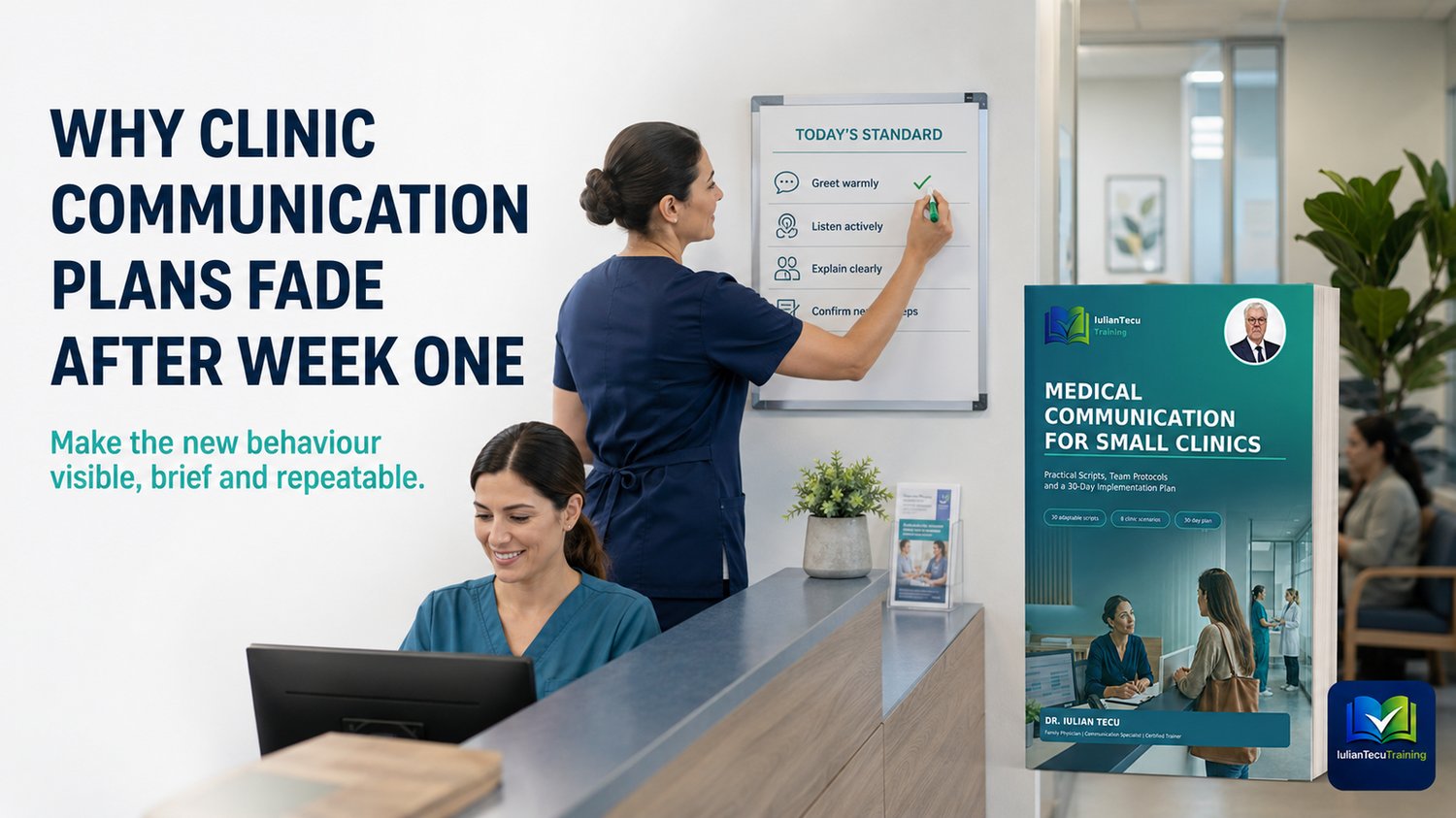
That is the implementation focus behind *Medical Communication for Small Clinics: Practical Scripts, Team Protocols and a 30-Day Implementation Plan*. The scripts provide language for common moments, while the protocols and implementation structure help a manager decide how those conversations become part of daily work.
The aim is not to finish a book and declare training complete. It is to choose a problem the team recognises, give the new behaviour somewhere to live and keep working until Tuesday genuinely looks different.
**Use the book’s 30-day structure to make one communication standard visible and repeatable: https://www.amazon.com/dp/B0HDJ1L6CQ**