
You finally get the meeting.
You researched the account.
You know the product.
You have your questions ready.
Perhaps you've even rehearsed the opening.
The prospect looks at you and says:
“Sorry. Today's crazy. I've got about 30 seconds.”
There are several possible reactions.
One of the worst is surprisingly common.
You start talking faster.
Company introduction.
Product.
Benefits.
Evidence.
Offer.
Call to action.
Everything that was supposed to fit into several minutes is now delivered at auctioneer speed.
Twenty-five seconds later, you've technically said almost everything.
The prospect has probably retained almost nothing.
The problem wasn't that you lacked a shorter script.
The problem was that the objective of the conversation changed—and your approach didn't.
Thirty seconds is not a miniature five-minute presentation
This distinction matters.
When time shrinks, content shouldn't simply shrink proportionally.
The purpose of the interaction may need to change.
Imagine you had five minutes.
You might reasonably establish context, ask a question, explore an issue, connect your solution to it and agree on what happens next.
Thirty seconds cannot comfortably carry all of that.
So stop asking:
“How do I fit everything in?”
Ask:
“What does this conversation need to accomplish now?”
That's a very different sales question.
In 30 seconds, you're earning permission
Thirty seconds is enough to create relevance.
It may be enough to demonstrate that you understand something about the prospect's situation.
It may be enough to ask one worthwhile question.
It may be enough to earn:
“Okay. Tell me a little more.”
That's already progress.
Consider the difference.
Version one:
“Hi, I'm Mark from ABC Solutions. We're a leading provider of integrated business solutions with more than fifteen years of experience helping organizations improve efficiency through…”
The clock is already winning.
Now consider:
“I'll keep this brief. We work with teams that are losing a surprising amount of sales time between first contact and follow-up. Is that something you're seeing too?”
It isn't a magical line.
It shouldn't be copied into every meeting.
Its usefulness is structural.
It gets to relevance quickly and creates somewhere for the other person to enter the conversation.
That last part matters.
A short meeting can still be a conversation
Salespeople sometimes treat lack of time as permission to stop asking questions.
Understandable.
Questions consume seconds.
But removing the prospect from a sales conversation doesn't necessarily make the conversation more efficient.
It may simply make it a shorter presentation.
One good question can outperform four rapid-fire benefits because the answer tells you what deserves the remaining time.
The difficult part is choosing the question.
“Tell me about your business” is probably too broad when you have half a minute.
“What's your biggest challenge?” can sound generic.
The question should come from preparation.
You already know something about the account.
Use it.
“I noticed you've expanded the field team recently. Has keeping follow-up consistent become harder as the team has grown?”
Now the prospect has something concrete to respond to.
Preparation has bought you brevity.
Three minutes changes the job
Suppose the prospect says:
“Okay. I've got three minutes.”
Don't simply add two and a half minutes of product information.
You've been given enough time to discover something.
A useful three-minute conversation might roughly move through:
Relevance → Question → Listen → Connect → Next step
Not as a rigid formula.
Real conversations don't stay inside neat boxes.
A prospect may interrupt after twelve seconds.
They may immediately ask about price.
They may tell you the exact problem before you've asked anything.
Good sales structure should help you navigate reality, not force reality to follow your structure.
That's why adaptability matters more than memorization.
What deserves the extra time?
Listening.
That's probably the first answer.
The difference between thirty seconds and three minutes isn't that you can now list more features.
It's that the prospect can finally occupy more of the conversation.
Ask.
Listen.
Clarify.
Then decide which part of your value proposition actually belongs there.
Five minutes isn't permission for a monologue either
Five minutes feels generous after thirty seconds.
It still disappears quickly.
Now you may have enough room to establish context, explore one meaningful issue, present relevant value and establish a next step.
Notice what isn't in that sentence:
“Tell them everything about the product.”
The objective of an early sales conversation isn't necessarily complete product knowledge.
Often it's movement.
Enough relevance for another discussion.
Enough confidence for a demonstration.
Enough interest to involve another decision-maker.
Enough clarity to exchange information.
A next step is more valuable than an exhausted prospect who has heard your entire brochure.
The hidden skill: deciding what to leave out
Sales training naturally concentrates on what representatives should say.
There's another skill that deserves more attention.
Knowing what not to say.
Imagine your normal presentation contains ten points.
Your prospect gives you thirty seconds.
Which one survives?
If you can't decide, the problem may not be presentation technique.
It may be that your value proposition isn't clear enough.
This is a useful preparation exercise even before a meeting:
If I had five minutes, what matters?
Now:
If I had three?
Finally:
If I had thirty seconds?
What disappears?
What remains?
And why?
That exercise forces prioritization.
Preparation should make you more flexible, not more scripted
There's an irony in sales preparation.
Representatives sometimes prepare so thoroughly for the conversation they expect that they become less prepared for the conversation they get.
The prospect is late.
Different stakeholder.
Unexpected objection.
Wrong meeting room.
No projector.
Thirty seconds instead of thirty minutes.
A good preparation system should survive those changes.
You should know your account well enough to shorten.
Know your value well enough to simplify.
Know your questions well enough to choose one.
And know your objective well enough to change it.
What if the prospect genuinely has no time?
Believe them.
This sounds obvious, yet it's remarkably easy to treat “I've only got a minute” as an objection that needs overcoming.
Sometimes somebody actually has only a minute.
Respecting that can itself communicate professionalism.
You might say:
“Understood. Rather than rush this, can I give you the one reason I thought it was worth speaking and then we can decide whether another conversation makes sense?”
Twenty seconds later, you may have a next step.
Or you may not.
Both outcomes are better than trapping somebody in a seven-minute “30-second” pitch.
Don't confuse activity with progress
Sales representatives can have very busy days.
Calls.
Visits.
Messages.
Follow-ups.
Presentations.
CRM updates.
But activity and progress aren't identical.
A short conversation that establishes a clear next step may be more productive than a long meeting that ends with:
“Send me something.”
This is why the closing question matters even when the conversation is brief.
Not a dramatic sales close.
Simply clarity.
What happens next?
A call?
A demo?
Information?
Another stakeholder?
Nothing?
Knowing is useful.
Build three versions of your conversation
Before your next important account, prepare for three realities.
The 30-second reality
What single point makes this conversation potentially relevant?
What one question could open the door?
The three-minute reality
What do you need to understand before presenting value?
Which part of your value proposition is most likely to matter?
The five-minute reality
How can you move from opening through discovery to relevant value and a clear next step without turning the conversation into a compressed presentation?
You don't need three personalities.
You don't need three unrelated pitches.
You need one clear sales objective that can adapt to different amounts of time.
The representative who adapts looks prepared
The prospect probably doesn't know how much preparation you did.
They experience the result.
A representative who panics when time disappears looks unprepared.
A representative who calmly says:
“Absolutely. Let's use the 30 seconds well.”
feels different.
Not because the sentence is clever.
Because the behavior communicates control.
You understand that their time matters.
You know what matters in your message.
And you're comfortable leaving something for later.
That's a much stronger first impression than squeezing another six product benefits into the final twelve seconds.
A practical toolkit for the conversation you actually get
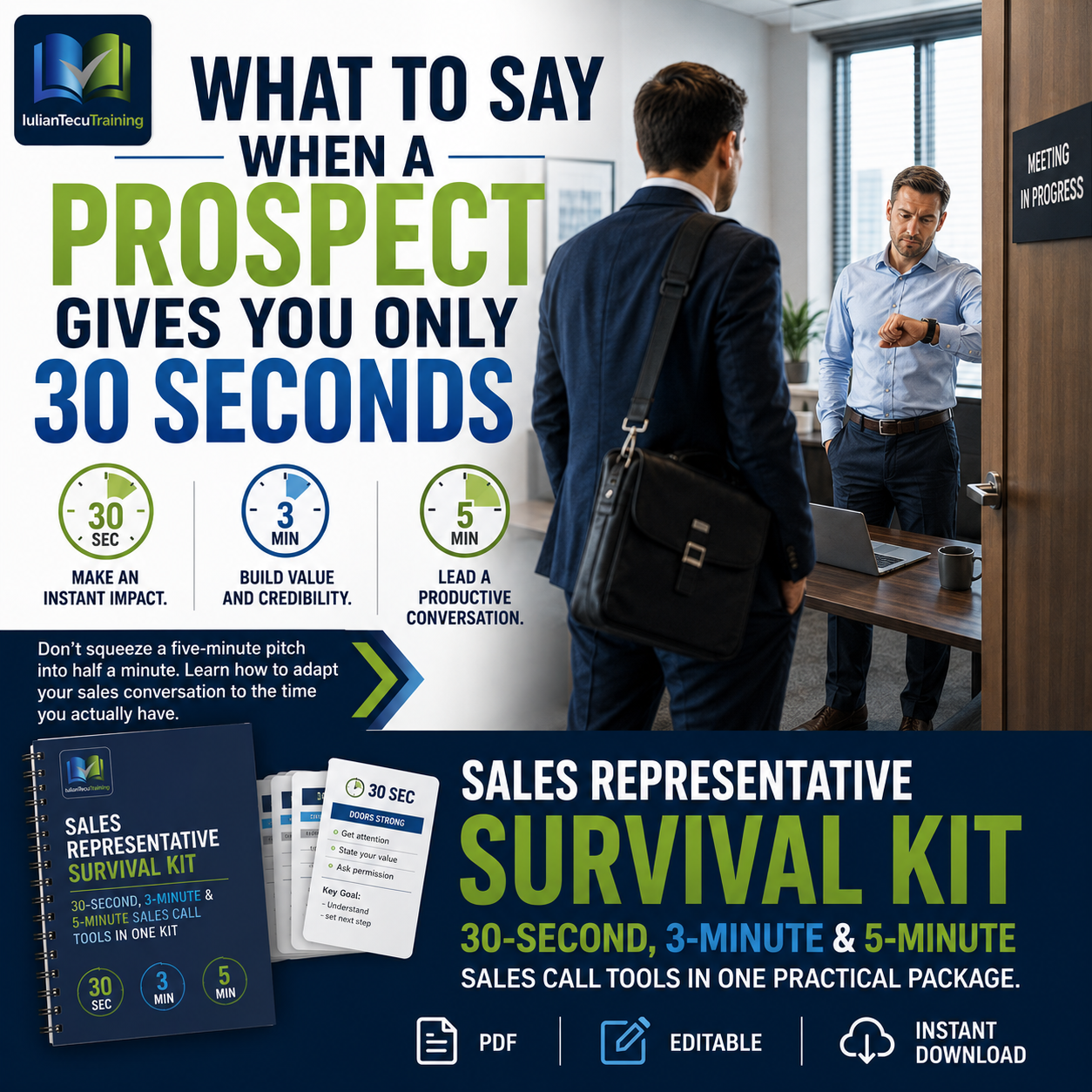
The Sales Representative Survival Kit was designed around this reality.
It brings together three connected field tools:
30-Second Sales Call — when attention is scarce.
3-Minute Sales Call — when there's enough time to discover relevance.
5-Minute Sales Call — when you can develop value and establish a next step.
The point isn't to memorize three speeches.
It's to walk into a sales conversation prepared for the amount of time the customer actually gives you.
Because field sales rarely follows the agenda exactly.
Your preparation shouldn't depend on it doing so.
Explore the complete Sales Representative Survival Kit
https://payhip.com/b/eU5Ga