
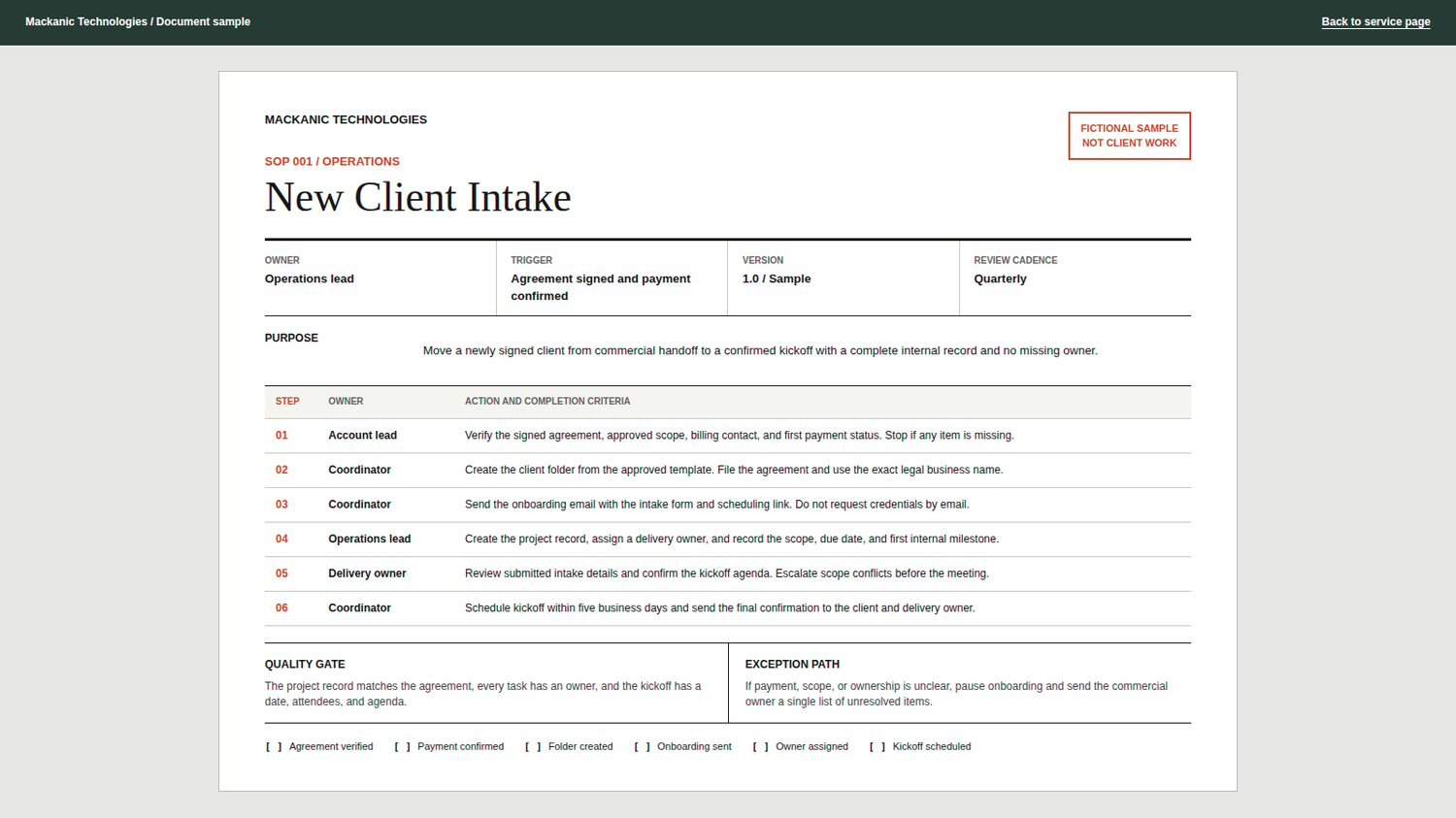
Meeting notes are useful evidence, but they are rarely a usable procedure. They preserve what people discussed, not necessarily what the next person should do. A reliable SOP needs a defined start, ordered actions, decision rules, quality checks, and a clear finish.
This guide shows a practical way to turn rough notes or a meeting transcript into an SOP without giving a writer access to your systems.
Start with a safe source copy
Make a working copy before you organize anything. Remove passwords, API keys, payment details, private keys, medical or regulated records, and customer-identifying information. Replace real names with roles such as account owner, reviewer, or support lead.
An SOP should tell someone where to find protected information. It should not become another place where that information is stored.
For a complete handoff checklist, see how to share an SOP source packet without exposing credentials or customer data.
1. Define the workflow boundary
Write one sentence for the trigger and one for the finish. This prevents a broad conversation from turning into an unmaintainable document.
- Trigger: the event that starts the workflow.
- Finish: the observable result that proves the workflow is complete.
- Out of scope: related work handled by another procedure.
For example, a client-intake workflow might begin when an agreement is signed and payment is confirmed. It might end when the owner, delivery date, source-material location, and kickoff status are recorded. Proposal writing and ongoing delivery belong elsewhere.
2. Classify each useful statement
Read the notes once and mark each operational statement as one of five types:
- Action: something a person performs.
- Decision: a condition that changes the next step.
- Evidence: a record showing that an action happened.
- Exception: a failure or unusual case requiring a different path.
- Gap: a question the source material does not answer.
This step separates executable information from background discussion. Opinions, repeated explanations, and scheduling chatter can usually be removed unless they explain a decision rule.
3. Assign roles instead of relying on names
Every important action should have one clear owner. Use stable roles so the procedure survives staffing changes. If two people appear responsible, distinguish the person who performs the action from the person who approves or receives it.
A simple ownership line can prevent a common handoff failure:
- Performer: completes the step.
- Approver: checks the result when approval is required.
- Escalation owner: decides what happens when the normal path fails.
4. Rewrite actions as testable steps
Put the actions in the order a new operator would encounter them. Start each step with a verb, name the output, and include only the context required to perform it.
Weak: Handle the client setup.
Testable: Create the project record from the approved agreement, assign the delivery owner, and record the agreed start date.
If a step depends on a condition, write the condition before the action. Avoid hiding several decisions inside one long paragraph.
5. Add quality checks and the non-happy path
A procedure is incomplete when it only describes the ideal case. Add at least one quality check and one exception path.
- What must be true before the workflow can finish?
- What evidence is retained, and where?
- What happens when required information is missing?
- Who decides when the normal process cannot continue?
- When should work stop instead of guessing?
For client intake, a quality check might confirm that the owner, scope, timing, and source-material location are recorded. An exception might route missing payment or contract information back to the account owner before delivery begins.
6. Run a cold-read test
Give the draft to someone who did not attend the meeting. Ask them to identify the trigger, owner, ordered steps, completion evidence, and escalation path. They do not need to perform work in a live system. The goal is to find assumptions that only the original participants understand.
Turn every reasonable question into either a clarification, an explicit gap, or an exception rule. Do not invent an answer that is absent from the source.
A compact SOP structure
A small-team procedure usually needs only these sections:
- Purpose and scope
- Trigger and prerequisites
- Owner and supporting roles
- Ordered steps
- Quality check and completion evidence
- Exceptions and escalation
- Revision owner and review cadence
Keep the first version narrow. One workflow that someone else can run is more valuable than a large manual nobody can test.
Use the free starter
The Free SOP Starter Template includes an editable Markdown SOP, a field checklist, a fictional completed example, and a security guide. It remains free; you can optionally choose a higher amount if the files save you time.
If you already have redacted notes or a transcript and want a bounded first draft, the $35 SOP Cleanup Review covers one workflow, up to 750 words or 15 minutes of transcript, with a two-business-day first draft and one revision. Requests are reviewed for fit before checkout, and no account access is required.