

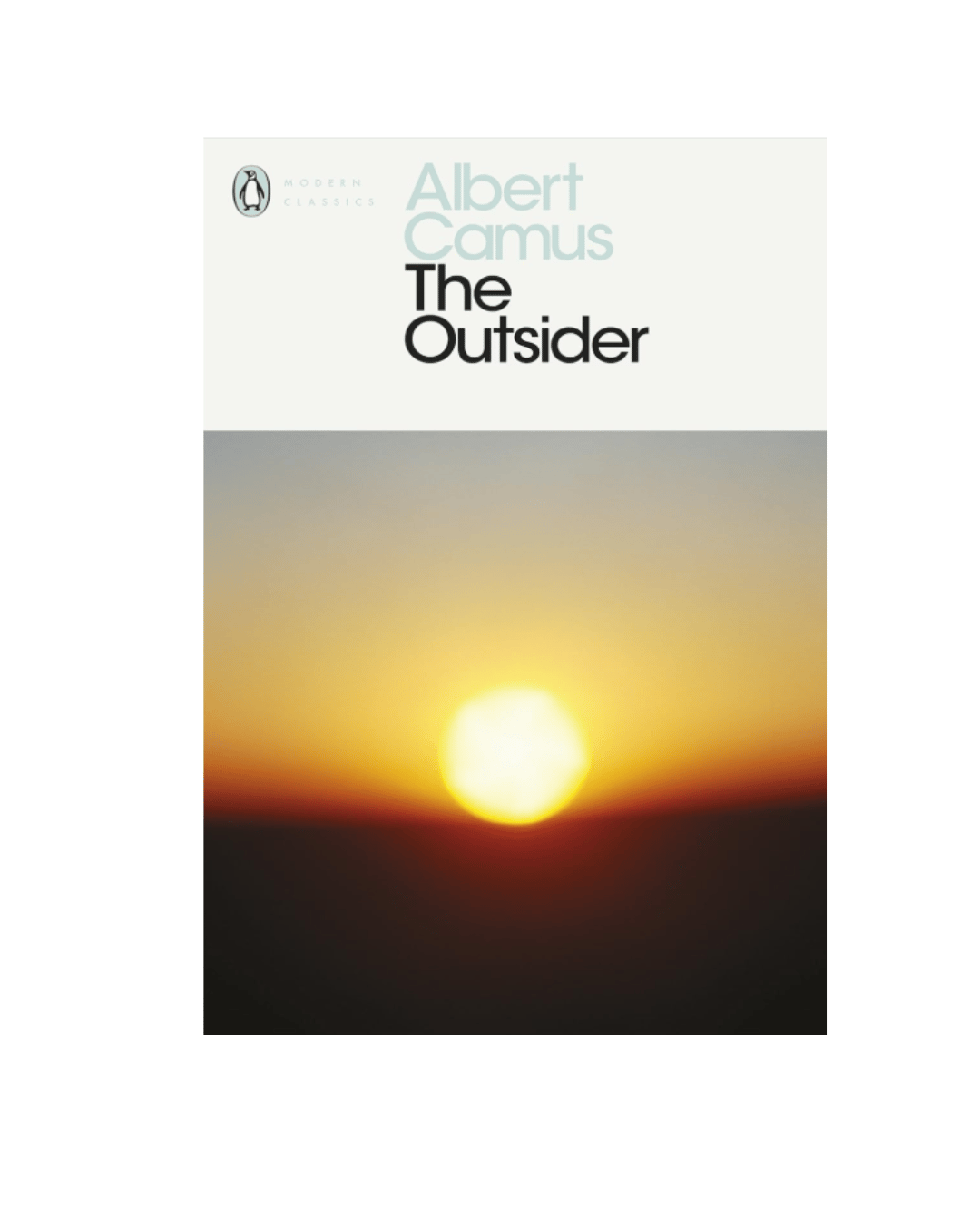
This post was originally written in 2008 and published on the Vulpes Libris bookblog.
It was subsequently republished by Philosophy Cafe magazine in a special issue on Camus.
I nervously decided to review The Stranger for our French week – nervously because I’m not sure what I have, if anything, to contribute to the thousands of pages of analysis that have been written about this slim, 185-page book, considered by many to be one of the most influential, powerful novels of the 20th century. But here goes.
Albert Camus was awarded the Nobel prize for literature in 1957, an achievement which filled him with anxiety because, at 44 years of age, he was the second youngest Nobel laureate ever (after Rudyard Kipling) and he despaired of producing work of the standard the world now expected of him. However, he need not have worried: only three years later he died in a car crash.
Much of The Stranger is written in a very simple, minimalist style (a good first choice for those who’d like to read original fiction in French) but this, in part, has helped it to transcend the contemporary trends of its day and to remain relevant to philosophical thought today. And everywhere The Stranger is discussed, philosophy rears its head. In particular the theories of absurdism and existentialism are bandied about so I had to check out their definitions. I’m not sure I’ve understood the difference between the two but both believe that there is no higher meaning in life other than physical existence. The ‘absurd’, a term coined by Camus, refers to the attempt by man to find meaning where none exists. A person can create specific meaning for his own individual life but this does not change the fact that life, a sensory rather than rational experience, has no deeper purpose other than existence. Death is the only certainty and the world is indifferent to man who is of no importance once he no longer exists. It is against this cheery background that The Stranger was written.
Although the plot is well known and secondary to the reading of this novel, if you haven’t read it before, you might like to look away now so as to avoid spoilers. Despite its short length, the book is dense with meaning and every sentence counts. The novel is divided into two parts, the first documents Meursault’s life and relationships, the second deals with his trial and meditations on death.
The opening line is probably one of the most famous in French literature. ‘Aujourd’hui Maman est morte.’ ‘Today Maman died.’ The mother in question lived in a old people’s home on the Algerian coast and belongs to Meursault (we never discover his first name). He attends her funeral with disconcerting aplomb and composure. The following day, he meets Marie, a girl he knows from before and begins an affair with her. In his relationships with her and his neighbours; Salamano, a widower who despises and loves his old, scabby dog in equal measure, and Raymond, a shady character who abuses his Arab girlfriend for whom he is probably pimping; Meursault seems to shows a lack of discernment that borders on autistic.
Meursault is constitutionally incapable of being untruthful. He is sensitive to the sensations the physical world around him provoke; he is perturbed by the heat of the sun, he enjoys sex with Marie, he appreciates her physical beauty. But his emotional reactions to more abstract situations appear strange.
‘When she laughed, I felt desire for her (Marie) again. A moment later she asked if I loved her. I replied that that it didn’t mean anything but that I didn’t think I did. She looked sad’
He tells the truth even when social etiquette demands a white lie.
‘Then he (Raymond) declared that, in fact, he wanted my advice on this matter, that I was a man, I knew about life, that I could help him and then he would be my friend. I said nothing and then he asked again if I wanted to be his friend. I said I didn’t care either way: he seemed happy.’
He assists Raymond to escape charges for beating his girlfriend even though he witnesses and even facilitates her beating. Raymond invites Meurseult and Marie to spend the weekend in a seaside cabin belonging to his friend, Masson. A stroll on the beach turns into a misadventure when they are followed by a gang of Arabs including the brother of Raymond’s mistress. Raymond passes a gun to Meursault and after Raymond receives a knife injury they return to the cabin. For reasons he can’t explain Meursault returns to the beach and, disorientated by the sun, kills the Arab with five gunshots.
During his trial the crime for which Meursault seems to be most severely judged is his lack of grief at his mother’s funeral and his refusal to express appropriate regret for the killing. The most fascinating part of the novel is Meursault’s anguished contemplation of his impending execution after he is sentenced to death. A violent confrontation with the prison chaplain is a breakthrough for Meursault and this allows him to submit to the ‘gentle indifference of the world’.
The extent to which Camus approves of Meursault and his journey towards enlightenment is something I wondered about. Society presents justice ideally as being blind to the emotional and psychological complications of human nature, focusing only on the truth and the facts but in this case the roles are reversed: Meursault is objective and detached about his crime but the justice system insists on trying to understand his motivation and condemns him harshly (relative to the sentence that might otherwise have been expected) when this cannot be explained within the confines of society’s expectations. Meursault becomes more sympathetic as the novel progresses and this is also reflected in the changing prose style which becomes richer, more complex. Camus seems to approve of Meursault’s evolution from a natural, unthinking indifference to a more considered one. Is Camus saying that we should become indifferent to the world just as it is indifferent to us? Or is he saying that we should take as much enjoyment as we can from the sensory pleasures of life but in the clear knowledge that none of this means anything and ceases to have relevance once the moment is past? Food for thought.

Comments ()