

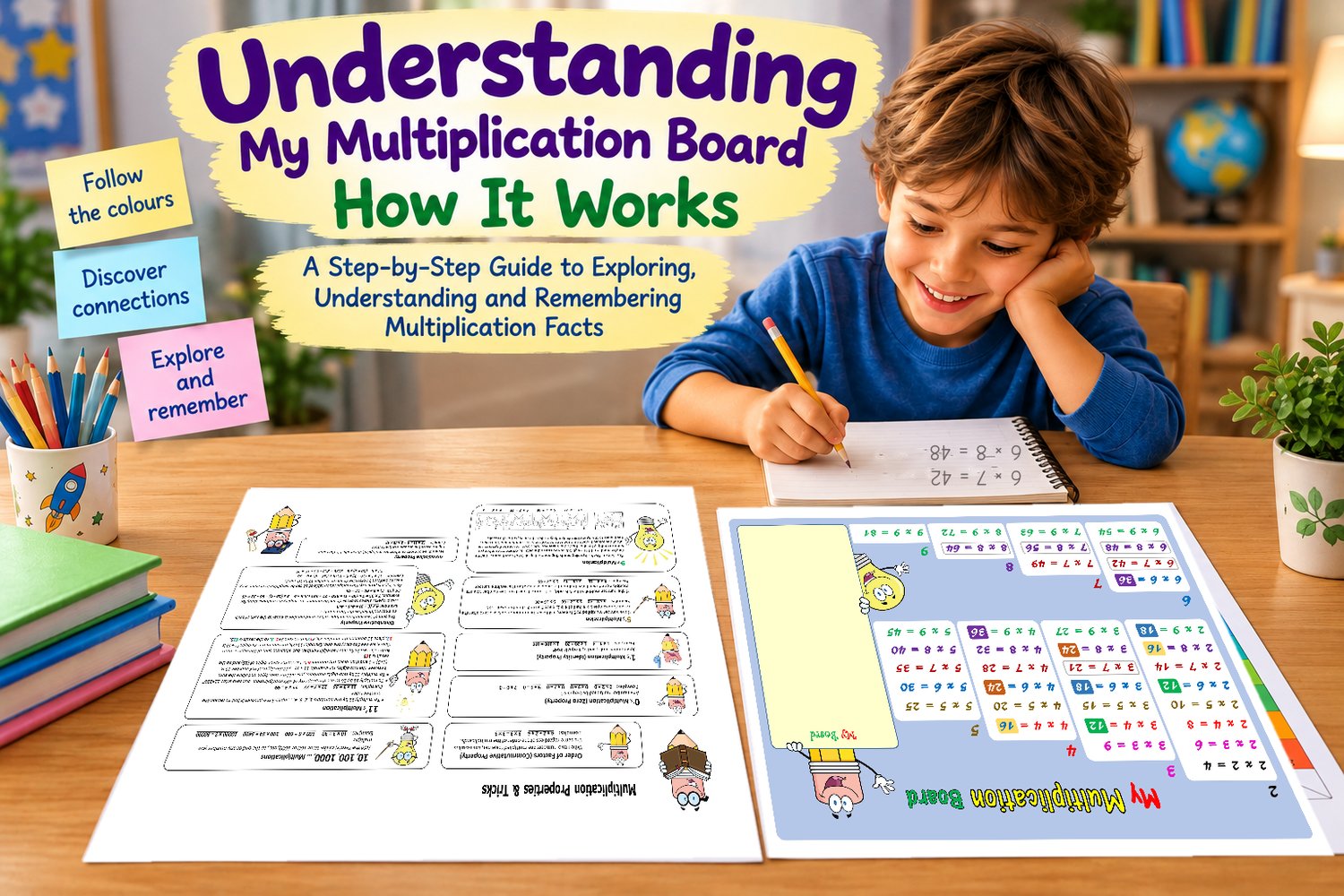
Understanding My Multiplication Board — How It Works
🎬 My Multiplication Board in Action — Paths, Colors & Tricks
🎬 Nine times table | Multiplication hand trick - External Video
Watch how My Multiplication Board and Multiplication Properties & Tricks work together to help children explore connections, understand multiplication, practice with purpose, and remember multiplication facts.
FOCUS → RECOGNIZE → THINK → CALCULATE → PRACTICE → REMEMBER
A free step-by-step guide for parents, teachers, and students
My Multiplication Board is designed to help students understand, practice, and remember multiplication facts from 1 through 12 as a connected system rather than a collection of isolated answers.
The Board organizes facts from 2 through 9 through purposeful colors, visual focus, shared-product matching, and the Commutative Property. The companion Multiplication Properties & Tricks poster introduces additional mathematical properties and useful calculation techniques to extend learning through table 12.
The learning approach combines visual familiarity, exploration, mathematical connections, understanding, and purposeful practice to support the ultimate goal of confident recall.
See the actual learning posters: My Multiplication Board on Payhip.
1. Each Multiplication Table Has Its Own Color
Each table from 2 to 9 has an identifying color. On the Board, each multiplication sentence is colored according to its second factor (the number after ×).
A table's identifying color can be found at its starting sentence, such as 5 × 5 for the 5 times table or 7 × 7 for the 7 times table.
The same identifying color also appears wherever that table's number is the second factor. For example, 3 × 5 carries the identifying color of the 5 times table, while 5 × 7 carries the identifying color of the 7 times table.
Important: That identifying color guides the horizontal path. It does not remain constant down the vertical path.
2. Follow the Color Horizontally Through Earlier and Following Tables
After identifying a table's color, follow the matching color horizontally. From your current position, you may search through earlier or following table sections, moving toward the selected table's starting sentence.
Before that starting sentence, the multiplication sentences are commutative forms of the selected table's facts.
The Commutative Property means that a × b = b × a.
Example — Explore the 5 times table
Find the 5-table color at 5 × 5, or wherever the second factor is 5.
Earlier matching sentences:
2 × 5 → 3 × 5 → 4 × 5
These represent the same facts as:
5 × 2 → 5 × 3 → 5 × 4
The student learns to recognize these connections rather than treating each sentence as a completely new fact.
Searching for matching colors also encourages focused attention and active discovery.
3. Reach the Selected Table and Continue Vertically
Every table begins with its square:
2 × 2, 3 × 3, 4 × 4, 5 × 5, and so on through 9 × 9.
After exploring the matching color horizontally, return to or continue toward that starting sentence. Then read vertically downward through the remaining facts.
Example — Following the 5 times table
Find the earlier facts horizontally:
2 × 5 → 3 × 5 → 4 × 5
Then return to 5 × 5 and continue vertically:
5 × 5 → 5 × 6 → 5 × 7 → 5 × 8 → 5 × 9
The horizontal path is traced by matching the selected table's color.
Along the vertical path, the second factor changes, so the colors change too.
The same approach works for every table from 2 through 9.
4. Switch Between Tables — Follow a New Color
While exploring any table, the second factor provides a colored link to another table.
Students can follow that color to explore the corresponding multiplication table without starting again from the beginning of the Board.
Example — Moving from the 5 times table to the 7 times table
At 5 × 7, a student may choose to explore the 7 times table.
Follow its identifying color forward:
5 × 7 → 6 × 7 → 7 × 7
Or explore backward toward:
4 × 7 → 3 × 7 → 2 × 7
At 7 × 7, continue vertically:
7 × 7 → 7 × 8 → 7 × 9
The earlier sentences are commutative forms of the 7 times table.
As always, the vertical colors change with the second factor.
Students can explore one complete table or switch paths whenever a different colored factor sparks their curiosity.
5. Visual Familiarity and Learning Through Discovery — Like Solving a Puzzle
My Multiplication Board is designed for active exploration, but visual familiarity also has a place in the learning process.
When displayed in a child's bedroom, study area, or classroom, the Board provides opportunities for continued visual exposure beyond dedicated study sessions.
Over time, seeing the Board may help children become more familiar with its colors, arrangement, and multiplication facts.
Visual familiarity complements active learning. It does not replace understanding, exploration, or purposeful practice.
Following a color, finding an equivalent multiplication sentence, recognizing a matching product, or discovering a path to another table can feel like solving a small puzzle.
Each discovery may give students a sense of achievement and enjoyment, encouraging them to explore further and develop a positive personal connection with the Board.
These enjoyable moments can invite further interaction and practice.
Together, visual exposure, active exploration, and repeated practice provide opportunities to strengthen familiarity and support more confident recall.
6. Why Are Some Multiplication Sentences Not Repeated?
The Board uses the Commutative Property to avoid unnecessary repetition.
For example, 3 × 7 and 7 × 3 have the same product and represent one underlying multiplication fact.
Across tables 2–9, the 64 possible ordered sentences correspond to 36 distinct facts.
Of these 36 facts, 15 involve either the 5 or the 9 times table. Familiar patterns in the 5s and the 9s finger trick offer useful ways to calculate these facts.
This leaves 21 other distinct facts for further exploration, understanding, and purposeful practice.
This organization helps children concentrate on facts that may require more attention, while continuing to practice and recall the entire multiplication system.
This reduction is an outcome of recognizing connections—not the goal of the learning system.
7. Highlighted Rectangles — FOCUS
Highlighted rectangles draw extra attention to selected multiplication facts that students may find harder to remember.
They make these sentences stand out each time students look at or explore the Board.
Repeated visual exposure may help build familiarity with these facts. Children can then use the highlighted areas for more focused exploration and purposeful recall practice.
For example, a student can look at a highlighted multiplication sentence, cover its answer, attempt to remember it, and check the result.
The rectangles are visual memory aids, not calculation strategies.
Their purpose is to direct attention toward selected facts and encourage additional practice.
8. Colored Product Squares — RECOGNIZE
Small colored squares inside the products identify multiplication sentences with the same answer.
Students can search for matching product colors and discover that different factor pairs sometimes lead to the same product.
For example:
3 × 8 = 24
4 × 6 = 24
Although the factors are different, both multiplication sentences have the same product.
Matching product colors help students recognize these relationships visually.
This turns recognition into an active search rather than passive reading.
9. THINK & CALCULATE — Properties & Tricks
The Multiplication Properties & Tricks poster introduces the Commutative, Associative, and Distributive Properties, along with useful calculation techniques.
These include approaches for multiplying by 0, 1, 10, 100, 1,000, and other powers of ten; methods for the 11 and 12 times tables; and the 9s finger trick.
These methods offer ways to work out multiplication facts that a child does not yet recall.
Children also learn mathematical properties while applying them to multiplication, rather than studying every property separately.
Calculating with these strategies and returning to the same facts through practice can gradually strengthen understanding, familiarity, and recall.
10. From 1 Through 12
Together, the Board and Properties & Tricks support multiplication from 1 through 12:
- ×1: Through the Identity Property.
- ×2–×9: Through the Board's color-coded multiplication system.
- ×10: Through place-value patterns.
- ×11: Through useful multiplication techniques.
- ×12: Through the Distributive Property, using 12 = 10 + 2.
Example — Using the Distributive Property
12 × 7 = (10 + 2) × 7
= 10 × 7 + 2 × 7
= 70 + 14 = 84
A property can help a student calculate a multiplication fact while building familiarity for later recall.
The goal is not to depend permanently on calculation methods, but to use them as helpful steps toward remembering multiplication facts confidently.
11. PRACTICE — Don't Just Read
The Board is meant to be explored, not simply read.
Students can find a starting color, search for connected facts, identify matching products, think, calculate, and return to the same facts through practice.
A simple memory exercise:
- Look at a multiplication sentence.
- Cover the answer.
- Try to recall the product independently.
- Check the answer.
- If necessary, use a relevant mathematical property or technique to calculate it.
- Revisit the fact later and try again.
This activity helps children move from recognizing an answer on the Board toward recalling it without assistance.
The vertical yellow writing area can be used for calculations, exercises, notes, or other mathematics practice.
On a suitable printed copy, students can use a pencil and erase their writing to reuse the area.
The Complete Learning Approach
My Multiplication Board combines several complementary learning elements.
Visual Familiarity: Continued exposure to the Board can help children become familiar with multiplication facts and their visual arrangement.
Exploration & Connections: Color-coded paths, matching products, and the Commutative Property help children recognize relationships between multiplication facts.
Understanding: Mathematical properties and useful tricks provide ways to understand and calculate multiplication facts rather than treating every answer as an isolated piece of information.
Purposeful Practice: Focused activities and independent recall exercises help reinforce learning and identify facts that require additional attention.
Stronger Recall: Through continued exposure, understanding, and practice, children have opportunities to develop more confident and natural recall.
Together, the Board and its companion Multiplication Properties & Tricks poster support learning multiplication facts from 1 through 12.
They encourage students to ask not only:
“What is the answer?”
but also:
“How does this connect to a fact I already know?”
The practical learning activities can be summarized as:
FOCUS → RECOGNIZE → THINK → CALCULATE → PRACTICE → REMEMBER
And the broader learning approach is:
VISUAL FAMILIARITY → EXPLORATION & CONNECTIONS → UNDERSTANDING → PURPOSEFUL PRACTICE → STRONGER RECALL
The goal is confident recall. Exploring connections, understanding properties, calculating unfamiliar facts, and practicing provide a pathway toward remembering multiplication facts from 1 through 12.
The Goal Is Remembering. The Journey Is Understanding.
Explore My Multiplication Board — Two Learning Posters + Complimentary How It Works Guide →
For information about the educational ideas behind this design, read The Educational Thinking Behind My Multiplication Board.
The research discussed there concerns relevant learning principles; it does not constitute independent evaluation or endorsement of this product.
Comments ()