
Written by Christina Ward, CPT
Antenatal & postpartum fitness · Nutrition coach · Pilates · CPR/First Aid
That AZ Mom · Online coaching for busy moms
This is general education, not medical advice or physical therapy. Get clearance from your provider before you start or return to exercise, especially after a C-section, tearing, or complications. Stop if you feel pain, heaviness, leaking, or dizziness, and see a pelvic floor PT if those symptoms show up.One of the most common pieces of advice new moms hear is some version of “just do more crunches” or “get back to your old ab routine.” For many women, that approach either doesn’t work or makes things feel worse.
Your core and pelvic floor have been through a major event. They need reconnection and smart progressive loading — not the same exercises that may have worked before pregnancy. This guide walks you through a realistic, gentle approach to rebuilding core strength after birth. It aligns with the philosophy behind my Gentle Recovery program and the free Postpartum Reset guide.
This is general education, not medical advice. Get clearance from your provider before beginning exercise, especially if you had a cesarean, tearing, or other complications.
WHY TRADITIONAL CRUNCHES OFTEN MISS THE MARK POSTPARTUM
Crunches and sit-ups create a lot of forward pressure and spinal flexion. In the early postpartum period (and for some women longer), this can:
- Increase intra-abdominal pressure in a way that stresses healing tissue
- Encourage doming or bulging if diastasis recti is present
- Bypass the deep core muscles that actually provide stability
The deep core system includes the transverse abdominis (the deepest abdominal layer that acts like a corset), the pelvic floor, the diaphragm, and the multifidus muscles along the spine. These need to learn to work together again. That starts with breathing and awareness, not with repetitive crunching.
STEP 1: RECONNECT WITH BREATH AND THE DEEP CORE (CAN BEGIN EARLY)
Many providers are comfortable with gentle breathing and awareness work within the first days or weeks after birth, as long as there are no complications and you feel ready.
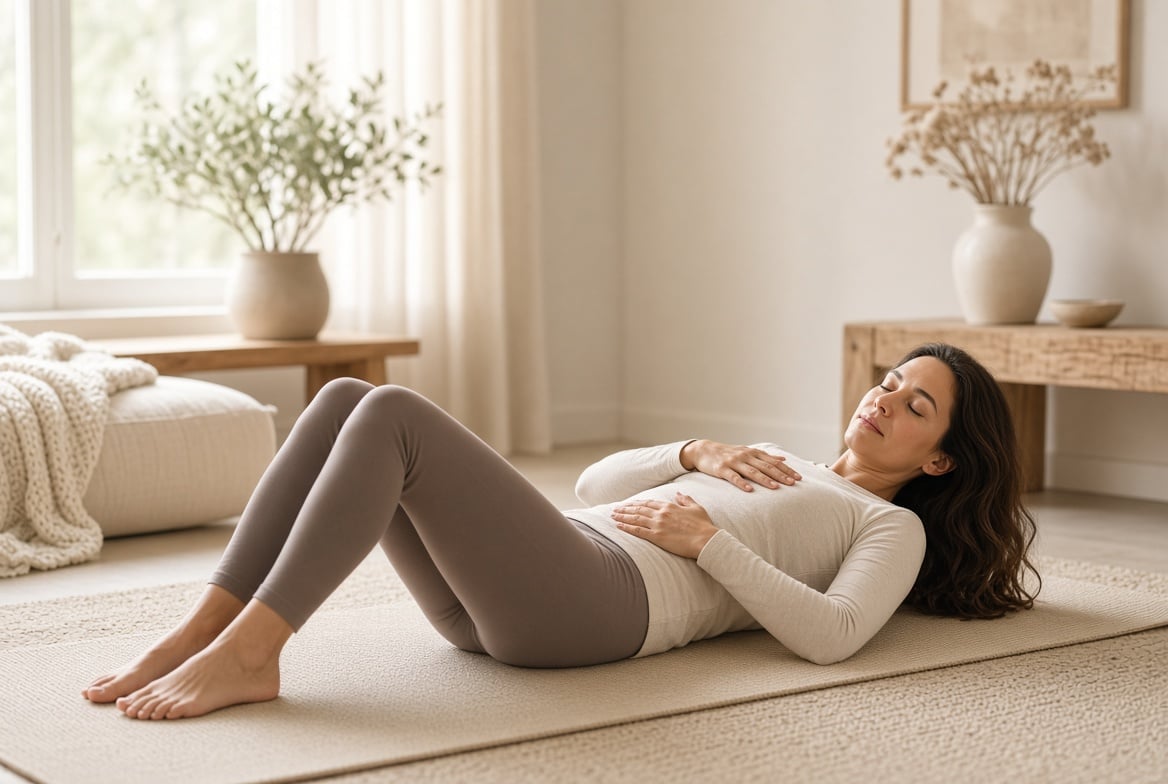
Diaphragmatic Breathing with Core Connection Lie on your back with knees bent (or side-lying or seated if more comfortable). Place one hand on your lower belly and one on your ribcage.
- Inhale through the nose and allow the ribcage and belly to expand softly.
- Exhale through the mouth and gently draw the lower belly in (as if zipping up jeans or moving the hip bones slightly toward each other) while the pelvic floor gives a light lift.
- Fully release on the next inhale.
Do this for 5–10 breaths, several times a day. Quality matters more than quantity.
Pelvic Floor Awareness Think of the pelvic floor as a hammock or elevator. On the exhale, gently lift (as if stopping the flow of urine or holding in gas — but much softer). Hold for a second or two, then fully release and let the muscles soften. Full release is just as important as the lift. Avoid bearing down.
These two practices form the foundation of almost everything that follows.
STEP 2: ADD GENTLE STABILITY AND COORDINATION WORK
Once you have provider clearance and the basic breathing and pelvic floor connection feel accessible, begin adding simple movements that challenge the system without high pressure.
Heel Slides Lie on your back, knees bent, feet flat. Exhale and gently engage the deep core, then slide one heel away along the floor until the leg is longer. Inhale and return. Keep the pelvis quiet and avoid arching or tucking excessively. Alternate sides.
Glute Bridges with Core Focus Same starting position. Exhale, engage gently, and press through the heels to lift the hips. Squeeze the glutes at the top without over-arching the low back. Lower with control. You can progress by adding a pause at the top or a small march.
Bird-Dog (Modified as Needed) On all fours. Keep the spine neutral. Exhale and extend one arm forward and the opposite leg back while maintaining a stable torso (no rocking of the hips). Modify by sliding the leg back instead of lifting, or by keeping the toes on the floor. This is excellent for coordination.
Side-Lying Work Clams, side-lying leg lifts, or openers help with hip stability, which supports the pelvis and core system.
Perform these with focused breathing. Two to three sets of 6–10 careful repetitions is plenty in the beginning.
STEP 3: PROGRESS TOWARD FUNCTIONAL, REAL-LIFE STRENGTH
As healing continues and symptoms improve (usually weeks to months, depending on the individual), begin integrating movements that look more like daily life:
- Sit-to-stand from a chair
- Carrying (start light and focus on posture and bracing)
- Getting up and down from the floor
- Light loaded carries or rows
- Short walks that gradually increase in duration
The goal is a core that supports you while you parent, not a core that only works when you are lying on a mat doing isolated exercises.
UNDERSTANDING DIASTASIS RECTI SIMPLY
Diastasis recti is the separation of the two sides of the rectus abdominis (the “six-pack” muscles) along the midline. Some degree of separation is normal in pregnancy. For many women it improves significantly with time and smart training. For others it needs more targeted work or professional support.
A simple self-check (not a diagnosis): Lie on your back with knees bent. Place fingers horizontally just above the belly button. Lift the head and shoulders slightly as if starting a crunch and feel for a gap and any doming or bulging. Check a couple of places along the midline. If you notice a significant gap or consistent doming during everyday movements, a pelvic floor physical therapist or qualified pre/postnatal specialist can assess and guide you.
Avoiding aggressive crunching and learning to manage pressure are two of the most helpful early strategies.
TIMELINE CONSIDERATIONS (GENERAL ONLY)
- Early days to ~6 weeks: Focus on breathing, gentle pelvic floor awareness, walking as tolerated, and rest.
- After clearance (often around 6 weeks, later for cesareans or complications): Begin the stability exercises above.
- Beyond: Gradually increase load, complexity, and impact only as symptoms and strength allow.
Everyone heals on a different timeline. Comparison is rarely helpful.
HOW THIS FITS REAL BUSY-MOM LIFE
You do not need long dedicated sessions. Five to fifteen minutes most days, stacked onto existing parts of the day, creates progress. Do breathing work while feeding. Do a few bridges while the baby plays on a mat nearby. Walk with the stroller and add posture awareness.
Pair the movement with solid nutrition. Protein, overall calories, and hydration matter for tissue healing and energy. My free high-protein recipe cards and meal planner are designed for this exact season.
WHEN TO SEEK EXTRA HELP
Consider a pelvic floor physical therapist or specialized coach if you have ongoing leaking, heaviness or pressure in the pelvis, significant abdominal doming, back or pelvic pain that is not improving, or simply want expert eyes on your recovery. There is no award for figuring everything out alone.
FINAL THOUGHTS
Rebuilding your core after birth is not about punishing your body or chasing an old version of yourself. It is about reconnecting, supporting healing, and building strength that serves the life you are living now. Gentle, consistent, intelligent work almost always outperforms aggressive approaches.
Start here: Download the free Postpartum Reset guide for a clear, non-overwhelming sequence you can begin using. Grab the high-protein recipe cards at the same time. When you want more structure and accountability, the 21-Day Challenge or 1:1 coaching gives you personalized progression and support.
You are allowed to heal at your own pace. Showing up for these small, consistent practices is already a powerful form of self-respect.
FAQ
When can I start core work after birth? Gentle breathing and awareness can often begin within 24 hours after birth (with provider guidance). More active exercises usually wait until after your postpartum check and clearance.
How do I know if I have diastasis recti? A simple self-check can give you information, but a professional assessment is best for a clear picture and personalized plan.
Will this help with the “mommy pooch”? YES! Rebuilding deep core function and managing pressure is far more effective for most women than endless crunches. Results vary and take time.
Can I do planks postpartum? Full planks are often introduced later, after good deep core and pelvic floor control is established and there is no doming. Modified versions (on knees or elevated) may come first.
What if I had a C-section? Healing timelines are usually longer. Scar mobility work (once cleared) and very gradual progression are important. Follow your provider’s specific guidance.