
As AI reshapes job categories and nothing feels like a guarantee of employment anymore, it really feels like breaking into tech in 2026 is like coming at the end of a field instead of at its peak, however one of its sectors, AI security, growing at the intersection of two things companies badly need: AI and cybersecurity.
And the thought that stops most of us is something like "it must need a machine learning degree and I don't have one" and it is wrong, you don't need to be an AI researcher or a senior security engineer to start. By the end of this post I hope that you'll know what the work actually looks like, what employers expect, and where to begin.
What is AI security, and why should you care?
Simply put, AI security is finding, understanding and preventing the ways AI systems can be attacked or fail.
Think about it this way, companies are plugging large language models (LLMs) into customer support, internal tools, software workflows, document search and autonomous agents, now these systems read sensitive information, talk to other services and take real actions.
That creates a brand new set of problems:
- What happens when someone tricks an AI assistant into revealing confidential information?
- What if a planted document makes a company's AI search leak data it shouldn't?
- What if an AI agent has too many permissions and someone finds a way to abuse them?
These questions are the risks security teams are now being hired to deal with. And securing an AI app takes more than knowing security or knowing how to use a model. You need to understand how the two interact, that's pretty much the whole field.
You don't need years of advanced math or to train a neural network before you can start. Most of the real work is about the system around the model: what text it reads, what it can reach, and where its output goes. If you already understand networking, Linux, web security, authentication or common vulnerabilities, you have a real head start. If you're completely new, you can start with how LLM apps work and build up from there.
Btw, If you're still figuring out whether this is the right direction and don't wanna commit to a whole learning path yet, just start with the basics of AI security here
What employers actually expect
If you go read real AI security job posts, they ask you to threat model AI features, understand risks like prompt injection, data leakage and agents abusing their tools, design guardrails like permissions and output controls, test these systems, and write findings that both engineers and executives can act on.
What they mostly don't ask for is someone who builds or trains models, and plenty of the people doing this work came from application, cloud or offensive security.
You need to understand how these systems work, where their trust boundaries are, how the vulnerabilities appear, and how to test and fix them. Here are the six areas worth prioritizing.
1. Prompt injection
This is the one that matters most, a language model basically gets its instructions and its data through the same channel. The app sends it one long block of text: the developer's rules, your question, and whatever email, web page or document the assistant pulled in to help. The model reads all of it together and has no reliable way to tell which parts are rules and which parts are just stuff to read.
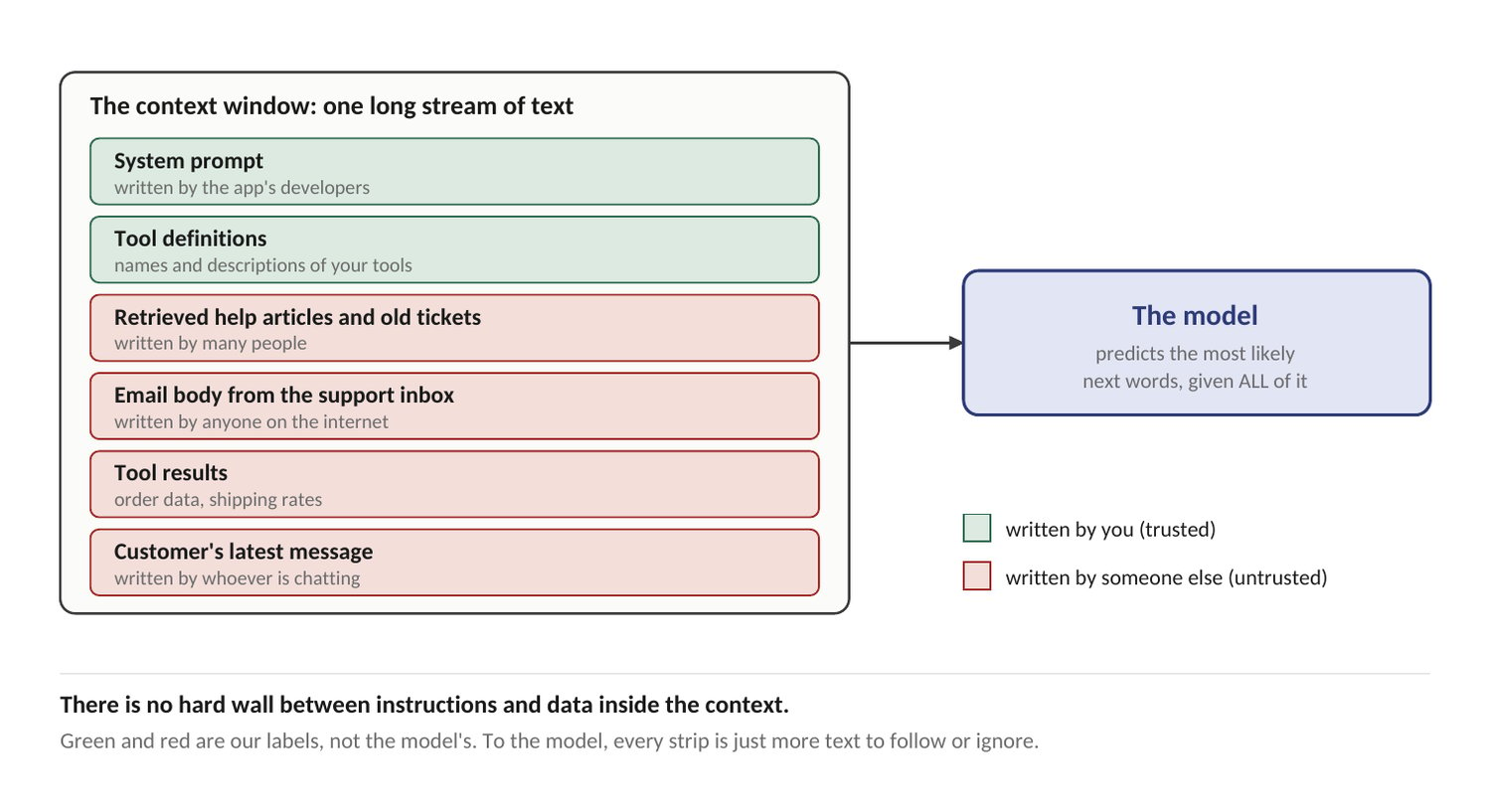
So if an attacker can get text into that block, that text can act like an instruction, that's prompt injection.
It has been the number one risk on the OWASP Top 10 for LLM applications since the list started. In 2025, researchers found a flaw in Microsoft 365 Copilot, nicknamed EchoLeak, where an ordinary looking email with hidden instructions could get the assistant to leak internal data when a user later asked it a normal question. Microsoft obviously fixed it, but it showed that the vulnerability can and does occur in real products.
The important part is that prompt injection isn't really about writing a clever prompt, it's about how an application handles untrusted text, keeps it separate from trusted instructions, and limits what the model can do when it gets fooled. There is direct injection (the attacker types it) and indirect injection (it arrives through a document or web page), and then the question of what happens if the model follows those instructions (breaches on different models are on different levels of severity since not all models are equal in terms of what they have access to).
2. RAG security
Retrieval-augmented generation (RAG) means an assistant searches a knowledge source, like company documents, before it answers. It's everywhere: internal wikis, product manuals, support bots.
The security problem is that finding the right document isn't enough, the app also has to check if the user is allowed to see it. Imagine an internal assistant that searches every company document, if the search layer ignores permissions, one employee can get an answer built from another department's files, files that the employee may not even have permission to access.
Other things to study here are poisoned content in the knowledge base, unsafe document ingestion, and sensitive details leaking into generated answers.
RAG is a great area to learn because it ties familiar security basics (authorization, data handling, trust boundaries) to AI-specific behavior.
3. AI agents and excessive permissions
An agent can call tools, read files, query databases, send emails and act on your behalf in general. That kind of access changes the threat model to an extent.
The questions to ask are simple:
- Which tools can the agent use, and with what permissions?
- Can untrusted input influence what it does?
- Does anything require approval before a sensitive action?
- Could an attacker steer it into something outside its purpose?
The principle: a model shouldn't inherit unlimited power just because it can ask for it, the fixes are the ones you probably know already, least privilege, server-side authorization, narrow tool interfaces and human approval for risky actions.
4. Sensitive data leakage
AI apps can expose information in a few different ways, since the model might repeat something sitting in its context, the search might pull documents without checking permissions, or an integration might log confidential data it never needed to keep.
A lot of these aren't model problems at all, they're application problems wrapped around the model. So the things to study are authentication and authorization, secrets handling, data access controls, logging and retention, and only putting into the context what the model actually needs. If you're used to web security, I'm pretty sure you can basically apply your same usual security logic here.
5. Insecure output handling
An LLM can write text that looks harmless but becomes not so harmless when another system trusts it. If an app drops model output into a web page, a database query or a command without checking it, old vulnerabilities come back knocking, just from a different source this time.
The fix is validating and encoding output where it enters the next system, using safe queries, and enforcing security rules outside the model. A good reminder that your traditional security knowledge is still pretty valuable here.
6. OWASP and MITRE ATLAS
You don't need to memorize every framework before you start, but these two are 100% worth knowing. The OWASP Top 10 for LLM Applications gives you a structured list of the main risks, and MITRE ATLAS maps how attackers approach AI systems.
They're maps, not courses, they help you organize what to learn, but reading them alone won't prove you can assess a real application, and that's the part employers care about.
In case you want a full guide
AI Security for Defenders and Breakers (2026 Edition) follows one realistic AI assistant, with an inbox, a knowledge base and real tools, through nine chapters: how LLM systems work, the AI threat model, prompt injection, RAG and poisoning, agents and MCP, output handling, wrong answers and runaway costs, testing and monitoring, and defense architecture. Every topic is taught from both sides, how it gets abused and how it gets caught and contained. There are 11 diagrams, a quiz after each chapter, and at the end you write up the assistant's assessment as a full sample report, which is exactly the kind of thing you can model your own work on.
What career paths can AI security lead to?
AI security isn't one job, it overlaps with several existing ones, and the best entry point depends on what you already know.
- Application security engineer. If you like web security, APIs and finding bugs, this is the natural bridge into assessing LLM apps.
- Product security or AI security engineer. You design, build and test the security of AI-powered products, which usually means stronger coding and cloud skills.
- AI Penetration tester or security consultant. You test AI-powered apps for weaknesses, show the impact and recommend fixes.
- AI red teamer. You evaluate how AI systems behave under adversarial pressure. Some roles are app-focused, others go deeper into model behavior.
- AI security researcher. You dig into new attacks and defenses. However these roles are the most demanding and often want research or ML experience.
Learn the fundamentals, then let your projects and interests show you which way to go. And to be honest with you, AI security is still a developing specialization, so roles and requirements vary a lot. The safest strategy is building transferable security skills while learning how AI changes the systems they apply to.
The difference between learning AI security and getting hired
Knowing and being able to show you know are two different things, employers right now want evidence that you can reason about security problems, investigate systems and explain your findings.
So approach it as a loop:
- Learn. Understand the systems, the attack surface and the defensive principles.
- Practice. Build a small assistant of your own, or review one you're allowed to test. For any system, ask five questions: what trusted input comes in, what untrusted input comes in, what can the model reach, where does its output go, and what would a successful attack cost.
- Demonstrate. Write up what you found, how severe it is and how to fix it.
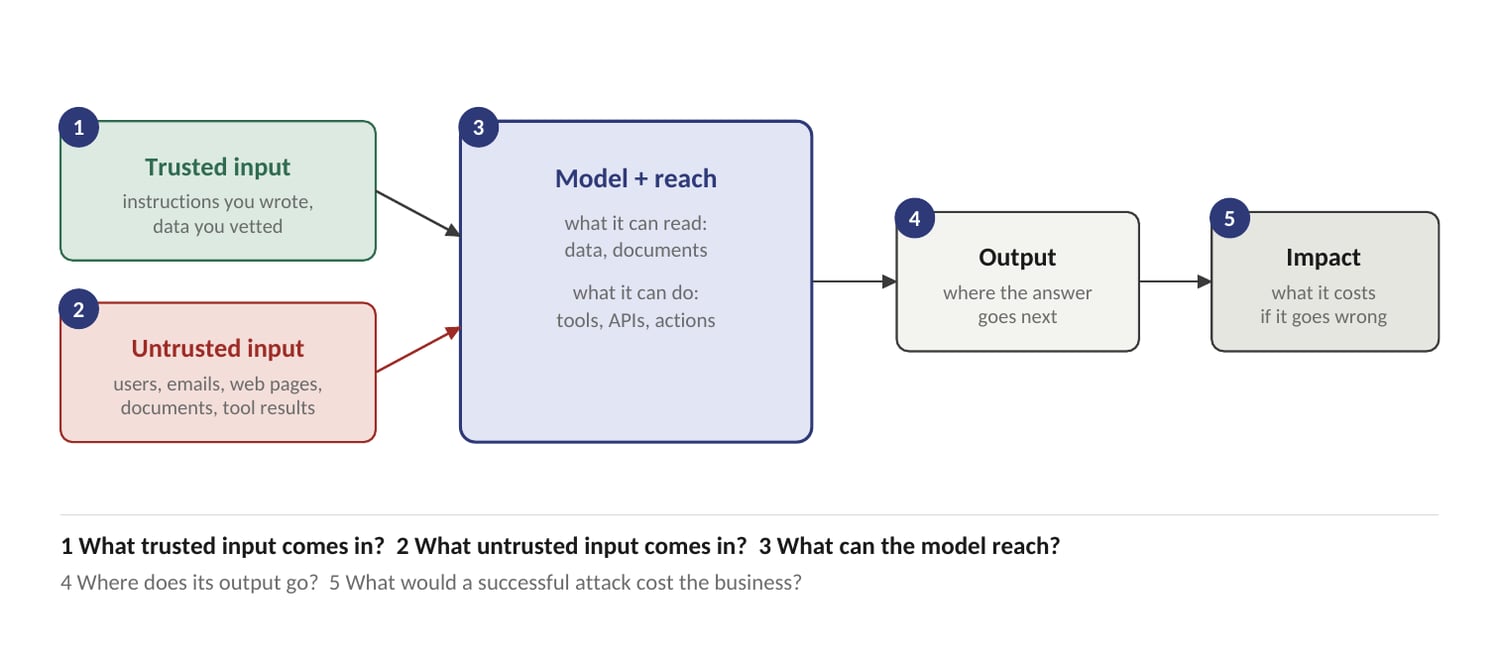
it's the method that makes you stand out. A short, technically sound assessment report tells a reviewer a lot, and it lets you basically say "I can look at an AI assistant, explain what could go wrong in business terms, and recommend fixes."
Your next step into AI security
It's understandable to feel uncertain about which skills are worth your time right now, but to be frank, spending months worrying about whether AI will make your skills obsolete won't build new ones. A better move is to learn where AI creates new security problems, build a foundation in the systems involved, and get good at finding and explaining real vulnerabilities.
You need a clear starting point, a structured approach and consistent practice, that's all.
If you wanna get the fundamentals then download "AI Security, Explained"
If you're ready to go deeper and want the whole path laid out, from how these systems work to writing your own assessment report, then get AI Security for Defenders and Breakers (2026 Edition)
Then put what you learn into practice, because the goal is to build skills you can show, problems you can solve and experience you can grow on. Start there.
And tell me in the comments your thoughts, I'll read every one