
Why the fat you can't see is driving your blood pressure — and what to measure instead
Post title for the page: The Fat You Can't Pinch: Why Visceral Fat Drives Blood Pressure
Meta description (for SEO): Visceral fat sits deep in your abdomen and raises blood pressure through five separate pathways. Here's what it is, why the scale can't detect it, and what to measure instead.
Most of us grow up with one idea of body fat: it's the stuff you can grab. It sits under the skin, it shows up in the mirror, and more of it is bad in a general, cosmetic sort of way.
That picture is incomplete in a way that matters enormously for blood pressure.
I found this out the slow way. High blood pressure arrived when I was 42 and I lived with it for nearly twenty years. In all that time, nobody sat me down and explained which fat was the problem, or why. I was told to lose weight. That's not wrong, exactly — but it's so imprecise that it costs people their motivation, and it cost me years.
Here's what I wish someone had told me at the start.
You carry fat in two very different places
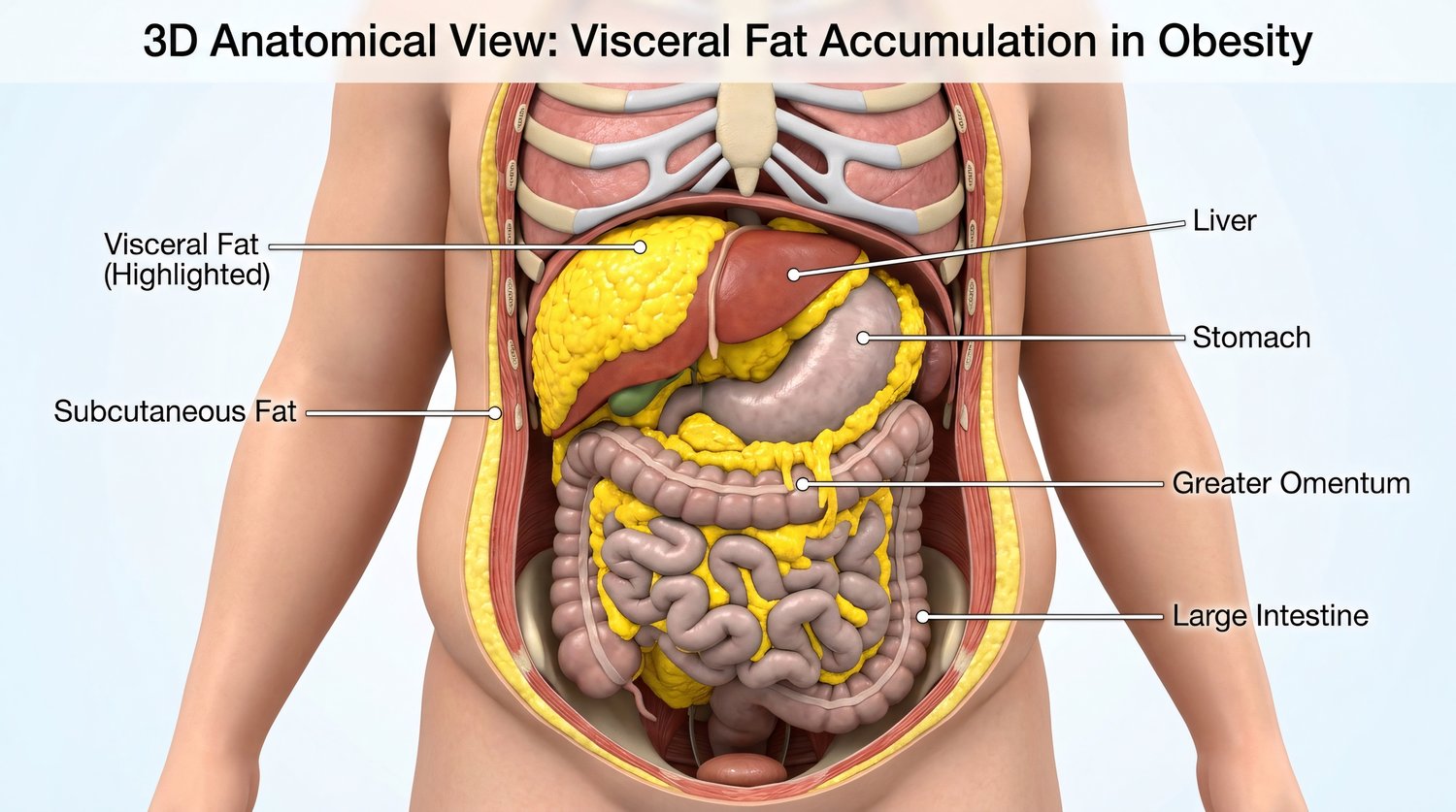
Subcutaneous fat is the layer directly under your skin — the fat you can pinch on your arm, your thigh, your belly. It's largely a storage depot. It's relatively inert, and in some places, particularly hips and thighs, it appears to be metabolically neutral or even mildly protective.
Visceral fat is different. It's packed deep inside your abdominal cavity, wrapped around and between your liver, pancreas, intestines, and kidneys. You can't pinch it. You can't see it directly. Someone can carry a substantial amount of it while looking only modestly overweight — or in some cases, while looking slim.
And unlike subcutaneous fat, visceral fat isn't a passive storage tank. It behaves like an active organ. It releases hormones and inflammatory signaling molecules directly into the portal vein — the blood vessel running straight to your liver. Everything it produces hits your liver first, at full strength, before the rest of your body has a chance to dilute it.
That single anatomical fact explains most of what follows.
Five ways it raises your blood pressure
Doctors have limited time. In a fifteen-minute appointment, "belly fat raises blood pressure" is usually as much explanation as anyone gets. But the mechanisms are worth understanding, for a simple reason: when you know why something works, you're far more likely to keep doing it.
1. Insulin resistance and sodium retention. Visceral fat sends free fatty acids and inflammatory signals straight to the liver, which impairs your response to insulin. Your pancreas compensates by producing more. And insulin does something most people never hear about — it signals your kidneys to hold onto sodium instead of excreting it. More sodium means more water retained, which means more volume in a closed system, which means more pressure.
This is why some people find they're "salt sensitive." Often the underlying issue isn't the salt shaker. It's insulin.
2. Hormones that constrict your blood vessels. Fat tissue produces angiotensinogen, the starting material in a hormonal cascade ending in angiotensin II — one of the most potent blood-vessel constrictors your body makes. Visceral fat produces disproportionately more of it than subcutaneous fat does.
If that sounds familiar, it's because a large share of blood pressure medications target this exact pathway. ACE inhibitors like lisinopril, and ARBs like losartan, work by interrupting it.
3. Sympathetic nervous system overdrive. Visceral fat increases activity in the "fight or flight" branch of your nervous system. That raises heart rate, constricts vessels, and encourages further sodium retention. Functionally, it's a low-grade stress response running quietly in the background all day.
4. Physical pressure on your kidneys. This one is refreshingly mechanical. Fat accumulates not just in the abdominal cavity but in and around the kidneys themselves. Compressed kidneys interpret the pressure as reduced blood flow, and respond by activating the hormonal systems above and holding onto more sodium and water. The kidney is behaving exactly as designed — it's just getting a misleading signal.
5. Sleep apnea. Central obesity is strongly linked to obstructive sleep apnea, where the airway repeatedly collapses during sleep. Each episode drops blood oxygen and triggers a surge of stress hormones. Untreated sleep apnea is one of the leading identifiable causes of blood pressure that won't respond to medication — and it's badly underdiagnosed.
A single medication typically addresses one pathway. Reducing visceral fat addresses all five.
That's not an argument against medication. Medication works, it works quickly, and for many people it's genuinely lifesaving. It's an argument for doing both.
Why the scale can't detect any of this
Here's the part that makes people quit, and it's the reason I'm writing this.
Visceral fat responds to lifestyle change faster than subcutaneous fat does. It's often the first fat to leave. Which means your blood pressure, your blood sugar, and your triglycerides can improve meaningfully before the bathroom scale shows much of anything.
So the pattern goes like this. Someone starts eating better and moving more. Three weeks later the scale has barely budged. They conclude it isn't working, and they stop.
In reality, the fat that was doing the most damage may already be shrinking. The scale is simply the wrong instrument for detecting it.
Day-to-day weight swings are mostly water, sodium, glycogen, and digestive contents. Weight can't distinguish where fat was lost. And if you've added any strength work, you may be gaining muscle while losing fat, which the scale hides completely.
What to measure instead
A tape measure. Waist circumference is the practical proxy for visceral fat — free, repeatable, and it tracks the thing you actually care about.
Measure first thing in the morning, before eating or drinking. Stand up straight, feet together, breathe out normally, and don't suck in. Put the tape level with the top of your hip bones — roughly level with your navel for most people. Find your landmark and use the same one every single time. Keep it snug and level all the way around without compressing the skin.
Record it once a week, same day, same conditions. Consistency of method matters far more than perfect accuracy — you're tracking change over time, not competing for precision.
There's also a simple refinement called waist-to-height ratio: divide your waist by your height in the same units. A commonly cited threshold is 0.5, which translates to a message you can remember without a calculator — your waist should be less than half your height. Worth discussing with your doctor, particularly since the right threshold varies by ancestry.
And your blood pressure, at home. This is the one I'd push hardest. I journaled mine every few days for months, initially just so I could see what was happening in my own body between appointments.
That habit turned out to matter more than anything else I did. It's what let me bring my doctor real information instead of good intentions — and it's why she went from politely doubtful to fully on board.
Current guidelines treat home monitoring as central to diagnosis and to adjusting treatment. Your readings aren't a nice extra. They're what your doctor needs in order to act.
Where this actually goes
I'm not a doctor, a nurse, or a dietitian. I have no medical training at all. I'm someone who lived with this for twenty years, noticed something in my own bloodwork, got curious, and worked with a good physician.
We're all different, and your doctor knows things about you that I never will. Nothing here is medical advice, and please never change, skip, or stop any medication on your own — those decisions belong to you and your prescriber together.
But understanding what's driving your blood pressure changes what you're able to ask for. And walking into an appointment with two months of your own readings changes the conversation completely.
Start there. Get a tape measure and a validated upper-arm cuff. Take readings properly and write them down. Bring them with you.
That's the whole beginning of it.
I wrote a full guide on this — 47 pages on visceral fat, the food and movement that reduce it, and how to prepare for the conversation with your doctor, including printable trackers and a one-page sheet you can hand over at your appointment. It's called The Hidden Fat Behind Your Blood Pressure.
Questions? I read everything: tammy@tammykrusoe.com