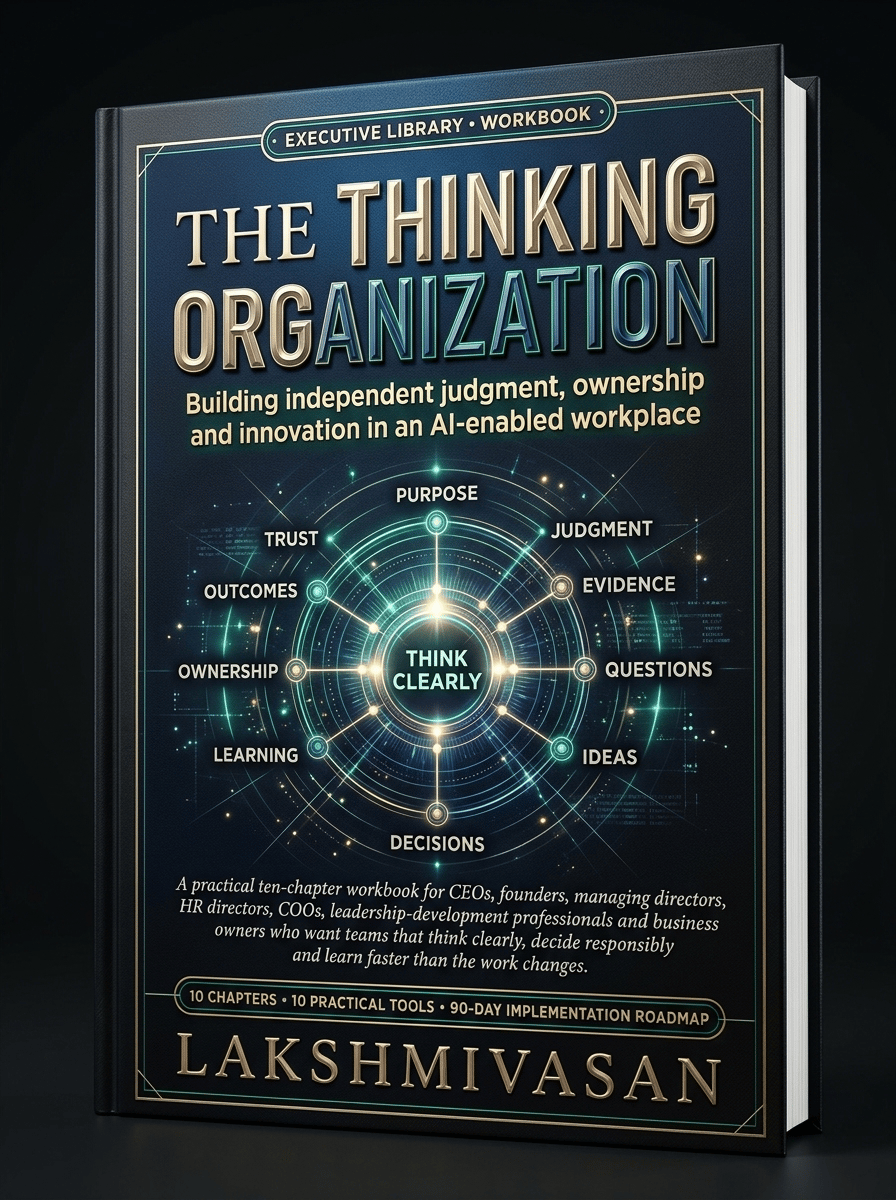
The Thinking Organization
EXECUTIVE LIBRARY | BY LAKSHMIVASAN
AN ORGANISATION THAT THINKS IS AN ORGANISATION THAT DECIDES WELL WITHOUT YOU.
A TEN-LAB WORKBOOK FOR LEADERS WHO WANT JUDGEMENT DISTRIBUTED RATHER THAN CONCENTRATED — WITH TEN INSTRUMENTS AND THEIR COMPLETED TWINS.
Most organisations do not have a talent problem. They have an authority problem dressed as a talent problem. Decisions travel upward because the system rewards escalation, meetings end without a decision because nobody was named to make it, and capable people wait to be told because being told is safer than being wrong in public.
The result is an organisation that thinks in exactly one place. The senior team becomes the processing unit for everything, the calendar fills with reviews, and the people closest to the work develop the habit of preparing options instead of choosing.
The Thinking Organization is a workbook, not a manifesto. Each chapter pairs an argument with a lab: an audit, a scorecard or a matrix that makes the current pattern visible, and then a small, specific change to the way authority, meetings and decisions actually run.
It answers the questions that matter to the people who have to make it work:
- Why is the organisation, rather than the individual, the right unit for thinking?
- How do you lead without taking the work back at the first sign of difficulty?
- What makes delegation an authority design rather than a task list?
- How do you build a culture where questions precede conclusions?
- What does a decision record contain, and how does it improve judgement over time?
- How do you make experimentation safer than guessing?
- Which measures of organisational intelligence avoid distorting the behaviour they measure?
- How do you identify future leaders with evidence rather than impression?
- What has to change in the meeting for the thinking to change?
- How do you run a ninety-day transformation without a programme office?
Judgement grows where authority, information and consequence meet in the same person.
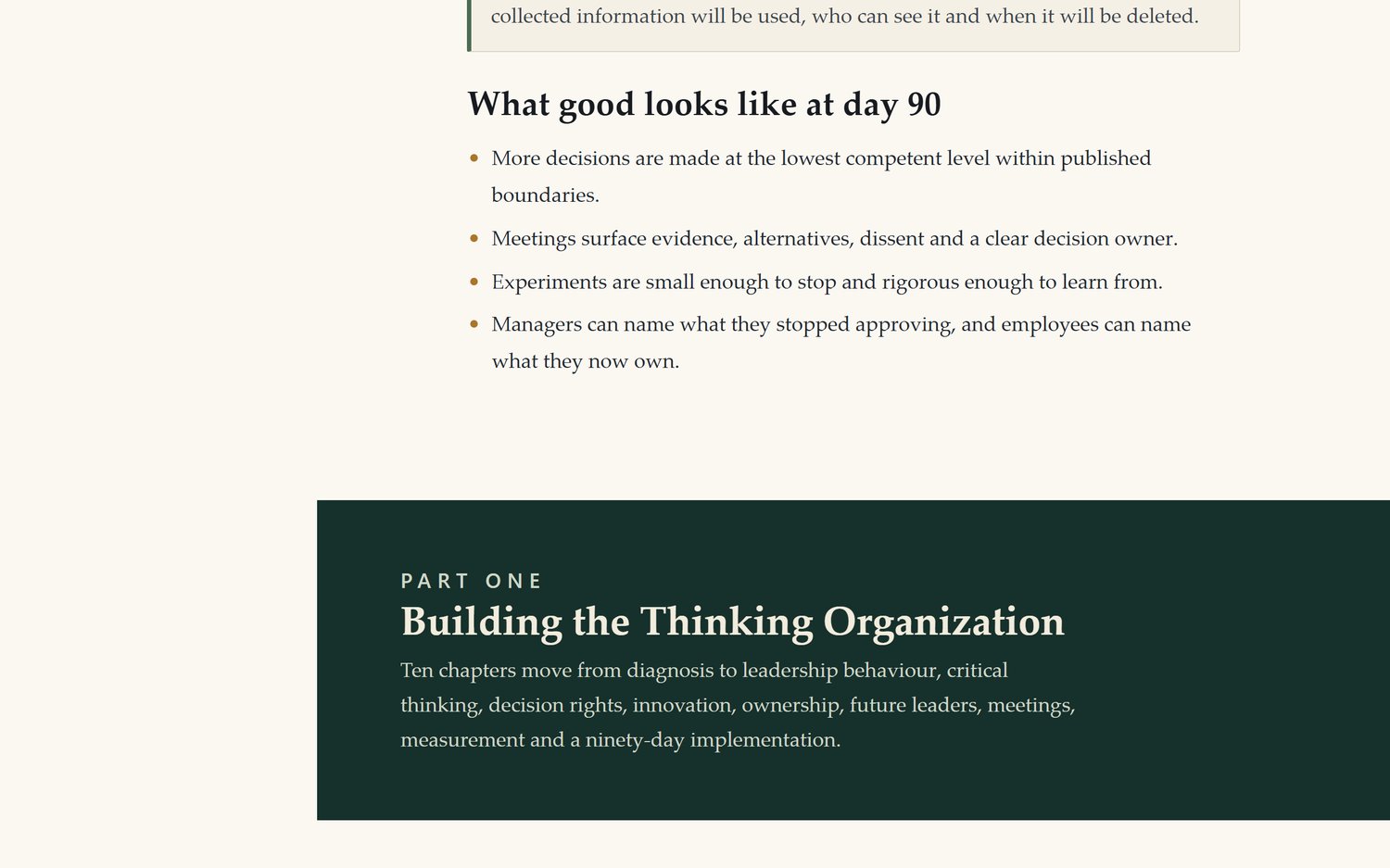
TEN CHAPTERS, TEN LABS
The premise
- The Thinking Organization Mindset — the organisation as the unit of thought
- Leadership That Creates Thinkers — leading without taking the work back
- Building a Culture of Critical Thinking — questions before conclusions
The machinery
- Independent Decision-Making — matching authority to consequence
- Creating an Innovation Culture — making experiments cheaper than guesses
- Ownership and Accountability — from task completion to outcomes
The people and the measures
- Developing Future Leaders — identifying potential with evidence
- Transforming Meetings and Communication — designing around the decision
- Measuring Organizational Intelligence — measures that do not distort
- The 90-day transformation planner
THE WORKING TOOLS
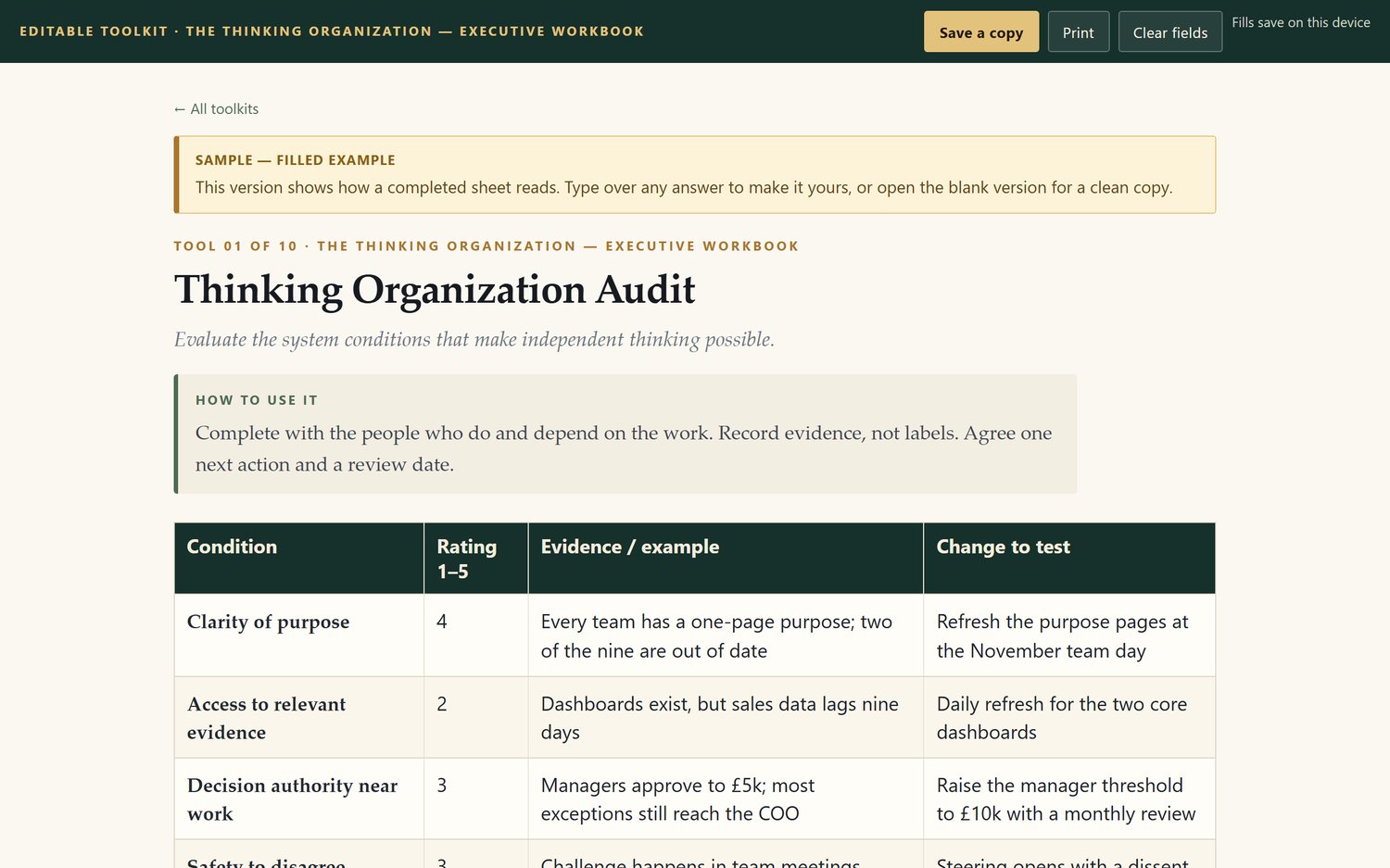
Every lab ends with an instrument you can use the same week, provided both as a fillable page and as a completed example.
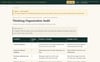
- Organization Thinking Audit — Locate where thinking is concentrated, and where it is being routed upward unnecessarily.
- CEO Leadership Scorecard — Score the behaviours that create thinkers against the behaviours that quietly replace them.
- Employee Thinking Assessment — A twenty-question critical-thinking challenge for teams, with a scoring key.
- Decision Ownership Matrix — Name the decider, the consulted and the informed for the decisions that recur.
- Delegation Framework — Delegate outcomes with the authority, boundary and review point attached.
- Innovation Idea Tracker — Move ideas from claim to evidence with a thirty-day experiment record.
- Team Problem-Solving Canvas — One page to separate symptom, cause, constraint and chosen response.
- Future Leader Scorecard — Evidence-based potential assessment across five dimensions.
- Thinking Meeting Template — An agenda designed around a decision, with the disagreement built in.
- 90-Day Transformation Planner — Sequence the ten labs into a single quarter of change.
WHAT YOU RECEIVE
- thinking-organization-executive-workbook.html — The full workbook: ten chapters, ten labs, facilitator guide and worked case.
- toolkit-workbook-01..10.html — The ten instruments, blank and ready to fill in.
- sample-filled-toolkit-workbook-*.html — Completed versions of all ten instruments.
All files are self-contained HTML documents. They open in any modern browser on desktop, tablet or phone, print cleanly to PDF, and require no installation or account.
FREQUENTLY ASKED QUESTIONS
Is this a course or a workbook?
A workbook. It is designed to be used in sequence over a quarter, with one lab per week or fortnight.
Who should run it?
A CEO, founder, COO or senior HR leader can facilitate it. The facilitator guide is included.
Do participants need to read the whole book first?
No. Each lab stands alone, though the first three chapters establish the shared language.
Can it be used with a single team?
Yes — the labs work at team level as well as across an organisation.
What format are the files?
Self-contained HTML pages that open in any browser, print to PDF and need no installation.
A NOTE ON THE EXAMPLES
The worked case follows a fictional professional services firm of 900 people whose decision latency had doubled over two years. All figures and outcomes are illustrative and are included to show how an instrument is used, not to prescribe an answer. Nothing here is a substitute for professional advice.
An organisation that thinks is built lab by lab, decision by decision.
EXECUTIVE LIBRARY · LAKSHMIVASAN · FIRST EDITION, 2026
IMPORTANT DISCLAIMER
This product is provided for educational, analytical and decision-support purposes. All figures, estimates and results depend on the inputs and assumptions you supply, and on third-party data such as rates, prices and exchange rates, which change over time.
Nothing here is financial, legal, tax or customs advice, and no specific outcome, saving or result is guaranteed. Verify applicable rates, regulations and contractual terms with the relevant authorities and qualified professionals before acting on any result.